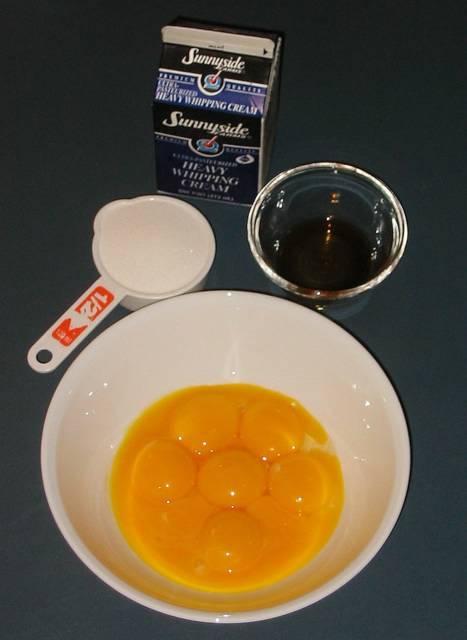
The ingredients needed are (clockwise from top) 2 cups heavy cream, 1/2 teaspoon vanilla extract, 8 large egg yolks, and 1/2 cup sugar.
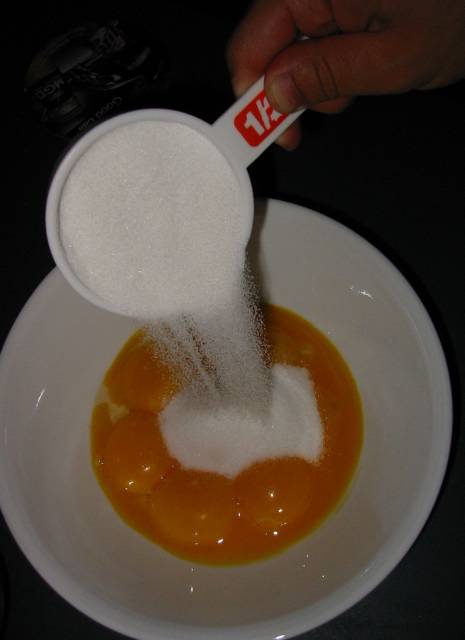
First pour the sugar into the egg yolks.
Related Articles
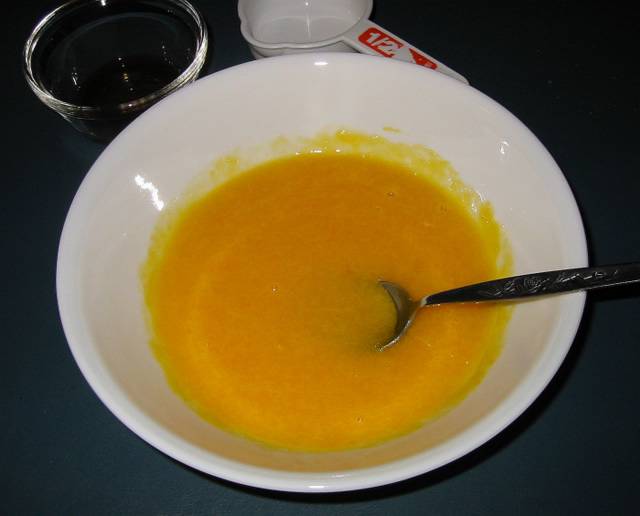
Heat the heavy cream until almost simmering (you can bring to a simmer and let it cool a minute). Add heavy cream to the egg yolks one tablespoon at a time while stirring vigorously. This will temper the eggs so as to not curdle them (or make scrambled eggs) when exposed to the heat of the heavy cream.
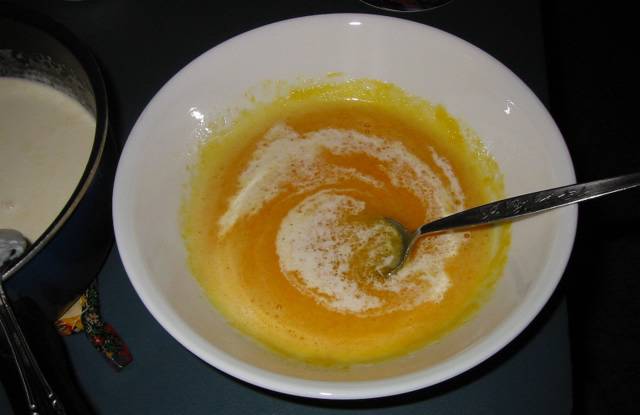
When about 1/4 cup of heavy cream has been integrated into the yolks, pour the yolks into the heavy cream and mix until smooth.
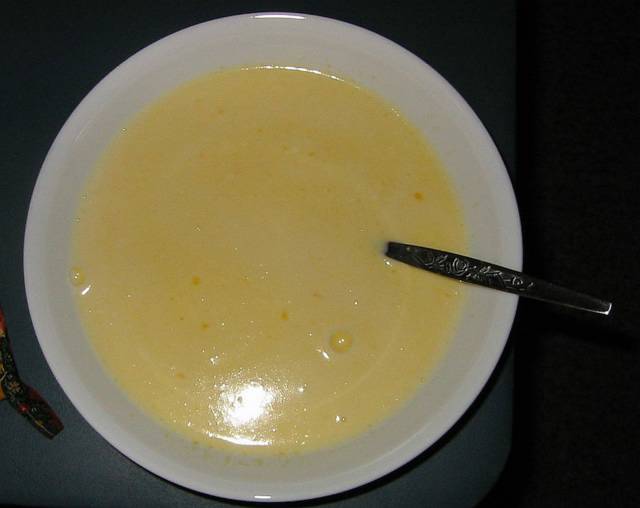
Now, using a fine mesh sieve, strain the custard mixture to remove any small clumps that may remain in the mixture. This step will help ensure a silky texture to the custard. Blend in the vanilla extract after the mixture has been strained.
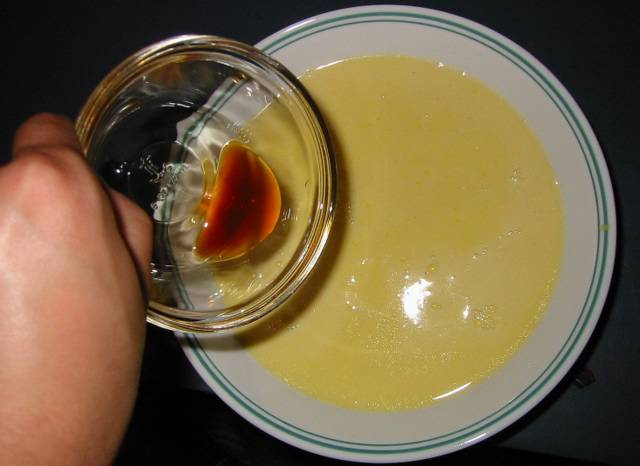
Pour the mixture into six to eight ramekins depending on size. (Makes a little more than eight four-ounce creme brulees.) In the picture below, I filled six four-ounce ramekins and two six ounce ramekins (the six-ouncers were not full).

Place the ramekins in a baking pan. Pour boiling water into the pan (be careful not to get water into the ramekins), so that the water level is halfway up the sides of the ramekins. Cooking the custards in a water bath will provide a low even temperature for the custards to cook evenly and set properly. Place in an oven preheated to 250°F for about one hour.

After an hour, check to see if the custards are done. We want them to be set on the outside edge, but jiggly (like jello) at the center. The easiest way to do this is to take a pair of tongs with food grade rubber bands wrapped around the ends to help grip the ramekins. Pick up a ramekin and shake to see if the centers jiggle. If only the center jiggles a little, it's done. If the whole thing is set, remove immediately - it'll be a little over done, but still delicious. If it's not done, just put it back in the water bath and check again in ten minutes. Once the custards are done, let them cool on a cooling rack to room temperature. This will let the custards finish cooking the centers on their own.
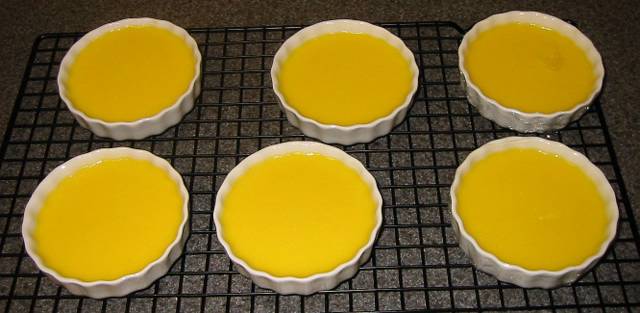
Wrap the custards in their ramekins in plastic wrap and refrigerate for at least eight hours before serving.
About an hour before serving, remove the plastic wrap from each ramekin and use a paper towel to gently soak up any moisture that may have extruded from the custard tops. Pour about a teaspoon of turbinado ("sugar in the raw") sugar in the middle of each custard. Tilt the ramekin and gently shake to let gravity move the sugar around until the top surface of the custard is covered evenly with turbinado sugar. Using a kitchen butane torch, propane blow torch, or welding torch (whatever strong open flame you've got lying around), heat the sugar until it bubbles and changes color. With a small butane torch, I take my time and don't move from one side of the creme brulee to the other until the spot I've been working on has achieved the brown color that I want. This takes a little over a minute for each creme brulee. (The process is faster with a larger torch.) Don't worry about heating up the custard underneath, we'll refrigerate the creme brulee for a bit before serving. Do worry about lighting your kitchen counter on fire. I usually place the ramekin on a piece of aluminum foil placed over a cooling rack.
Once you're done scorching your cream, place the ramekins back in the refrigerator for about 45 minutes. The caramel will still be hard, but if you wait too much longer, the sugar will start to soften and dissolve into the custard.
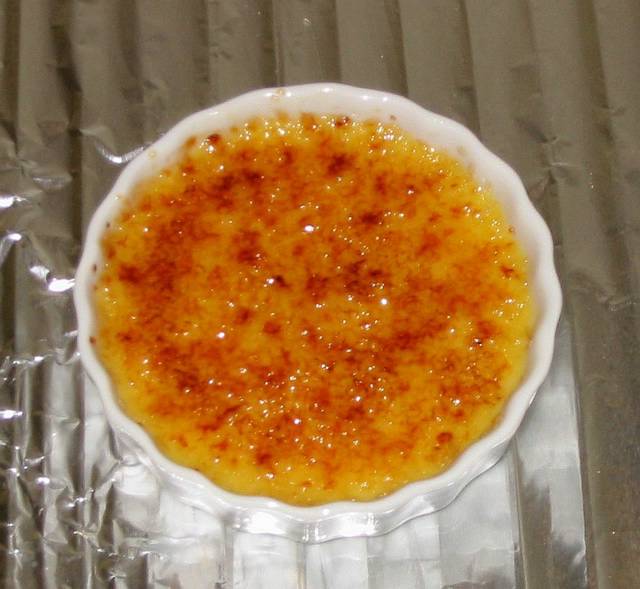
Crème Brûlée (serves eight)
| Preheat oven to 250?F (120?C) | |||||||
| 8 large (135 g) egg yolks | mix | temper and mix | strain | mix | bake 250?F (120?C) 1 hr. in water bath | refrigerate 8 hours | caramelize |
| 1/2 cup (100 g) sugar | |||||||
| 2 cups (475 mL) heavy cream | heat until almost simmering | ||||||
| 1/2 tsp. (2.5 mL) vanilla extract | |||||||
| 1 tsp. (4 g) turbinado sugar | |||||||
Related Articles

Workaround for no blowtorch is an oven with a BBQ-setting. It should work with both gas ovens and electrical ovens that haven open heating coils. Put the oven into BBQ-setting, for electrical ovens, wait until the coils are glowing red. Place your cremes directly under the BBQ-heat-source as close as it gets (you want maximum heat - the quicker the operation goes, the better, you do *not* want to heat the custard too much). It is also crucial to leave the oven door ajar the whole time to prevent general heating of oven and, by extent, custard.
Another creme-brulee-thing: In Belgium, where poeple cook more or less like in france, you go about caramelizing the sugar and refrigerating in the opposite order. You first cool the custard without the sugar. Immediately prior to serving - you can actually do this at the table - pour the sugar over the custard (brown sugar works best) - and caramelize. The sugar is then served sizzling hot, while the custard underneath is mostly cool. The top layer of custard may get a bit warm. So much better! Also, be generous about the sugar. You want a complete layer of caramelized sugar to break through.
Another tip: Add a small amount of Grand Marnier and/or orange shavings (is that the word for bits of paring?) to the custard. Only very littleYou want enough to enhance the taste, but you don not want to actually taste the orange. Very good, and you can call it creme brulee a l'orange (more french words = good).
I've updated the recipe summary to include the refrigeration of the custard and the brulee step.
it's called 'orange zest'
The problem with not caramelizing the creme brulee is that you haven't made creme brulee. In french, creme brulee literally translates as "burnt cream". Without the caramelization, you simply have a custard. A custard sitting on a syrup sauce is creme caramel or a flan - both of which usually you bake with a caramel base in the ramekin which liquifies byt he time the custard is set and forms a syrupy sauce that coats the custard after it's been removed from the mold/ramekin. An awesome dessert, but not creme brulee...
instead use vanilla pods. after bringing the sugar and cream mixture to a boil, take it off the heat and scrape the beans out of 1 vanilla pod, add the pod as well and let steep for 15 minutes. remove the pod and continue with the rest of the recipe.
the difference in flavor is incredible. i have nothing against using vanilla extract in cakes, cookies, etc. but in something as sublime as creme brulee, where the flavor of the vanilla really shines through - only real pods will do.
Well, in my recipe, I use vanilla extract - but as one anonymous poster commented, it will not be as clear of a vanilla flavor as compared to using real vanilla. Tasting the two side by side will definitely show the difference, but if you don't have vanilla beans around then, by all means, use extract. (Whatever you do, don't leave the vanilla out...)
re: refrigeration time
Four hours is a bit short, but if that's all the time you can give it, then give it a try. Usually, I make the creme brulee at least a day in advance, so refrigeration time is not a difficulty.
Whisk
Scald
What program did you use to make the recipe card? I think it's brilliant.
The recipe summaries are currently hand-coded in html.
The traditional creme brulee iron is called a salamander.
In all my travels I've noticed that the top hotels use the real vanilla and the difference is incredibly better. Any suggestions on where to get the beans inexpensively as the cost is ussually $20 on up here in CA. for only about 4 pods.
I find that if the propane tank is very full, the torch will work upside down. Otherwise I hold the ramekin up in an oven mitt.
A good reliable source for vanilla beans is Vanilla-Saffron Imports, in San Francisco.
Other: vanilla is not the only flavoring used. In fact, one very nice variation is to set on one dessert plate three ramekins with the different flavors. Ginger is nice, green tea, cinnamon, herbs (basil is amazing). You are only limited by your imagination. Just infuse the milk with the flavor of choice.
Freezing is also an accecptable method to chill the custards. It also has the added benefit that when you're done brulee-ing the sugar the custard should still be nice and cold.
my dad recently tried a chocolate creme brulee mix, but was not satisfied
any ideas on how to make a chocolate creme brulee from scratch?
thanks!
Usually there is a port at the base of the torch that lets you fill it from a larger canister you can pick up at the supermarket (the butane canisters used for cooking on a portable stove). Generally, you take the nozzle of the butane cannister and insert it into the port on the base of the torch and pres to release butane into the mini-torch. However, I suggest you find the instructions that came with your torch or find someone who has the same model of torch and read their instructions.
Yes, you should have no problem with that. The cooking time may have to be adjusted, but it will probably still work if you don't make any adjustments at all.
I made cream caramel once and it was hard and more like a jelly (different from American jelly) it was wobley. Anyhow I have tasted creame burle a couple of times but was wondering if the way that resturant cooked it was like a secret recipe as I dont understand how they made it so creamy. Is it the cream in the brulee that is so different than just milk in a cream caramel??? I know its a real dumb question but I dont want to waste my time if the recipe is just going to be hard again.
It was mentioned that vanilla extract leaves an alcohol taste. I've only used the beans when making the creme, but there is vanilla extract available that is in glycerin instead. It may not be in standard grocery stores, but I think health food stores often stock it. May be simpler than tracking down vanilla beans.
Williams Sonoma on line is a good place to buy everything one would need, including a chinois.
My recipe calls for a tsp of orange zest and vanilla bean to simmer with the cream for 15 minutes. The bits of peel are strained out by the chinois leaving a smooth, creamy texture.
Vanilla Extract and Vanilla essence
the essence is crap - just a flavour in alcohol - very cheap
the essence however is the pulp of the vanilla bean pod.
Its flavour is excellent although not as good as good fresh pods.
It is thick and paste like and well worth buying. but expensive
Just tried a Crème Brûlée with basil leaves infused in the cream with the real vanilla pods. Fantastic... quite Surprising, maybe needs a different name though...
I used to have a branding iron with the restaurants logo to scortch the tops, looked great.
The extract is the good stuff the essence is crap...
I love Creme Brulee, and have easy access to vanilla beans. In Norway we have something called vanilla sugar, and it works nicely when beans nowhere near.
BTW: A great site for us engineers... :)
Alternative would be to turn it out of the ramekin onto a dessert plate and spoon a light caramel sauce over it and call it creme carmel instead of creme brulee.
Are there non-black vanilla beans? I believe that all vanilla bean pods turn dark brown or black when dried and matured.
Vanilla beans should be able to be stored indefinitely when properly stored. Keep them in a cool dry place in an airtight container. Don't store them in the refrigerator or the freezer. I've heard of many people storing them in vodka or covering them in sugar with great success. The vodka and sugar then becomes vanilla flavored after a few weeks.
Why is creme brulee on it's own mealy and coarse, but baked in a water bath smooth and creamy. Why oh why?
Responses appreciated.
Simply put the water bath evens out the temperature absorption, you need that amount oh heat to cook it but it must penetrate slowly to stop the protein clumping and forming scrambled eggs.
If you cook scrambled eggs in a double boiler for the creamiest eggs ever.
cheers Ray
Crème Brûlée with sweet potatoes
6 egg yolks
2 cups heavy cream
1/2 cup brown sugar
3/4 tsp vanilla extract
about 2 medium sweet potatoes (sorry I did not measure- it might have been less)
Pretty much follow the recipe for regular creme brulee but with the following additions:
Peel, cube and steam the sweet potatoes until soft. Smash the sweet potatoes with a potato ricer to get them smooth. I guess you could use canned sweet potatoes and mush them up in a food processor as well, but I did not want to make sweet potato paste, which might happen if you over-mix them in a food processor. Besides a food processor costs a couple hundred dollars while a potato ricer costs less than ten.
I guess you could do other things to get the sweet potatoes nice and cooked and smooth, I just choose to steam them because it was easy.
Let the mushed-up sweet potatoes rest until room temperature, and mix them in with your egg mixture.
To incorporate brown sugar with the eggs, I sifted it with my sieve into the eggs to remove any lumps, and to make sure I added it a little at a time so that the sugar incorporated itself into the eggs slowly. I was probably being over-cautious, but brown sugar likes to lump, and custards are supposed to be smooth.
After tempering the cream into the egg-sugar-sweet potato mixture, you will need to really sieve the resulting custard. There is a lot of fiber in sweet potatoes, and while healthy, it must be strained out for a nice smooth custard.
(If anyone can think of something good to do with all this fiber and leftover pre-custard that remains in the sieve I'd like to know, it should be pretty tasty. )
Since we are already adding sweet potatoes, you could consider adding flavors other than vanilla. Allspice, cinnamon, ginger or some combination thereof are good candidates.
A french press is a tall cylinder with a spout, and a fine mesh screen on a plunger. It's typically used for steeping coffee and then straining out the grinds.
After mixing in the cream you just pour it into the press, push down the plunger and then pour straight into the ramekins.
The screen does a great job straining the custard - it's very fine and the plunger makes it go quickly, and the spout and lid make pouring into the ramekins a lot easier.
-Wade
Their website address is http://www.beanilla.com
the creme brulee i tried to make did not solidify! I followed the instructions exactly and it just did not seem to work!
My friend tried making it with double the cooking time and it still did not seem to completely solidify... any suggestions?
I purchased some vanilla beans from www.beanilla.com and added them to this wonderful recipe. Good thing I bought a couple of extra because I ended up botching this recipe the first time through.
No problems with solidifying though....
Not sure why purple_earth?!?
- The best place to get vanilla beans is off of ebay. There are a couple of good sellers (organic-vanilla and arizonav) that sell excellent quality beans. The buy-it now price is usually low to begin with, but you can also snipe one of their auctions and get a large batch for practically nothing (then give the rest to friends and family, if it's too much for you).
- I've had a great success rate with using a the oven's broiler to caramellize the sugar. The tricks are: a) leave the oven wide open throughout the process b) get the ramekin within 2 inches of the coil c) position the ramekin so it's under the loop where the coil turns around (that's the most evenly heated area d) pay close attention because the difference between perfection and charcoal is about 5 seconds.
- You can make express-brulee by using powdered sugar instead of the granulated sugar (the powder has cornstarch in it, which helps gelatinize the mixture faster). Then instead of putting the cream-egg mixture into the ramekins, pour it back into the pan and heat it (whisking ferociously) for another 3-4 minutes. Then pour into the ramekins and cool.
- Try the above extress method combined with Jamie Oliver's custard tart shells - the result is heavenly, I promise! (I don't like Jamie's custard as much as Michael's recipe)
- The most common reason why the custard doesn't harden is that you start out baking it in cold (or lukewarm) water. Make sure you boil the water before pouring into the pan in the oven (an electric kettle is probably the best way).
- I like the citrus-flavored creme brulee as much as the original version. Just put a piece of lemon or orange peel (one large chunk, not shavings) into the cream, heat it up, then let it sit for 10 minutes and heat it back up again. Then remove the peel and proceed as usual (if you use vanilla beans, first scrape them then put the scrapings and the shells in the cream and follow the same process to extract as much vanilla out of the the shells as possible)
- The hardware-store torch may work better upside down if you let it run for a few minutes before you start the bruleeing process (it heats up the torch, as well as depletes the tank so the liquid level is lower). If all is lost, take it back to the store and trade up to a self-igniting regulated version ($5 extra)
- You can speed up cooling by putting the brulee in the freezer (don't let it freze though!). The low temperature also helps keep it cool despite the torching.
Well I want to thank you for the recipe... It was delicious... It looked like an easy recipe and I was trying to impress my date on my culinary capabilities...I just want to share that it worked...
Thank You again and also the followup comments... The vanilla bean I will try next time and along with the other variations...
me
All the times I've made creme brulee I've used the broiler to caramelize the sugar.
I'd always known the torch was an alternative and heard how well it caramelized sugar, so I decided it was time to purchase one and keep it handy.
Well, after reading all the precautions, quite frankly it scared me and I wondered if it was safe to even have that thing anywhere in my home! The fuel seemed like such a hazard -- clearly labeled by the state of California as containing chemicals and by-products known to be carcinogenic (!). This just scared the bejeezus out of me and I returned the thing.
I got one of those Bernzomatic kitchen torches as a gift, and I'm unsure if I should use it -- I have the same concerns and reservations about it as the regular torch regarding fuel.
Can anyone enlighten me if the byproducts of the fuel deposit on the food while the torch is being used? I don't want to have an irrational fear of this, but what I read on the label freaked me out and I don't want to contaminate my food.
Also, for those of you that have a typical hardware store Bernzomatic propane torch, how do you safely store it?
I live in a small condo, so I'm worried about small spaces with hot temps. I keep imagining that if I put it in my garage one day I'll hear an explosion. :shock:
Thanks for any and all input about this.
See how you go, good luck.
ps, live on the wild side and use one!!! :P
I tried cooking the Creme Brulee at 90 degrees for 1½ hours(another recepe). Still was a bit runny after I cooled them down. I'll try the 120 degree/waterbath/1 hour method next time.
http://www.cdkitchen.com/recipes/recs/262/Easy_Creme_Brulee6793.shtml
and has received good reviews. I thought it was delicious, but I'm wondering why everyone doesn't make it this easier way? Is there anyone who had tried both ways and can tell me if the more involved recipes are worth the effort?
The flame itself should be touching the sugar on the custard. What color does your sugar turn as you scorch it? If parts are turning black quickly, you may want to back the flame off a bit and more the torch around more quickly for an even burn.
The main carcinogen you'll get from using a blowtorch are the chemicals made when a carbohydrate combusts in depleted oxygen... ie. when the sugar is burnt. Anytime you have a BBQ and slightly brown/blacken your food you are creating carcinogens. However you shouldn't worry about this at all - the levels are much lower than the amount you're exposed to just by going into a city, and I've rather take my chances with some delicious meals!
As far as I can gather, most products in the USA come with ridiculous warnings because the manufacturers are so scared of getting sued. We don't have the same problem in the UK and my chef's torch only comes with warnings about keeping the fuel cool. The gas is the same stuff (almost) as the gas you use for gas ovens and even Bunsen burners in schools.
As for keeping the fuel cool, try monitoring the temperature in a shadowed corner of your kitchen (a cupboard away from the oven) for a couple of weeks. If it's under what the fuel container says, store it there :)
I had to cook for 1.5 hours instead of 1 hour, but I think I'm using deeper ramekins than Michael.
Also, I found that after I torched the sugar, three minutes in the fridge was sufficient for the top to be quite chilly. No need to chill for forty-five minutes.
Thanks so much for this recipe -- they taste great, and I'll be experimenting with different flavors next time!
there's a benedictine monk in south part of the philippines who makes a good version of this creme brulee pinoy style.
You may have cooked it longer which will result in a firmer custard. I assume the firm texture was underdesirable? Generally, it should only wobble when you pull it out of the oven, but after cooling and setting it should be firmer than Jell-O.
kind regards
creme brulee torch
I used a small butane torch for the last brulee but would like to make a true salamander. Has anyone actually used this iron successfully?
Jail break!
1) To get the best color and thickness to the top I used a mixture of standard white processed sugar and turbinado. Alone I would get either a bland looking crust with uniform thickness or a nice looking crust of varying thickness. I found that brown sugar does not work well at all.
2) I used the Bernzomatic TS4000 MAPP torch and it tool around 20 seconds per ramekin. It was pretty sweet.
3) You can speed cooking time to ~20m by adding boiling water to the water bath. I used a cooking thermometer to monitor and brought the temp to 173F before removing from the oven.
I'm thinking maybe add a little of chocolate liqour instead of or with the vanilla. i was thinking a bit a cocoa powder too but it might make the color a little greyish brown and might not be appealing, so i was thinking maybe just set some light ganache ( not to thick ) in the bottom of the ramekin first, let set a bit, then add cremme mixture.. and bake in the water bath. then you can burn sugar as usual and drizzle some chocolate also on top of the sugar after all fancy like.. maybe a mix of white and dark.
i have tried a candied pinapple bottom, with a ginger creme brulle. very nice. garnish on top of burnt suger with thinly sliced candied ginger.
I can boil potatoes, eggs, make an omelet and some macaroni with cheese. Oh yeah, butter'n'bread also.
Wonder what I'll get if I try this (he-he-he, don't try this at home).
By the way, I tried it but I think the custard may have required a bit more cooking (one hour at 250°F, inside a pan filled with boiling water) because the texture was like heavy cream but a bit more solid than that.
Can you please tell me why your receipe calls for heating the ingredients? What happens if this step is omitted?
As an example of the alternative approach:
http://www.cremebrulee.com/creme.htm
Thank you in advance for explaining this to me.
Regards.
Creme brulees are served in their ramekins. When done properly, the middle is not soft, but the same texture as teh rest of the creme brulee - you take them out of the oven while the centers are still jiggly however.
Other custard desserts can be served outside of their ramekins (like a creme caramel), but generally creme brulee's cannot.
Made these a few times now and always good. Nice and simple steps with a great end product.
http://www.1point21gigawatts.net/index.php?p=64
Even got me a blow torch just for the task.
I need to make 70 of these little guys for desert. I am Concerned about getting the timeline correct. They will be serVed as the fifth course, so the timing for service has to be fairly precise.
Any suggestions?
Back in the 70s at I worked at the Mass General Hospital (Boston, MA) and they used to sell baked custard in individual dixie cups. The problem with that is it would probably catch fire when you torch it. Unless I can rig some kind of sleeve for the top inside part of the cup for when I torch it. Sounds labor intensive though.
I know I can get individual foil type tart pans. Would that work? I have only made creme brulee in glass and ceramic before.
For a large number of servings, you are probably better off caramelising the sugar in a pan first and pouring onto the custards rather than torching each one - takes about 20-30 seconds per serving adding to your preparation time.
The vast majority of recipes (including the one here) require that the custard set while in the oven (center jiggly).
However, a few, including my french cookbook and this recipe (http://www.gourmetsleuth.com/recipe_cbrulee2.htm) state that the custard should be liquid when removed from heat, and would solidify in the refrigerator. (maybe this is a more traditional method?)
does anybody know why there might be the discrepancy between the two methods?
Thanks for any advice ...
It seems they should achieve the same effect. Looking at the other recipe you linked to, it uses half as many egg yolks (and less sugar). My guess is that it aims for a lighter, creamier result, and possibly results in a less firm custard.
I'm tempted to query a couple local chefs for an answer.
Also, a personal favourite twist is lavender creme brule. I put the lavender in the cream for a couple days before using it and strain it out before baking, but when I had it in a restaurant the flowers were on top of the creme and it was quite good as well. Just be sure not to put too much in if you leave the flowers, as they do keep quite a strong flavour.
If you store your vanilla beans in sugar to the point that the sugar is flavored by the vanilla bean, does the bean still have any potency left for other uses, i.e., flavoring the cream in this recipe? The same with storing beans in vodka. I'm assuming using a vodka-stored bean for this recipe would be bad, as you'd be adding alcohol to the recipe, which we're already avoiding by not using extract. But, would the vodka-stored bean have potency for other recipes that do not need to avoid alcohol in them? Could I flavor sugar with a bean, then use it for vodka flavoring, and then use it for something else?
SUPER SILKY METHOD:
Allow hot cream to cool for ~5 minutes. While tempering eggs, temper 1 Tbsp at a time until >1/2 of the hot cream has been added to the egg bowl while stirring. Continue until egg bowl nearly full: you'll know when the potential for a stirring mess is too high. Then re-temper the egg mixture back into the hot cream, by adding 1 Tbsp at a time of the egg mix to the hot cream in the pan. Then just pour the rest in, while stirring.
This results in a texture so smooth, it's like milk. Or cream. Or that reaaallly smooth luxury chocolate everyone loves.
THINGS TO AVOID!
Don't use vanilla extract. Just don't bother. Yes, spend the $12 for those two vanilla beans and then *GASP* cut 1/2 of one up and throw it in. It tastes great. Plus if you dice it, the black pieces add asthetic value.
Broulet:
Heating with a torch:
OK. It doesn't work, unless you do it just right. Just right means torching perpendicular to the sugar, so that you don't miss any. Alow the flame to barely touch the top. Because of my torch I had to hit it at an angle, and all it did was seriously burn a few top kernels sticking out. It also melts very fast.
NOTE: This does NOT work if the Creme Broulet is not done enough. If it's runny, you didn't use an ice bath/refrigerate it long enough. Adding sugar will and torching it will just end up with a weird burnt custard with melted sugar on top.
Broiler:
IFF (that's IF and ONLY IF) you have a broiler that cooks EVENLY will this work. Otherwise, like me, you'll get one burnt to a nice charcoal crisp, one hardly done, and one half-baked with a massive "bubble" in the sugar. Keep an eye on it, don't leave it in.
Pan Method:
Carmelizing the sugar before hand in a pan on top of the stove works GREAT! At least, it should if you are an expert at carmelizing sugar that is. STOP the heat BEFORE it reaches the color you want. It will continue to darken even after the fire is off. Wait for the deep golden color, and you'll end up with walnut black. You can dip the bottom of the pan in a water bath stop the heating if it's not a glass pan. Use potholders and immediately add the mixture to the top of the custard, if you wait it will be too thick to work with.
Do NOT add too much! A very thin coat IS better. If you add too much all you get is ROCK HARD candy on top that no one will want, or be able to eat without cracking out a few teeth fillings. The darker it gets, the more likely it is to be way too hard. This URL has some temperature guidelines for carmelized sugar: http://www.baking911.com/candy/chart.htm
The best & easiest method is the torch, if done right. It results in a nice thin sugar layer as well. I just can't get it right :P
Last but not least DON'T add sugar to every custard just yet! Even if you plan on torching the top! Remember, if you're not good at this, at least you can salvage your culinary skills and serve the custard by itself. It's the better half anyway.
Heat @ 250F for 1 hour. Check and confirm that yes, of course, it's not done. When you jiggle it, it probably looks like thick milk. But check it anyway to show yourself what undone Creme Broulet looks like. Now wait another 10 minutes, and yes, it's still not done. But, it's more done! So turn it up to 300-325 now, and wait another 10 minutes. It should be done. The top will be mostly firm, maybe with some jello-like jiggle in the middle. It doesn't really matter if the entire top is firm, because it will still taste good and the rest of it is silky smooth. If you're worried it's too done, take a chopstick or fork and stick it down the middle, then move it around a little in a conical fashion (to avoid making a larger hole). You should meet very little resistance below the top layer, since it should still be runny down there.
Make SURE to actually refrigerate it for 8 hours OR put it in an ice bath for 1 hour or until the ice is melted. Ice bath: large pan, add full layer of ice first, then add water. Put the ramekins in, and add water until it's ~1 cm below the top of the ramekin. This is what makes the custard firm but smooth. Otherwise it still looks like runny egg yolks, even after it's cooked. And all your kitchen helpers will wonder whether it's done or you decided to make vanilla egg-nog.
Summary: All told, I probably cooked 1:20h @ 250F, then 15min @ 325F. Keep in mind the water bath you're cooking them in will limit the immediately surrounding temperature to a maximum of 100C (~212F) because of evaporation, so all you're really doing is turning up the heat at the end to cook the top layer. That way you also make sure the bottom layer is "cooked" but still runny, to produce the silky texture.
Also see my post above on obtaining an ultra smooth silky custard.
(I'm hoping to make a massive quantity of creme brulee for the residents of my dorm..... Suggestions?)
Thank you.
(I'm hoping to make a massive quantity of creme brulee for the residents of my dorm..... Suggestions?)
Thank you.
A big part of Crème Brûlée (that sets it apart from runny custard) is the crisp melted sugar cover shell. The ideal CB "breaks" when you dive into it with a spoon and the soft custard clings to the shell. The very best CB dishes are large, larger than the classic ramekin, and flat because, ideally, you want that crunch with every bite.
For a large group I would say make it in a cookie pan with high sides. Big, yet shallow. Everyone would then get that crispy bite. The difficulty would lie with the water bath, but engineers have an uncanny way of solving those sorts of issues, no?
Try it first, just add some to regular creme brulee and stir. Yeah you lose the crunchy top but such is the price of science.
BTW I do not have ramekins so I use a glass pie dish and make the crust under the broiler on foil in a second dish. I can place it on 30 minutes prior to serving and no one knows or just dish it up and crush the crust on the top for the pragmatists out there.
S.A.
If it is possible how would you manage to cook it in the water????
http://www.youtube.com/watch?v=p2jfl4709gw
you just cook the cream and add 1 pkg of semi-sweet chocolate chips and cook until melted then add other ingredients as directed.
Hot as in spicy hot?
I can't help but think we're not communicating correctly here. I'm asking if it's temperature or spiciness. It's not clear to me if you are using hot and burning to represent temperature or a sensation. Both should be impossible with creme brulee - if it's too hot (temperature), refrigerate it for an hour after using the torch. If it's too hot (spiciness), check your ingredients (maybe buy new ones) - maybe something went bad - although I can't imagine how cream, eggs, and sugar could be spicy. Hmmm... vanilla sugar. Taste that on it's own - maybe it's vanilla chili sugar (vanilla and chili powder is a combination that you could find in Central and South American cuisine).
Are you burning the vanilla sugar? Have you tried regular sugar? Maybe the vanilla when burnt causes irritation of the tissue in your throat? (I haven't heard of this before, but I also don't know about anyone taking at torch to vanilla)
I also not recommending continuing to eat/taste the food causing the irritation. You might be allergic to something or some by product is being created during the torching or the torch may be faulty, who knows.
Creme brulee...marvelous. Excellent recipe & comments. My husband of many years (deceased) was an engineer & I drove him crazy because I did not follow recipes. I was however blessed with very decerning taste buds, not just for flavor but for texture differences. I make creme brulee that everyone loves. Some even offer to pay for me to make it for them. I try to gift them what they are craving for holidays. The recipe I seem to have matched comes from Victor's in San Francisco. My husband took delight in my guessing ingredients at the lovely restauarants we sampled. Victor's closely matches this recipe. I was hoping for one of the lovely demitasses that had survived the 1906 fire. Alas! one of the few irreplaceable items they coveted. The other thing it took me a few years to discover was what made their cream so heavy, smooth and body temperature sensitive. They admitted it had to do with the cream but that was a far as the pastry chefwould go. I learned that in the U.S. we have no heavy cream that matches the amount of butter fat in France (probably Europe). I craft this heavier creame by adding 1 stick of butter to one quart of heavy cream when heating the cream (one of the reasons this recipe is a very good one). I incorporate the add'l fat when making whipped cream dishes for the holidays as well (just whip after it has chilled as you normally would).
Victors served the creme brulee at Sunday brunch & if you were lucky enough to get one of the lovely demitasse cups they were just over half filled (vanilla bean of course), silver dollar of burnt sugar perfectly covering the top, wonderfully chilled sitting on a bed of crushed ice. The magic happened when your mouth closed around the spoon of custard. "Breaking the crust" was lovely but the sensation of the custard & sugar melting "into' your mouth immediately, releasing those complimentary flavour of ingredients is worth that added stick of butter and effort of perfecting the addition to the above recipe. The downside to the demitasse is you always crave more.
One add'l suggestion: Lavender, lovely...handle w/care as its taste varies w/the steeping...but if you would like to try a refreshing "complex" palatte clensing dessert, after straining for the lavender, add finely crushed rosemary leaves to the custard (i'm sorry i measure by taste but the experiment is worthwhile). Garnish w/a couple of mint leaves and plumped berry (i prefer blackberries). Happy holidays.
I have found mini foil cups....no problem
, ( not foil cup cake holders) and NEED TO KNOW ...how long should I cook these mini cups for ...and do I cook them at the same temperature. I assume the recipe stays the same.
Can anyone help? with specifics....not the obvious like just keep checking them while cooking .......
thanks
I manage to avoid this potential tragedy by using a half cup size measuring cup to run the hot cream down the side of the larger bowl with the eggs & sugar mix while I stir like a banshee with a wire whisk. With practice I have even managed to get the bowl to rotate gently as I stir, so the side of the mixing bowl doesn't warm too much under the cream.
It may be a totally pointless exercise, but it looks fun and slightly risk ("oh what a nice color for the walls!"), and I humor myself into thinking I actually have some culinary skill.
The other thing I do is to keep the bain marie water level above the level of the CB mix.
I don't really know if either of those techniques are effective, as I'm afraid to not do them for fear of losing a batch, so comments are welcome.
"over cooking" custard dishes pi's to omegas - is the usual cause for cracking.
it's a high wire act -
undercooked = gooey centers
overcooked = cracks
did you do these in a water bath?
the temperature inertia of a water bath should give you a bit more leeway (clock time) in checking / pulling from oven.
Also the insides seem very runny. Sigh. Can I put them back in even though they have cooled quite a bit?
if they are still too loose in the middles, but parts(?) have cracked, and you used a water bath, I'm suspecting the oven temp was too high and would recommend you use a separate thermometer to double check.
the theory behind the water bath is to allow then entire mass to all come up to temperature in an even way.
need to avoid milk. It is great with coconut cream instead, although I suppose not all the incredibly deicious-sounding taste extras are suitable to the coconut cream!
Earl grey tea and coconut? Must try!
Soak up the liquid with a paper towel, top again with sugar, and broil/burn the sugar. The sugar crust will only stay for a couple hours if you're lucky.
Just to see what happened, I used one extra egg yolk in my usual recipe tonight and the custard came out (predictably) harder, more like the consistency of ice cream than the custard I've made before. I can't imagine what it would be like with eight egg yolks like the recipe calls for, but I glean from the comments that people have had success with this version. Is this just a matter of personal taste?
Yes, the traditional creme brulee recipe uses roughly half of the egg yolk specified in this one. I use the one listed in "The Professional Chef", which -- while specifying by weight -- calls for 4 yolks per pint of cream. The window for getting the custard to set perfectly is narrower, but the end result is much more delicate.
I think that that flame is too small - it would be like trying to caramelize the custard top with a box of matches...
so, make it in a ramekin, chill, run a knife around the circumference and flip it out onto the pastry.
nadda problem . . .
so, make it in a ramekin, chill, run a knife around the circumference and flip it out onto the pastry.
Only thing I would add to that is possibly to line the bottom of the ramekin with a sheet of parchment paper that is cut into a circle to help unmold the custard when you flip it over after running the knife along the edge.
I've held them three or four days without an issue. Prior to applying the sugar and caramelizing, just use a paper towel to absorb any liquid that may have collected at the top while in the fridge.
I highly recommend this recipe, it's simple and delicious.
Also, I exploded the top edge of a custard cup. Might be a good idea to wear glasses while making these.
Michael has warned for this, and my experience with making the crème also shows this, is that everyone has different circumstances with baking. My sister gave me a recipe once but she uses low ramekins and has a cool, big oven, where I have only high ramekins and a cheap little electric oven. The crèmes turned out to be too soft inside. I don't know anymore what I changed but to me this whole experimenting is the whole fun of it all.
To remarks about vanilla: here in Europe a lot of recipes advise to let a vanilla bean (cut it open first, so the little seeds can swim out) boil with the heated cream, instead of adding vanilla-extract.
You can buy whole vanilla bean at most regular stores near the other spices, and it will look like a chile pepper.
What you want to do is cut it in half along it's length over the custard, and scrape the inside of the bean causing the vanilla seeds in the center to go into the custard. I typically let it sit for a little bit to allow the custard mixture to soak up some of the vanilla flavor before cooking in the oven.
This will add a distinctive "vanilla" look to the custard with all the little seeds in it once it's cooked, and does wonders to the taste! Very easy addition to the recipe, albeit a bit on the expensive side - 2 whole vanilla beans usually cost about 5 bucks.
I haven't tried it yet, but you should be able to steam the custard. The only thing to watch out for is that the steam temperature doesn't get too high (you'll want to just simmer the water once it starts giving off steam - don't set it to a rolling boil) to keep the custard from curdling. Also, try to keep water that has condensated on the lid from dripping back onto the custards. Cook until the centers just jiggle slightly, then cool.
Also, if the ramekins are glass, and the custard has been chilled, won't they break when put under a broiler or when they are torched to get the sugar crackle on top?
Cover each ramekin with plastic wrap and make sure the plastic goes down onto the surface. That will help.
I wouldn't put them under the broiler. Use a torch and keep moving - if you do it with constant motion, the glass should hold.
for long in the inverted position. Today I solved the problem by adding a
Mr. Heater 5' propane hose assembly (part #F273710)which I purchased from Tractor Supply for $13.00. This connects to the little tank and then to the torch
body. Tested and the result was superb. Advantage over broiler is 10
seconds to do the sugar with no extreme softening of the custard. For me,
the broiler almost destroys the custard. Torch $16.00, Hose $13.00 and
you have a rig a chef would love at the same cost as the Mickey Mouse
refillable creme brulee torches.
Bon appetite, Tom
if you use GOOD vanilla extract, the difference is hardly noticeable, if you use cheap vanilla extract, you can absolutely tell the difference.
Good vanilla extract is expensive, but it's worth it. Check your gourmet stores or cooking stores.
A restaurant near me has several flavors of creme brulee, most made with the addition of liqueurs, which seem to work better than non-liqueur flavorings, anything non-alcoholic I've added has ended up changing the end consistency. I'm assuming most of the alcohol bakes out in the course of an hour in the oven, but still might consider who is going to be eating it before you add booze.
So far I've tried (1/4 of booze is MORE than enough, many of these are strong flavors)
Chambord -- this is excellent!
Godiva Chocolate Liqueur -- this is pretty good, but I gotta give credit to Paula Deen for this one, wasn't me.
Amaretto -- this almond competed strangely with the vanilla, I think if I try this one again, I'll leave out the vanilla.
Frangelico - Hazelnut not my favorite flavor and the same issue with the amaretto, vanilla nut is a strange combination to me.
Homemade Raspberry cordial -- this was awesome too, but I don't want to start posting recipes in someone else's forum.
-Z
Anyway, some thoughts about creme brulee:
Flavorings are great, but my favorites are the ones that you have to chase around your palate and might not figure out. Try steeping some chai tea in the hot mix. Just enough to give it the aroma that will flirt with the vanilla. Calvados might be good, too, but I haven't tried it. Traditional CB has no vanilla, no sugar. Just cream and eggs. It derives it's sweetness from the coating.
Not all eggs are created equal. Make sure that they are fresh. A fresh egg will have a nice, tall yolk. Almost hemispherical in shape. Older eggs have flatter yolks, disc shaped and past their prime for custards.
For me, the magic of creme brulee is all the contrasts. Creamy and crunchy, hot and cold, the mouth feel of the custard and the sharp aroma of the carmelized sugar all at once. Yum.
If your sugar has much black about it it is burnt, not carmelized. Slow down your heat or keep the torch moving faster. Or both. Ace Hardware used to sell a small torch, self igniting and at a right angle to the top of the canister. You don't have to worry about flipping all that propane upside down and it's not big enough to nuke dessert on the first pass.
Custards are fickle. However, all mine tasted great no matter how bad I messed up. Have fun with them. Try again. Mistakes are very easy to find homes for.
If you get a lot in it can ruin the texture and flavor of the custard. Also, too much water makes the sugar not caramelize correctly. If it's only a little, it can mess up the appearance of the custard. If it's a tiny bit it might not matter at all.
I would respectfully suggest borrowing a torch, or perhaps using a broiler.
www.penzeys.com
My husband insisted on adding finely crushed amaretti (cherry flavoured crunchy biscuits) to the mix, but other than that we followed the recipe exactly.
Result is very nice, the bigger bits of amaretti floated to the top during the baking, making brownish top and the rest smooth, taste is great too.
Dunno abt others' problem with the baking time tho, since we baked for an hour & 120°C and the brulées came out firm, slightly too firm - not jiggly, even.
Wondering why's that?
Also, they are nicely creamy and smooth to taste, but the look is not silky, neither anything like curdled cream or runny egg, just...hmm...not silky like tofu...; is this how it's supposed to be like?
Wondering why's that?
Unfortunately, oven temperatures vary quite a bit from oven to oven. It sounds like your oven might be running a little hotter than expected. The water bath should have helped regulate the temperature a little, but you may want to check on your cremes a little earlier to see if they have reached the desired doneness (just jiggling).
One thing to keep in mind with all baking recipes - the time is just a guide. On your first attempt at any baking recipe, you should check the time a little earlier and at regular intervals to see when yours is done. Once you have an idea of how long it takes to bake in your particular environment, make a note and the next time you can check closer to the finished temperature. Remember, the timing you got when you checked often is going to be a little different (longer) than the timing when you do not check as often the next time around (because every time the oven door is opened, some heat is lost).
Adding the hot to the cold eggs is called tempering - probably someone already said that.
Re: dorkydi
Yes, the traditional creme brulee recipe uses roughly half of the egg yolk specified in this one. I use the one listed in "The Professional Chef", which -- while specifying by weight -- calls for 4 yolks per pint of cream. The window for getting the custard to set perfectly is narrower, but the end result is much more delicate.
If the Professional Chef recipe you like specifies 4 yolks per pint of cream, why do you say to use 8 yolks for a pint? Have you forgotten there are 2 cups in a pint? I just made Alton Brown's recipe that is 6 yolks per quart (3 yolks per pint) and it's like eating a vanilla cloud. Your recipe must be much thicker using more than twice as many yolks.
Starting with cold water will drastically increase the cooking time required for your custards to solidify. The gas oven shouldn't make a difference unless the oven is running cooler than it should be (an independent oven thermometer could help to determine that). How much longer did you cook the creme brulee before you determined it wasn't going to solidify?
[b:6cb73c698e]Dr Oetker's Crème Brûlée[/b:6cb73c698e] premium dessert mix ( can be found @ nearest World Market or your local specialty store along with a Tiramisu mix )
You can then experiment with the mix using different flavorings ( my next ones are Strawberry, Blueberry, Orange etc... ) as it is neither time consuming nor costly to make ( 5 min prep, 5-8 min cook ) and cost under $3
Even order from Amazon --
Product Details
Dr. Oetker Classic Crème Brulee Dessert Mix 3.7 oz by Oetker New: $2.59 B) B)
Anyway, I wanted to mention that there is an easy modification to help ensure perfect custardy consistency every time -- deeper well ramekins. The ones shown here are wide and thin. They work fine, but timing is a little more tricky for the beginner and it is easy to overcook the creme.
I personally use deeper but narrower ramekins that hold the same amount as shown here. I find them far more forgiving since you can get a 1) higher water bath for better insulation and 2) decreasing the surface area while maintaining the volume causes the heat to percolate slower into the matrix, allowing smoother cooking and less chance of cooking through too quickly.
On the other hand, I cook at a higher temperature, 285-300, and cover my ramekins with foil to reduce evaporation from the creme. I also start with hot-ish tap water instead of boiling in the water bath to help make sure that the water and the creme are brought to temperature together and slowly. This also means I cook for longer, usually about an hour twenty to an hour and a half.
I don't know how much of this is superstition on my part as I've never experimented much since I started getting the consistency where I wanted it, so YMMV...
Also, if the ramekins are glass, and the custard has been chilled, won't they break when put under a broiler or when they are torched to get the sugar crackle on top?
I've experienced this under three different circumstances:
using pasteurized egg yolks
letting the cream boil
using 40% heavy cream (instead of 36%)
Also try torching sugar on top of a ramekin filled with creme brulee ice cream. My favorite twist on this dessert.
I bought a mini butane torch and even though I try to hold the flame further from the creme brulee, I find I can taste the butane?
Is this a common issue?
Thank you
the custard really does not have a lot of marked flavors so it lends itself to being "spiced up"
a bit of googling will turn up all kinds of flavorings - including both white pepper and cayenne.
I think the combo works because the pepper has a little "bite" to it which offsets the sweet/creamy nature of the custard.
if you want to try it, I can only offer this advice: a little cayenne goes a long way - it's easily overdone.
Famous at Trinity College, Cambridge (reputedly introduced by a SCOTS FELLOW)
Recipes on Cooking For Engineers don't follow the "normal" recipe format. In the text, we generally include the ingredients we're about to work with and are pretty wordy about the process of putting together the recipe. The full ingredients list follows the article along with the summary of steps in tabular format. The intended way to read these recipes is to read the article first to get an idea and understanding of how the recipe is to be made, then use the summary table (we provide a link to a printable version of just the table) to have in the kitchen with you and actually make the recipe.
Just a comment for a very early post (years ago ...) regarding the result being spicy.
This happens when you use artificial vanilla flavour in large quantities.
Congrats for the site.
My girlfriend and I just made a slight variation of this recipe (only difference: 4 eggs rather than 8). We filled 4 small ramekins (nominally 6 oz, according to the maker, Emile Henry) approx. 3/4 full, and still had enough custard left to put about 5/8" layer in a larger (5" diameter, maybe) ramekin. (This exhausted our ramekin inventory.)
I was a bit surprised that the total volume of custard wasn't accommodated by the 4 smaller ramekins (I found the recipe elsewhere, with 4 6-oz ramekins called for), but I shouldn't have been: 3/4 * (4 * 6oz) = 18 oz, whereas the volume of custard is certainly more (figuring 1 yolk to be about 1/2 oz or a bit more). But I then noticed that none of the recipes I've found online are very specific about the total ramekin capacity needed for the recipe. WHAT DO YOU FOLKS FIND IS NEEDED ??
A very related but different issue: is the nominal volume of a ramekin (the vol. stated on the packaging, e.g.) the volume of the thing filled to the brim, or the *usable* capacity? (I can't check mine 'cause they're all full of creme brulee, in the fridge!)
THANKS FOR ANY AND ALL COMMENTARY ON THESE VERY ENGINEER-Y MATTERS!!
-Sean
1. **Foil Ramekins**: These are your best bet! Heavy-duty foil cups (like [these](https://www.webstaurantstore.com/)) are heat-resistant and sturdy enough for torching. They’re designed to hold shape, and you can even find shallow, crème brûlée-specific foil dishes online. Bonus: They’re oven-safe for baking the custard directly in them.
2. **Skip the Dixie Cups**: As you guessed, paper or thin plastic cups (*cough* like [mini plastic dessert cups](https://www.jeffsquard.com/blog/post/sweet-treats-in-tiny-cups-the-joy-of-mini-plastic-dessert-cups)) are a no-go for torching—they’ll melt or singe. Save those for chilled desserts like mousse or pudding!
3. **Torching Hack**: To avoid labor-intensive sleeves, torch the sugar *just before serving*. Prep the custards in foil ramekins, chill them, and carry the sugar-topped cups in a cooler. Bring a kitchen torch to the party—guests will love the tableside drama!
4. **Foil Tart Pans**: These *can* work, but opt for deeper ones to hold the custard. Double-check stability—wobbly pans + caramelizing sugar = stress.
**Pro Tip**: If you’re nervous, do a test run with one foil ramekin. Bake, chill, torch, and see how it holds up. Crème brûlée is forgiving, but the vessel makes or breaks the finale.
And hey, while disposable ramekins are perfect for this fiery dessert, don’t forget those [mini plastic cups](https://www.jeffsquard.com/blog/post/sweet-treats-in-tiny-cups-the-joy-of-mini-plastic-dessert-cups) for no-bake treats next time—they’re lifesavers for portioned parfaits or mini trifles! 🍮🔥