I recommend looking at the Equipment & Gear: Knife Parts article to get an idea of what to look for in general when selecting a knife. We'll also be using the terminology laid out in that article to identify knife parts.
If you don't want to read the whole article then jump down to the Conclusions.
What brands were tested?
Each of the chef's knives tested was selected for a reason.
I started with Henckels and Wüsthof - the two most popular "high-end" chef's knives available in the United States. These are the manufacturers that have been pushed as quality cutlery at most home kitchen supply stores. (The knives tested were the Henckels Pro-S and the Wusthof Classic. Both companies produce lower quality, budget lines that are inferior to their high-end knives. Heckels manufacturers, under the premium branding of Zwilling J.A. Henckels, the Pro-S, Four Star, Five Star, and Twin collections. Wüsthof-Trident makes the Classic, Grand Prix series, Culinar, and Le Cordon Bleu lines as their premium knives.)
I then added the R.H. Forshner / Victorinox chef's knife as a relatively low cost entry. This knife was the Cook's Illustrated Editor's Choice in their knife testing (actually, it's from the same family - I wasn't able to figure out exactly which knife was tested by Cook's Illustrated without a model number).
The Global cook's knife was included because they are the most popular Japanese kitchen knives available to the average American consumer. In the last several years they have made a big impression with their stainless steel handles and imposing presence in stores like Sur La Table, Williams-Sonoma, and, most recently, Bed Bath & Beyond.
The Kershaw Shun is another Japanese manufactured line that has practically leaped onto the stage. Described by Cook's Illustrated as the "Cadillac" of chef's knives and personally endorsed by Alton Brown, I had to include it in the roundup. The Shun was also a personal favorite of mine (as expressed in the Equipment & Gear: Kitchen Knives article).
I then included one more well-known brand - Cutco. Cutco is not sold in stores but is instead marketed in the U.S. through a referral based direct marketing method (similar to the old party system). The Cutco claim is that they are the best selling high-end kitchen knife manufactured in the United States.
The other knives I included are not as well-known, but are well respected: MAC, Tojiro, and Nenox. I attempted to contact several other knife manufacturers (including Kyocera for their ceramic chef's knife) but failed to receive a response (and I had reached my limit on knives I was willing to buy for this test).
Test procedure
All of the knives were tested out-of-the-box because I made the assumption that most readers will not be hand sharpening their knives. (In addition, once a knife has been sharpened, it would be difficult to compare the performance of the knives because of the added factor of the sharpener's skill and equipment.)
I started off with the desire to measure the physical dimensions of the knives: thickness of spine at bolster and at tip and angle of bevel at the cutting edge. Unfortunately, I wasn't able to measure the angle of bevel to any degree of accuracy (most of the knives taper to the edge and the actual bevel is over a very short distance of perhaps a millimeter). I did use calipers to measure the spine thickness at two points on each knife and determined that the thickness of the spine does not affect the cutting performance (it may play a role in other factors to be considered when selecting a knife, like weight). The knives were also weighed.
The rest of the testing was focused on subjective cutting performance. I spent a month thinking about how I would set up an apparatus to make objective measurements, but couldn't come up with a feasible test that did not seem contrived and too abstract to compare to how a knife would actually be used in the kitchen. As such, I settled on making the subjective testing as "accurate" as possible, performing the same cuts over and over again with the knives. First all the knives were subjected to the particular cutting test and roughly ranked against each other. Then knives close together in the ranking order repeated the cutting test (often alternating cuts) until I could determine if one was noticeable superior to the other or they were pretty much equal in performance. Prior to each cutting test, the knives were steeled to realign their edges.
Test 1: Carrot Test
Description: Unpeeled carrots were cut in two different ways. The first method started by positioning the carrot parallel to the counter and driving the heel of the knife into the carrot at a 30° (from horizontal) angle. The blade was driven in (like a wedge) for about 2 mm, enough for the knife to stay in place. The knife was then pulled from heel to tip along that groove. The motion was completed with no conscious downward pressure. The result was examined - a sharp knife would be able to slice cleanly through the carrot, a duller knife might slice through most of the way but end with the carrot snapping off, while a very dull knife would simply slide in the groove. The second test method involved cutting thin (1 mm or less) cross-sectional slices from the carrot. The slicing was accomplished by starting the tip (about an inch from the point) of the knife on the surface of the carrot and pushing the knife forward and down (usually traversing only a couple inches) to cut through. The effort required to cut through as well as the cleanliness of the cut were compared to rank the knives.
Test 2: Potato Test
Description: A potato was first cut in half along its major axis (long side). A potato half was then set down on the cutting board with its cut side down to keep the potato from rolling or moving during the test. Thin slices of potato were cut off by starting the tip on the surface of the potato and pushing the knife forward. This technique was used to perform the majority of the ranking based on effort needed to cut through, cleanliness of cut, and how straight the cut was. In cases where it was difficult to determine if one knife was superior to another with similar performance, a reverse stroke was used as well: the stroke started with the heel of the knife and the knife was pulled back without any additional downward effort.
Test 3: Tomatoes
Description: This is a very popular demonstration (although I'm not sure why - I've only seen extremely dull knives perform badly with tomatoes). Because, in my experience, all knives cut tomatoes reasonably well, I focused on the feel of the knife during the cut. Specifically, I watched for any slipping while cutting and the level of ease with which the knife slid through the tomato. None of the tomatoes were crushed, were mangled, or lost excessive juice during the test. The tomato was first cut in half through its axis of symmetry (through the stem to the tip) and laid down to prevent rolling. The heel of the knife was placed on the skin and the knife was pulled back allowing the weight of the knife to help the blade slide through the tomato.
Test 4: Scallions
Description: The greens of fresh scallions were thinly sliced into circles using both a mincing motion (keeping the point anchored on the cutting board and pushing the heel of the blade down) and a short slicing motion (placing the point on the board and the scallions under the middle of the knife and sliding the knife forward about an inch). Both actions were repeated for several seconds as scallions were fed under the knife with the left hand. Both the feel of the knife and the cleanliness of the chopped scallions (clean cuts or signs of crushing, bruising, or tearing) were taken into account in this test.
The Knives (in alphabetic order)
Cutco 9-1/4" French Chef
 Most common price: $104 (available through a Cutco representative)
Weight: 8.30 oz. (236 g)
Spine thickness: 12/128 in. (2.4 mm) @ bolster; 5/128 in. (1.0 mm) @ tip
Henckels 31021-200 Pro-S 8-in. Chef's Knife
 Most common price: $90 (amazon.com)
Weight: 9.30 oz. (264 g)
Spine thickness: 8/128 in. (1.6 mm) @ bolster; 5/128 in. (1.0 mm) @ tip
Global G-2 20cm Cook's Knife
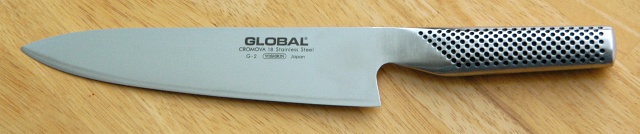 Most common price: $86 (amazon.com); $86 (MetroKitchen)
Weight: 5.85 oz. (165 g)
Spine thickness: Not yet measured
MAC MBK-85 MAC Mighty Chef 8.5"
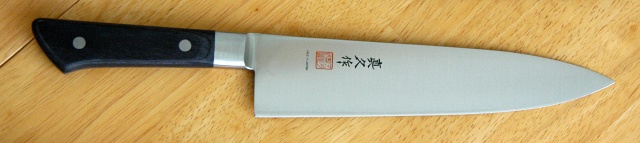 Most common price: $120 (amazon.com); $120 (MAC Knife)
Weight: 7.25 oz. (206 g)
Spine thickness: 13/128 in. (2.6 mm) @ bolster; 4/128 in. (0.8 mm) @ tip
MAC MTH-80 MAC Mighty Chef 8" with dimples
 Most common price: $100 (Cutlery and More); $110 (amazon.com)
Weight: 6.45 oz. (183 g)
Spine thickness: 12/128 in. (2.4 mm) @ bolster; 8/128 in. (1.6 mm ) @ tip
Nenox S1 210mm Gyuto
 Most common price: $261 (JapaneseChefsKnife.com); $270 (Nenohi)
Weight: 6.30 oz. (178 g)
Spine thickness: Not yet measured
RH Forschner Victorinox 40521 Fibrox 10-in. Chef's Knife
 Most common price: $29 (amazon.com)
Weight: 7.85 oz. (223 g)
Spine thickness: 12/128 in. (2.4 mm) @ bolster; 5/128 in. (1.0 mm) @ tip
Shun Classic DMO706 8 in. Chef's Knife
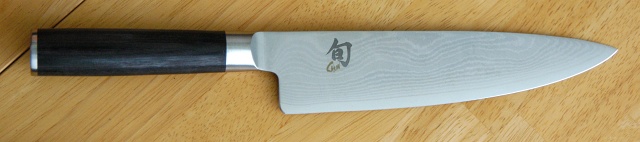 Most common price: $120 (MetroKitchen); $124 (amazon.com)
Weight: 7.50 oz. (212 g)
Spine thickness: 12/128 in. (2.4 mm) @ bolster; 6/128 in. (1.2 mm) @ tip
Tojiro DP F-808 21cm Gyoto Chef's Knife (60 Rockwell)
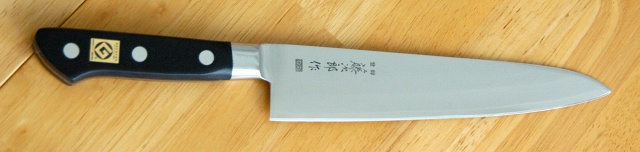 Most common price: $50 (JapaneseChefsKnife.com), $59 (Korin); $100 (various shops in Japantown, San Francisco, CA)
Weight: 6.30 oz. (179 g)
Spine thickness: 8/128 in. (1.6 mm) @ bolster; 6/128 in. (1.2 mm) @ tip
Tojiro Powdered High Speed F520 21cm Gyoto Pro Chef's Knife (62 Rockwell)
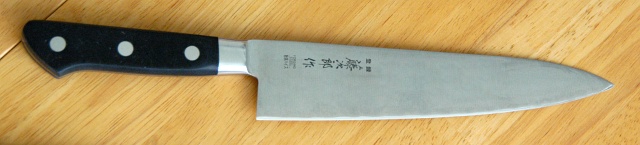 Most common price: $130 (JapaneseChefsKnife.com); $250 (Jorgensen International)
Weight: 6.65 oz. (189 g)
Spine thickness: 8/128 in. (1.6 mm) @ bolster; 5/128 in. (1.0 mm) @ tip
Wusthof 4582 Classic 20 cm. Cook's Knife
 Most common price: $95 (amazon.com)
Weight: 8.80 oz. (249 g)
Spine thickness: 17/128 in. (3.4 mm) @ bolster; 5/128 in. (1.0 mm) @ tip
Knife Performance Rankings
I've numerically ranked each knife starting with "1" as the best performing knife. Knives with the same ranking are so close in performance that I was not able to differentiate between the knives. Please note that these numbers are for ranking only and are not a relative performance level (for example the difference between a 1 & 2 ranking may be much smaller than the performance difference between a 5 & 6). Knives of the same ranking are listed in alphabetic order.
In addition to relative ranks, a rating is assigned to each knife: U - Unacceptable; S - Serviceable; E - Excellent; O - Outstanding.
Unacceptable knives do not cut as expected. Either the cuts were not clean (requiring excessive force or multiple strokes) or the blade bruised or crushed the ingredient to an unacceptable degree. Serviceable knives performed their cutting action as expected. There is nothing exceptional about the knife - it simply performs as you'd expect an average knife to perform. More force is needed when using a serviceable knife than an excellent or outstanding one. Excellent knives slice with ease. The knives are properly balanced and sharp enough to feel as if the user is simply guiding the knife and the knife is performing the cutting. Outstanding knives simply perform beyond all expectations. The knife's cutting ability is noticeably better than that of an excellent knife.
These rankings do not take in account other factors such as cost, handle shape, and weight. They simply portray the cutting performance of the knife.
Carrot test
| Rank | Knife | Notes | |
|---|---|---|---|
| O | 1 | Global G-2 | Felt effortless as the knife slid through the carrots. |
| 2 | MAC 8.0" with dimples | Cleanly cut through carrots. | |
| MAC 8.5" | Cleanly cut through carrots. | ||
| E | 3 | Tojiro DP | Cleanly cut through carrots. |
| Tojiro PHS | Cleanly cut through carrots. | ||
| 4 | Nenox S1 | Cleanly cut through carrots. | |
| 5 | Shun Classic | Cleanly cut through carrots. | |
| 6 | Forschner | Cleanly cut through carrots. | |
| S | 7 | Wusthof Classic | Most cuts were clean. |
| 8 | Henckels Pro-S | Some tearing occurred when cutting through the carrot. | |
| U | 9 | Cutco | First carrot test did not cut through. Second carrot test yielded several pieces where the carrot was broken or torn off after cutting about 60% through. |
Potato test
| Rank | Knife | Notes | |
|---|---|---|---|
| O | 1 | Global G-2 | |
| 2 | MAC 8.0" with dimples | Forward stroke is same as MAC 8.5", but reverse stroke cut noticably deeper and easier. | |
| 3 | MAC 8.5" | ||
| Tojiro DP | |||
| E | 4 | Nenox S1 | Hard a smoother feel while cutting that other knives, but required more force than Tojiro DP. |
| Tojiro PHS | |||
| 5 | Shun Classic | ||
| 6 | Forschner | Slight sticky feeling as it sliced through the potato. | |
| S | 7 | Wusthof Classic | |
| 8 | Henckels Pro-S | ||
| U | 9 | Cutco | Hard to make straight slices (cut line curves outward at bottom of stroke - a trait of a dull knife). |
Tomato test
| Rank | Knife | Notes | |
|---|---|---|---|
| E | 1 | Global G-2 | Glides through tomato |
| MAC 8.0" with dimples | Glides through tomato | ||
| 2 | MAC 8.5" | Glides through tomato | |
| Nenox S1 | Glides through tomato | ||
| Shun Classic | Glides through tomato | ||
| Tojiro DP | Glides through tomato | ||
| Tojiro PHS | Glides through tomato | ||
| 3 | Forschner | Glides through tomato | |
| S | 4 | Wusthof Classic | |
| 5 | Cutco | The cutting edge grips the tomato skin easily and as the knife is drawn through the tomato, it feels like a micro-serrated knife. | |
| 6 | Henckels Pro-S | Blade slipped slightly before catching and cutting through the tomato. | |
Scallions test
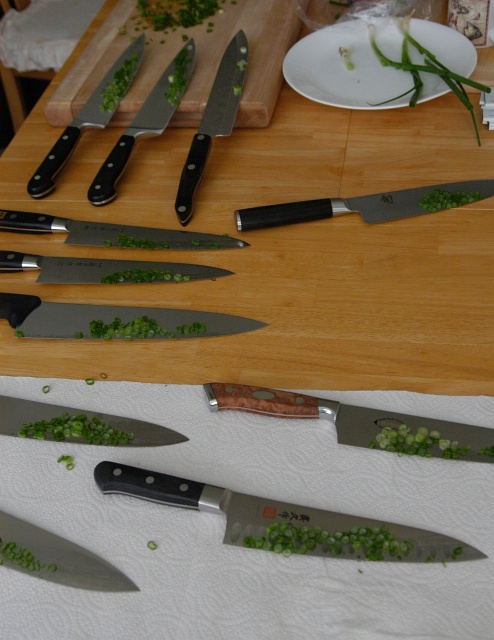
| Rank | Knife | Notes | |
|---|---|---|---|
| O | 1 | MAC 8.0" with dimples | Extremely clean cuts. |
| MAC 8.5" | Extremely clean cuts. | ||
| 2 | Global G-2 | Extremely clean cuts. | |
| E | 3 | Shun Classic | Cuts scallions cleanly. |
| Tojiro DP | Cuts scallions cleanly. | ||
| Tojiro PHS | Cuts scallions cleanly. | ||
| 4 | Nenox S1 | Cuts scallions cleanly. | |
| S | 5 | Forschner | Very slight tearing. |
| 6 | Henckels Pro-S | Slight tearing during rapid chopping. | |
| Wusthof Classic | Slight tearing during rapid chopping. | ||
| U | 7 | Cutco | Completely fails test. Scallions were crushed and torn. |
Examining pure performance, the Global G-2 is the best of the bunch. However, the MAC places a very, very close second (with the 8-in. with dimples [MTH-80] coming out just a bit better than the 8.5-in. without dimples [MBK-85]). In fact, all three are exceptional performing knives.
Other factors
However, the purchase of a knife should not be based solely on its cutting performance. Other important factors to consider are up to the individual chef. Handle design may be the most important factor when buying a knife. If the handle doesn't feel comfortable, then chances are you won't be comfortable using the knife. A handle that feels comfortable in one grip may be uncomfortable when gripped another way. Unfortunately, this means I can't tell you which knife handle is best for you. I recommend going to a store where you can actually hold the knife. A store like Sur La Table, where you can practice a slicing motion on a cutting board, is your best bet for picking the right knife.
Another factor to consider is how the knife feels with your particular cutting motion. If the knife delivers a lot of shock to your hand as you chop or slice, you may want to seek out a slightly different design. For example, the two MAC knives have slightly different feels even though, visually, they seem to have identical curvatures. The general balance of the knife should feel nice to your particular style as well. Choosing a knife that is comfortable to you will help ensure that you won't wear yourself out when you have to do a lot of cutting.
I find that the Global G-2, although very light and an excellent performer, just doesn't fit my hand as comfortably as some of the other knives. The relatively thin handle and shallow taper to the blade makes holding the knife slightly awkward for me. I prefer a grip where my hand is choked up on the handle a bit allowing my thumb and forefinger to rest on opposite sides of the blade just in front of the bolster lip. The design of the Global knives just doesn't seem to let me grip that way and keep the knife from trying to twist out from under me. For that reason, my personal preference is the MAC MTH-80 MAC Mighty Chef 8" with dimples.
The styling and finished look of a knife is very important to many. For example, the Global G-2 has a very distinct look at many will find compliments the decor of their kitchens. The fit and finish of the Nenox S1 is one of the best I've ever seen. I find that the handle feels wonderful in my hand and also looks beautiful. In addition, the Nenox has some more detail work than the mass produced knives - for example, the spin of the knife has been carefully rounded and smoothed. (However, the bolster lip of the Nenox is a sharp right angle causing it to be a little more difficult to use.)
A final factor that I'm going to mention is the care of the knives. Although, many of the knives claim to be dishwasher safe, none of the knives should actually be washed in a dishwasher, except two - the Forschner Fibrox and the Cutco French Chef's will easily survive multiple cycles in a dish washing machine. You do need to make sure the blade will not bounce around or touch other objects in the dishwasher. The Cutco knife's handle may change color after several washes in the machine. My recommendation for all knives is to hand wash them and dry them immediately with a clean cloth.
Conclusions
Cooking For Engineers Recommended:
MAC MTH-80 MAC Mighty Chef 8" with dimples ($110)
Overall best performance regardless of price:
Global G-2 20cm Cook's Knife ($86)
MAC MTH-80 MAC Mighty Chef 8" with dimples ($110)
MAC MBK-85 MAC Mighty Chef 8.5" ($120)
Best Value (Price for Performance):
RH Forschner Victorinox 40521 Fibrox 10-in. Chef's Knife ($29)
Please note that this knife does not fit in a standard knife block because the blade height is 2-1/8 inches (5.4 cm) and most knife block have slots for 2 inch (5.1 cm) knives. Victorinox does manufacture the equivalent knife with a 2-inch heel in an 8-in. length.
Best Value for Almost Outstanding Performance:
Tojiro DP F-808 21cm Gyoto Chef's Knife ($50)
When purchased from JapaneseChefsKnife.com, this Tojiro knife becomes an amazing bargain. When purchased from other vendors at higher cost, you might as well get a Global or MAC. This knife is also available from Korin Japanese Trading Corp. for $59.
Final notes of interest
Most salespeople working at the cutlery counter of your local stores will tell you that a forged knife is a sign of a strong sturdy knife and any forged knife is superior to a stamped knife. This may have been true in the past, but this is definitely no longer a universal truth. The two MAC knives tested in this article are stamped knives with bolsters that are welded on, ground, and polished. MAC Knife claims that using the stamped steel gives them a level of control over the tempering, the bevels, and the thinness of the blade. I don't know if all that's true, but I do know that the two chef's knives we tested out performed all of the forged knives. Ah, but, you argue, the MAC knives tied or were slightly beaten by the Global G-2? The Global G-2 is also a stamped knife.
Also, as a sanity check, I had several people come over and try out the MAC 8-in. with dimples along with several of the other knives shown in this article. Every single tester agreed that the MAC was the best knife that they had ever used.

The tests were performed over two days (two Saturdays) and meticulous notes were kept. After the first day of testing, I really didn't want to continue with the article because I didn't want to deal with continuously washing and drying eleven knives and performing all the comparisons over and over (mainly due to limited counter space). By the end of the first two tests, I already knew which knives were probably going to come out on top - but I needed to finish the testing and documenting to prove it. Tina helped considerably the second day of testing by taking notes for me as I dictated while slicing and chopping. (I also cleared off the dining room table so I would only have to wash all the knives between tests instead of everytime I ran out of space.)
The write up took a lot longer than I expected, and technically I don't think I'm really done. The article took about five days to write, and I still remember more stuff that I want to add - so don't be surprised if the article changes to become a bit more detailed or clearer as time goes on.
Anyway, I hope my readers will find this article informative and interesting.
I'd love to read another test when you've had a chance to sharpen them on the Nortons. I rarely have a knife come from the factory/maker with a satisfactory edge, especially Tojiros. If you were to use your stones and put the same 8000grit edge on each knife I think you would be able to do a test that exposed the differences in the quality of the steel. Just a thought...
The tomato skin test, for example, is based entirely on the sharpness of the knife.
I'm a big Henckels/Wustoff fan, I have a few that I give regular love and maintenance and they could split a hair.
The only knife that is exempt from my criticism is Cutco which is supposed to never need sharpening. (overpriced garbage)
Then comes the matter of the steel. Japanese knives have harder steel than Western knives do, which increases wear resistance at the expense of brittleness (proportional to the hardness). This means that Japanese knives tend to hold their edges longer than Western knives do, and because the blades are thinner, they cut more easily.
Personally, I would have loved to see a Chinese cleaver (Chan Chi Kee, Suien, Nenox, etc.) included in the mix.
Misono UX-10, stamped blade
http://knifeoutlet.com/revolution.htm
The review would have been much stronger if you had used a well regarded local sharpening service or a consitent, repeatable system (such as the Australian Furi hones) to bring all of the knives to the same edge.
Consistent sharpening does not lead to consistent performance. Blade hardness, composition, bevel geometry, weight, and thickness all play a part in how well a knife cuts.
I highly recommend you re-release this review (which is of marginal utility at this point) after re-conducting it with consistently sharpened blades.
Great <i>idea</i> though. I was really looking forward to reading it.
They are offering Damascus kitchen knives w/VG-10 core, A.G. Russell kitchen knives w/wood Rucarta handles and KAI kitchen knives.
How do these compare with Henckels, Wusthof or the MAC MTH-80 you recommend?
They are offering Damascus kitchen knives w/VG-10 core, A.G. Russell kitchen knives w/wood Rucarta handles and KAI kitchen knives.
How do these compare with Henckels, Wusthof or the MAC MTH-80 you recommend?
I'm not a fan of full bolsters, but I've heard good things about A.G. Russell and VG-10 steel.
I think it bears noting that the reviewer bought these at a restaurant supply store. Knives used in industry are different from those used by amateur chefs. They are meant to be abused, run through the sterilizing dishwasher, and so on. These knives conspicuously display the NSF logo for the health inspector to see.
I have had fancier and more expensive knives, and I may try some of those reviewed here. But, I can absolutely say that the Forschner Victorinox are great knives at a bargain price.
Second, thanks for the tip on the Mac knife, a brand I have never used but have now added to my Amazon wishlist.
1) The most important part of a knife is the hand that holds it
2) A knife is a very personal ,every one has there likes and dislikes
3) A factory edge should be sufficient for any home user, We only had our knifes sharpened 1 a week, honing is important
4) All knifes tested here are GOOD knifes, this falls into personal taste, grip, hand size, weight and a mired of other factors.
I have "heard" great things but wanted some objective opinions. Anyone care to comment or would Mike be willing to test some cereamics down the road?
Sounds like for now, the MAC will top my wish list.
Also, I didn't follow your comment about the "shallow taper" to the Global's blade. Are you referring to the curvature of its blade? However, the MAC's don't look any more curved; in fact, the MTH-80 seems to an almost flat cutting edge (like a santoku).
In a previous comment, someone stated that the CUTCO knife
As an owner of CUTCO knives, I know that my straight-edged knives need regular sharpening. I did not purchase my set because I need a top performing Chef's knife. I purchased my set because the CUTCO steak and carving knives (with Double-D edges) cut well and are a pleasure for me to use.
/Torq
On hard Japanese blades I would only use glass smooth or very fine ceramic steels like the ones found here:
http://www.handamerican.com/steel3.html
With coarsely textured steels one has a very high risk of damaging a hard Japanese blade...
Personally I have avoided steels and use my highest grit polishing stone (8000) or flatbed leather hone to bring an edge back to life.
If the diamond steel you bought is very fine and is not harsh on the edge then I think you will be in good shape. I would advise using as little pressure as possible when using the steel. The weight of the knife is more than enough...
Get some good stones and learn how to do it yourself. It's a very rewarding skill.
http://users.ameritech.net/knives/ward.htm
That should get you started. Of course, if you don't want to do it freehand, or if you want to start off with a guide, there are several good sharpening systems available, the premier being the EdgePro Apex or Pro model.
Solid products and prices, and a few options depending on your need and skill
Having said that, I do have a criticsm. It is not a fair comparison to compare knives with a factory edge. Some manufactuorers intentionally leave the knive a little blunt for safety in transportation. You cannot get a like-for-like comparison with a factory edge because you can't know that they all have comparably sharp (or blunt) edges out of the factory.
I own a couple of Whustof knives and the difference between factory edge and newly sharpened is night and day. They are one company that has a policy of keeping the knives rather blunt and I did have cutting issues with them out of the factory.
I don't agree with the authors assertion that people reading this article and buying knives at this price are the sort of people who use the knives with a factory edge. I think most people reading this article are likely to be rather geeky about their knives.
To me, a good knife is also about how it performs over time and how well it does re-sharpen over and over again. Though I do appreciate the difficulty of defining and measuring this attribute. At a minimum I would love to see what would happen if all these knives where taken to a reputable knife sharper and the tests re-done.
The favourite knife was also the only knife to be bevelled. I wonder if that was the difference? Anyone got any thoughts on that?
That said, however, the best advice one can give for knife selection is: choose one that feels best in your hand. It is 100% subjective. It does you no benefit to buy a top rated knife that causes blisters.
All knives will get the job done. Over time how you treat the knife is up to you.
The company is run by engineers and the knives are designed by engineers, they consistently rate highly in reviews, I have two and they are the most comfortable and best performing knives I have ever used.
As an aside for the Anonymous Reader who bought a diamond steel, go easy on that blade. Diamond steels do more than just realign the blade. They will sharpen/take away matter when you rub the blade against them. Some knives can't be sharpened by a regular steel, so I'm not saying they steered you wrong, it's just a little trickier with a diamond/ceramic steel to accomplish what you need. And you will only ruin any blade if you don't know how to hold it at a proper angle to sharpen/hone it. So get some education, because it definitely is a worthwhile skill to acquire. Happy sharpening!
It should be worth noting that Shun Classic knives are available in left-handed models as well:
Chef's Resource's Left Handed Shun Catalog
Cutlery & More: Shun 8-in. Chef's for Left Handers
Not all stores carry them.
I agree with the individuality issue you mention. I recently picked up a left-handed Shun and love it. ;)
I've found that food service knives are the best balance between cost and function- the steel is decent and you can get a chef's knife for $40. I've used my Dexter-Russell set for ~5 years now- even though periodically someone has thrown them in the dishwasher or left them in a pan of water overnight. They're a bit hard to find- I go to a resturant supply store.
http://www.dexter-russell.com/Search_details.asp?id=639&group_name=sofgrip.asp
R/
Go to Razor Edge for tools and techniques to learn how to sharpen your knives yourself the correct and safe way.
The guys on here can make an ax sharp enough to shave with. You can make your knives sharp enough to be safe and efficient.
Why doesn't anyone here say it as it is? These knives are too bloody expensive!!! How many people would buy a knife that's more than $100?
or even $60? I think $50 is a good limit.
Why doesn't anyone here say it as it is? These knives are too bloody expensive!!! How many people would buy a knife that's more than $100?
or even $60? I think $50 is a good limit.
Isn't that why Michael recommended the Forschner as the best value for performance at $29?
lol
all the crazy knifenuts here: http://www.knifeforums.com/forums/showforum.php?fid/26/ where $100 for a good knife is considered a bargain and $50 is a steal...
A beautiful knife with a "super steel" core doesn't come cheap...
"SANETU" Cowry X Santoku 165mm http://www.japanesechefsknife.com/SPECIALS.html
"Cowry X is the tough powdered metal alloy specially developed by Daido Steel Company for high performance cutting tools. It contains high carbon (3%) and high Chromium (20%) with 1% Molybdenum and 0.3% Vanadium, and can be heat treated to HRC63 to 67 without brittleness." - JCK
If you think the western style chef's knives reviewed on this site are expensive you probably won't believe these prices:
http://www.japanesechefsknife.com/KDSeries.html
Traditional honyaki knives are even worse... :shock:
However, my only beef (har har) is that only the tests did not include meat, poultry, and fish. In my view, cutting those materials is every bit as important as carrots, scallions, tomatoes, and potatoes. It would have been nice to create a battery of tests whose respective purposes were indexed according to what attributes of the knife are being tested.
Nevertheless, very nicely done!
Peace & Happy Cooking,
Kai
I'm too cheap to be cutting meats... plus I'd have to test the meats in fresh and frozen states...
Re sharpening. I buy lots of knives, and I've yet to see a company advertise that they ship dull for safety. Therefore, I say let the products as shipped speak for themselves, for three reasons:
1. Consumers shouldn't have to guess if they're getting a product that's ready to use or not. The product should be ready to use, even if that warrants warning stickers.
2. Depending on what "professional" sharpens them and how, you introduce variables of blade geometry and temper tampering into the tests, with what were virgin tools.
3. Sharpening is personal for the consumer, too. A geek like me who knows how to sharpen does it religiously and well. A person who wants a knife to function when they use it, and otherwise stay out of the way, needs to know which knives will bear up under rough treatment. My knives rock, but their factory edges are distant memories, and I consider the sharpening I've done to them over the years to be customization.
As for knives being too expensive, I always point my non-knifehead friends to the Forschner. A real giant killer, that. But for an enthusiast, "too expensive" is like telling a cowboy his Stetson or Resistol is too expensive. How much is too much to pay for a tool that might outlive you, and serve you superbly in the meantime? For something you only have to buy once, in a disposable world?
Subjective handle comfort comments would be great. It's personal, but it can give you an idea of what knife will fatigue large or small hands in particular.
In any case, nice test, and thanks for including knife weights. I've made my trade-up decision. :)
i own most of the knives tested, and will concur with most of your conclusions. what i find interesting is that the global, the macs, the forschner and the shun are all stamped blades! so much for all the
"experts" and their "expert opinions" that the best knives have to be forged.
modern stamping techniques can produce some very nice knives!
(OK, the cutco is also stamped, but how they command the price they
demand for that junky blade is beyond my imagination.) what others may not know is that the stamped knives tend to be very straight blades. i hang around one of the bay area's biggest knife shops (the perfect edge cutlery in san mateo) and i have examined hundreds of knives (they are very nice to me as i have bought lots of knives from them) and the stamped knives are very very straight compared to the forged knives. the forged knives often have something "unstraight" about them ... they are curved, dog legged, bent, twisted, and even wavy edged ... problems if you need to make long straight cuts, not a problem if all you do is chop and mince, but something to be aware of nonetheless.
in fact, many of my friends, who have bragged about their knives, were surprised when i mentioned many knives being unstraight. sure enough, they sighted down their forged knives and found me to be correct. i would then show them my knives and they are very noticeably straight.
it is very difficult to make long straight cuts with a crooked blade.
the other thing i will conjecture is that even if all the knives were to be sharpened by the same knife sharpener, the thinner the blade, the sharper the knife. (this is why straight edged razors, which are reeeally razor sharp, are always very thin bladed. i cannot understand, knowing physics, how a thick blade can ever approach the sharpness of a thin blade.) so even if the test were to be remade with all the knives sharpened, the results would probably be the same. german blade fans tend to be very loyal to their knives, but i have shown many of them my japanese blades and many have admitted that they have never actually USED a japanese blade and were surprised how much sharper they were compared to the german blades, even after bragging how their knives were "hair splitting sharp". misono, kikuichi, suisin, hirotomo, masamoto, and masahiro all make western styled chef knives that would easily rival and exceed the sharpness of german steel, and at an under $100 price.
actually, my latest buy, a $20 tarhong #1 carbon steel ping knife (chinese veggie cleaver) is proving to be a VERY sharp, VERY easy to handle cook's knife. after cleaning up the edge with just a few swipes of a 2000 grit waterstone, i was able to chop ten pounds of onions without shedding a single tear!! forget those "tips" about how to cut an onion without crying (partially freeze it, slice it under water, breathe thru your mouth and not your nose, breathe thru you nose and not your mouth, etc.) ... if your knife is truly sharp, you can cut/slice/chop an onion and you will not cry.
sorry for the long post, but ... just my thoughts.
Anyone have similar experiences?
MAC Knives has excellent customer service. Please ask your friend to contact MAC Knife, Inc. at (888) 622-5643 to talk directly to them.
My guess is that your friend may have twisted the blade once it was wedged into the cheese. Quality knives should be treated with care - they are finely constructed instruments. I don't recommend that knives be washed in the dishwasher (can bang around and get nicked or lose their tips), be thrown into a sink, or allowed to impact any surface besides vegetables, meat (avoid bones except with a cleaver or thick bladed chef's), and wood or plastic cutting boards. I've seen so many people using a granite board or rapping their knives on jars or bowls and then wondering why their edge is dull or chipped...
What are knives used for? To cut things. If they aren't sharp, they aren't going to cut well. Ergonomics and things such as that are all secondary to the quality of the cutting edge.
All of the knives in this review need to be sharpened and THEN retested. It's the only way to get accurate data. Manufacturers rarely ship new knives sharp. Even if they do, the amount of sharpness varies widely from manufacturer to manufacturer.
I've got a $10 Farberware Pro 8" chef's knife that I sharpened so sharp I could shave with it. It has been an absolute joy to use.
It's the edge that's important. Without it, it's just a butter knife.
A note about edges. The angle of the grind used to make more of a difference (before the ultra tough high temper stainless) in how long the edge will last. If you slice with the kife (rather than chop--which by the way is the trick for using a katana or other sword) the brittleness of the steel is not a problem.
Note that only a few years ago, no serious kife person would have recommended any stainless knife on the grounds that it wouldn't hold an edge. This is related to the stamped/forged argument too, the real reason that stamped knives used to be inferior (and they were!) was that the manufacturers didn't use the best steels in the stamped knives--they reserved them for their 'top line' forged knives.
Dull knives are dangerous learn proper maintenance for your particular blades.
Knives, being an extension of your hand (I tell my cats that my knives are my claws,) are extremely personal. Find one you are comfortable with, and which you feel in control with. Cutting off bits of yourself is not fun.
If you have no training in using a knife, I recomend that you study the subject & if possible have someone who knows walk you through the various uses. Best not to develop bad habits as they may be dangerous and will probably be less efficient (more tiring.) In general, the weight of the knife should do most of the work. If you have to put a lot of pressure on a knife to make a cut, then there is something wrong.
In the old days, when demonstrators were showing kives (in stores & at fairs and such) they used to put very fine edges on their knives. This makes the tomato test and the paper test very impressive--at the cost of having to rework the edge often.
My 2 cents.
As another here has already mentioned, The Chef's knife is the ONE AND ONLY Cutco knife I don't use, because once you use the Double D blade you never go back. It's funny that it's the one you chose to demonstrate with.
My steak knives were as sharp today as they were years ago, HONEST! until my son tossed my last one. So I just replaced all of the steak knives and look forward to using them for the rest of my life.
I still have the rest of the collection, and use them EVERY DAY.
The Double D is the ONLY way to go, too bad it's NOT ON THE CHEF'S KNIFE. You need to reconsider what you are using. A chef would not use this Cutco knife on a tomato or potato anyway.
-ddog
Well good cooking and good engineering…
I recommend learning how to use waterstones. They work well with high Rockwell knives...
My full sharpening progression:
1. Norton 220, 1000, 4000, 8000 Water Stones
[img:c0cccf7cdb]http://img470.imageshack.us/img470/4026/stones19nn.th.jpg[/im...db][img:c0cccf7cdb]http://img470.imageshack.us/img470/6459/stones23wx.th.jpg[/im...db]
2. 12000 Kitayama Super Polishing Water Stone
[img:c0cccf7cdb]http://img470.imageshack.us/img470/2811/01099109kb.th.jpg[/im...db]
3. Handamerican 11"X3" Flatbed Leather Hone w/ 0.5 micron chromium oxide honing paste
An abundance of information on where to buy and how to sharpen properly can be found here:
Kitchen Knife Sharpening
These look funky on the website but they are inexpensive and surprisingly good performers:
http://www.warthers.com/kitchen_knives/index.php?cPath=21
As a chef I've used most of those knives and I think you're spot-on except for one minor detail: most knives are not shipped fully sharpened. To keep things equal you should have run each knife through a slot sharpener so that each was sharpened to the same angle.
As for Cutco knives, they are excellent for slicing, but not for cutting. Their "double D" edge is a type of serration (as much as they deny it) and only works well when a sawing motion is used. No chef I know uses one. I challenge ANY Cutco user to make fine bruniose (1/16 inch cubes) with their knife. Incidentally, we had an issue on a chef board I frequent where multiple "I love my Cutco" posts were made under different names from the same IP that, when checked, belonged to someone who sold Cutco.
I have a Mercer ($65) that I use for general work (cutting meat, chopping, opening bags) and a Calphalon Katana series($90) that I use for my fine work.
A good way to reprise this test might be to enlist the help of a local culinary class.
The main issues / critcisms that I have read seem to be:
1. (Biggest issue for most folks) A sharpened edge vs. a factory edge
2. Ergonomics impressions (will vary with the person)
3. Alternate cutting methods and/or materials
I have Gerber (both the Balance Plus and the older Aluminum handled knives), a low-end Sabatier set, and some of the mid-priced Japanese knives at home. I've also demo'd or borrowed at a friends place to use Henckles, Forscner, Shun, and others at various times. The biggest things to me were 1) Was it Sharp? and 2) Did it feel comfortable in my hand?
If you have a culinary school nearby, maybe you could let them do the work (sharpening and running the various knives through the paces in prep work). Then give them surey forms to fill out to get a more balanced follow-up on the review. Include items like hand size and their own preferred knives to help give a way to balance their responses and you might get some informative input.
http://www.futurechef.com/product.asp?item_no=MAC-MTH-80
I have a few different knives, mostly less-than-stellar quality as I'm just coming out of "dirt-poor student" mode. However, one that I like is the Peasant Chef's Knife from Lee Valley Tools. Why? To be honest, there's no scientific reasoning, I just like the feel of it. But then, I'm still very much a n00b when it comes to knives.
Oh, and for those who were thinking Shun knives are for rightys only, you should read Alton Brown's website - he specifically mentiones they make left-handled knives, since he's a lefty too.
first, i seem to notice that all the major (and minor) knife companies brag about how sharp their knives are. if they are indeed shipped "dull", that would be totally counter to their bragging, no? why would a company brag about how sharp you can GET their knives, since a good sharpener can get any knife sharp? just an observation.
secondly, if you COULD do the test all over again, but this time with all the knives sharpened by the same person, i feel the results would not change significantly because the top rated knives all had/have a thin blade profile.
the german knives tend to have a thicker profile, ergo, the 22 degree bevel on both sides of the blade. the japanese blades, with more like a 10-15 degree bevel on both sides, will feel sharper due to less of the "wedging" effect of the thinner blades.
third, there may be some perception of addition sharpness with blades that have a rougher or irregular texture on the blades. with blades that are perfectly flat and polished, foods like potatoes tend to stick to the blades via some sort of suction (even try to slice a potato in half and the potato sticks to the blade so hard that you found it hard to pry the potato off the knife?)
as i have previously mentioned, i own most of the knives used in the test and i found most will pale in comparison to my chan chi kee (CCK) no.2 slicer cleaver. this large (25cm X 12.5cm) blade has a 2cm edge that is
thinner than a business card. This knife i sharpen at a 5 degree bevel ...
maybe less. as i have observed, the thinner the blade and the shallower the angle, the sharper a knife blade.
The functionality of my knives is upgraded significantly by using a sharpening method involving a series of 3 to 5 waterstones and resulting in a mirror polish. "Steels and rare occasional stone use" (assuming one JIS 1000 stone or lower) simply does not produce an edge that I find satisfactory. What are your experiences with knives sharpened progressively to JIS 8000 or higher?
no, the lower grits are only needed for re-beveling when the knife still has the rough factory bevel or requires edge defects to be worked out. I only use the leather hone or one of the fine stones before a day's work.
Only a couple mm's which make up the edge bevel (not the sides) gets polished and the edge is certainly affected in the process. It is not the mirror polish that improves the cutting effectiveness. Rather, it is the alignment of the edge that improves with the use of finer and finer abrasives. The mirror polish is simply the visual side effect of using an extremely fine abrasive.
It sounds like you have a good system that fits your needs and I respect that. Personally, if I was to use a steel I would probably start with a "glass smooth" steel and then use a fine ceramic when necessary (http://www.handamerican.com/products.html). I am obsessed with getting my knives as sharp as I can afford and I find that I get the best performance when the edges are taken to the finest abrasive level possible.
Get the Wusthof Classic or Henckels Professional S. DO NOT get the Global unless you like the feel of their handles. I find them too small and their roundness and unnatural taper makes them harder to control than Wusthof or Henckels knives.
My question is: how or where can I get a set of six ceramic edged Henckels knives sharpened? I bought them in Germany between about 1995 and 2000. They never did sell these in the US nor are they any longer sold in Germany.
Any suggestions anyone?
My question is: how or where can I get a set of six ceramic edged Henckels knives sharpened? I bought them in Germany between about 1995 and 2000. They never did sell these in the US nor are they any longer sold in Germany.
Any suggestions anyone?
Find out who sharpens the Kyocera ceramic knives and see if they will do the Henckels for you.
Yeah, we'll accept you because you were a math major-that's close enough.
http://drsharpening.com/
Dave at DR Sharpening is well respected, and has experience with ceramic blades.
Trained Criminal investagive auditor and insurance auditor. Currently, + for many years, financial, strategic and production planer and venture capital investor. I need absolutely repeatable, consistant, return producing results for larges groups of organizations and individuals.
So when your reviews differed from Consumer Reports, and the chat around the stores ( many hate global for poor performance ) I got excited. What is the truth. Many years of using Henckels, Wustof, Shun, Dexter Cleavers, and recently Katana, with many many knives (own 40 or so, 20+ chef's knives.) Truth is in everything said.
My findings indicate that no knife is great out of the box. As a producer myself, it would just be too damb expensive to assure that. That being said, there is a limit to the sharpness range to a given knife, and more importantly, with each indivual knife of a given manufacturer's model! Example, went thru 11 Henckels Pro S 8" Chef's Knives. Every one was different before and after home sharpening. The sharpest, out cutting MAC, Shun, etc was much sharper than the dullest, which would not go thru an onion. Huge difference. Found this to be the case with all German Knives. Japanese were, as there cars, much more consistant, and generally razor sharp when new.
Have found that though Japanense knives seem to be sharper and cut better than most German knives ( a good Henckels will beat them though, and hard to get) new, the get dull quickly. Cannot resharpen them to original edge after just a few uses. My Shuns are duller than President Bush's speeches. My Katana, which when used to I love, also dulled almost immediately. Though they, while being obviously dull, still cut better than most. Explain that one please! The one absolute, Henckels definitely sharper than Wustof. Every time. MAC to new to see how edge holds. Global dislike for bad balance, and they are not sharp! Eveone in the store here complains about that and gets mad after listening to reviews of greatness then buying.
I have settled on Henckels as my primary. Went thru many chef's knives to get 8" Four Star & Pro S, with and without dimples that are sharp. The one exception to the comparisons is Santokus from Henckels are sharper than any Japanese knife out of the box and down the road. I asked Henckels about this, and they replied by design the do not make the other knives sharper, though they can do so easily. Lost my notes why, but I am sure they will respond to inquiry.
Good luck to all
My findings indicate that no knife is great out of the box. I have settled on Henckels as my primary. Went thru many chef's knives to get 8" Four Star & Pro S, with and without dimples that are sharp. The one exception to the comparisons is Santokus from Henckels are sharper than any Japanese knife out of the box and down the road. I asked Henckels about this, and they replied by design the do not make the other knives sharper, though they can do so easily. Lost my notes why, but I am sure they will respond to inquiry.
Good luck to all
I agree that no knife out of the box is as sharp as someone skilled in sharpening can do at home. If I had pick a favorite, I would say the Wusthof Classic is very slightly better than the Henckels Pro-S because it can be sharpened to an ever so slightly sharper edge and it lasts slightly longer during use. I say this without prejudice, because I own about a dozen of each brand in my collection. Needless to say, both are fantastic.
EVERY knife needs to be sharpened with a steel between uses to keep its scalpel/razor like edge. A knife isn't ready to use until it shaves hair. I have OCD and a fetish for sharp knives. :)
QUESTION: I never got into using a Santoku, nor do I own one. I use wide chef's knives of different sizes. What is it about Santokus that is making them so popular? Is it just a new fad? I think I would miss the point on the chef's knife when I needed to pierce something or cut out an imperfect part of the food I was preparing.
Since you're a sharpness junkie, try this excercize my knifeskills instructor gave us: wrap your cutting board in plastic wrap and slice green onions (making sure to get all the way through) without cutting the plastic. Scoring the plastic is OK, but it should hold water when you're done.
I started using my parents Chicago Cutlery. A decent starter knife but far from very useful.
I then bought myself some Wusthof Classic chef knives. It was worlds apart. I loved using it. It was sharp. I was able to keep it sharp by sharpening as needed.
I then saw Global. I loved the look and ordered some. I loved the weight and sharpness of them. I have small hands so they fit great. I am able to do great things with them. I have 6 Global knives (3" paring, 6" serrated, 5.5" vegetable, 8" chef, 9" bread and 13" flexible carving). I love how they keep the edge and are able to stay razor sharp. I do have a Global sharpening kit.
While at a knife skills class recently, I was able to use a Kyocera ceramic knife. It was much sharper than mine. It felt great to cut with. It was lighter than my Globals which are much lighter than the Wusthofs. I loved how it cut. No bruising or crushing. It was great. Now I just have to arrange to get one.
Since you're a sharpness junkie, try this excercize my knifeskills instructor gave us: wrap your cutting board in plastic wrap and slice green onions (making sure to get all the way through) without cutting the plastic. Scoring the plastic is OK, but it should hold water when you're done.
I am not familiar with this. Is the purpose so you learn to use only the force needed to cut through the food and not strain your hands? What difference does it make if you cut through the plastic in this excercise? I admit I'd probably cut through-my cutting board has cut lines on it, that over the years have become a mosaic from chopping food. Please elaborate.
I am an industry chef and the last new knife I purchased was a Kai (Japan) Shun Santoku. I find it is just the most perfect knife and I use it for 90% of the kitchen work I do. The shape is not a fad. It cuts, slices and chops, turn the blade over and the rounded edge is great for buttering bread! It still has a point and a sharp one at that, which is fine for cutting out bad bits and piercing. Tonight I spatchcocked a chicken (cut the backbone out), sliced potatoes, chopped onions and garlic, and then jointed the chicken when it was cooked. I get my knife professionally sharpened once a year, and I steel it about once a week. Every 4 months it might need a touch up on a waterstone. It is usually shaving sharp. VG10 10 is a great steel and the damascus pattern and gold lettering, make the Kai/Kershaw Shun stand out.
I am not familiar with this. Is the purpose so you learn to use only the force needed to cut through the food and not strain your hands? What difference does it make if you cut through the plastic in this excercise? I admit I'd probably cut through-my cutting board has cut lines on it, that over the years have become a mosaic from chopping food. Please elaborate.
It's about an experienced chef showing off *wink*
Seriously, the point is control and sharpness. If your knife is truly sharp you don't need much pressure, so the excercise is to learn how to use just enough and no more.
No, I have not had the opportunity to sit down and test a double-D against a "standard" serrated knife. In truth, I use serrated blade infrequently - mainly as a bread knife or if I'm someone else's home and don't have my knives with me...
if you have the time, read through the essay on egullet... very thorough.... and goes over more of the science/physics than cfe
:D
I think you should have tested them on meat and fish too!
Any knife's edge should reflect its intended use. Just as their are many types of teeth on saws, depending on what you intend to cut with them, knife edges should not all be the same.
Most people agree that bread knives are more effective when they are coursely serrated, and a sharp knife with a coursely sharpened blade, (one that leaves thousands of tiny but sharp stridations on it), will cut more tomatoes easily than one with a polished razor edge. Fact is that polished razor edges may be deadly sharp, but they make lousy cooking edges becase they tend to dull much more quickly and be harder to touch up quickly, than their roughter counterparts. Razor edges aren't even desirable for many kitchen jobs because they bite too quickly into things you may not want to cut into, like when you are trimming meat and poltry. Sometimes its nice to be able to follow the contour around obstacles instead of cutting into them.
Its also not fair to compare the cutting pressure of knives with vastly disimilar blade angles and surfaces. A good knife is comfortable to use, requires less effort to use, and stays sharper than a bad one, on the task you use it to do. And for the record I don't push any of my knives through carrots, I chop them very quickly.
I have thourally enjoyed the forum and do have an extensive collection of kitchen knives that were almost all purchased used, and many were old rusty forged carbon steel knives when I bought them for next to nothing. I enjoy restoring them, putting a good edge on them, and using them.
Anamouse@earthlink.net
Imagine my shock when I got it and the D-handle fit my left hand perfectly - the flat against my palm, my fingers curving around the right half of the 'D'!
Literally, I picked up the knife and it felt perfect.
Even using a proper knife grip, it felt perfect.
Has anyone else experienced/seen this??
Does anyone have any personal experience with either of these knives, or any recommendations?
Is anyone familiar, other than what the Wuhstof pamphlet says, with the Le Cordon Bleu line of knives? I would really appreciate some help.
Thank you.
I've been thinking about getting my own knife (I only ever use one and I use it for everything) for a while now. This has given me much to consider.
Now I just have to find sources of the knives in Canada... Google here I come.
I love your site, and the way you have the recipes is exactly how I think...
Once again, awesome, and keep up the site!
Amanda
As another here has already mentioned, The Chef's knife is the ONE AND ONLY Cutco knife I don't use, because once you use the Double D blade you never go back. It's funny that it's the one you chose to demonstrate with.
My steak knives were as sharp today as they were years ago, HONEST! until my son tossed my last one. So I just replaced all of the steak knives and look forward to using them for the rest of my life.
I still have the rest of the collection, and use them EVERY DAY.
The Double D is the ONLY way to go, too bad it's NOT ON THE CHEF'S KNIFE. You need to reconsider what you are using. A chef would not use this Cutco knife on a tomato or potato anyway.
I was doing a CUTCO search on their rockwell hardness rating and pull in this site and your message. There is a ton of Cutco of all generations being sold on eBay and just worh checking out. For out of production Cutco, there is plenty for sale by many sellers and a good buyers guide on dating your Cutco. Paul
I have recently been doing some research into knives, originally with the intention of determining what is the "best" knife in the world. What I have found out is that there is no such thing. As so many have said before me, the qualities that make a knife "the best" are variable and very subjective.
For instance, different types of steel have different characteristics. Some are very difficult to sharpen, but hold an edge for a long time and do not rust. Some must be handled with care to prevent rusting, but are super easy to re-sharpen to a razor's edge. Some knives a lightwieght, but are not constructed as durably as heavier knives. Some people may want a cheap knife that won't need sharpening for five years, at which time they will throw it away and buy another, and some people want to pass their beloved forged knife on to their grandchildren... It all depends.
What struck me most about the review was the sincerity of the reviewer, as well as the naivity of his tests. It proved the adage well: sometimes we are ignorant not only of the answers, but of what questions to ask. Being an engineer does not automatically grant expertise in the very complex subject of knife design. For expertise I would look for reviews written by someone who has devoted himself to the complex subject more deeply than our reviewer.
Still, keep up the good work. It's cool to find such a big forum for other knife geeks.
She has Mac, Hattori, and Wustoff that she uses regularly.
Her comments are these:
European knives are solid and heavy built knives. They are made very well and will last a lifetime. About the knife, they are thicker and the blade edge is usually sharpened to 20-25 degrees.
She mentioned this is fine for standard western cooking. It chops, cuts, and slices well. They are well made.
However, the knife is made for a different purpose - as the Western Foods are prepared different than Japanese food.
Most of her Japanese knives are sharpened only on one side, thinner than the German knives, lighter weight, and hard steel.
Many dishes she prepares require very thin slices, which she could never do with her Wustoff.
She sharpens her own knives and said that she can sharpen them all equally sharp, but the hard Japanese steel knives can take a sharper 10-15 degree edge - because of the harder steel - which can not be done on the softer German knives.
We spoke a long time about it and I tried all her knives.
She stopped me and said. These are her knives and work for her, but may not be right for me. Because she loves them and has become familiar with them, does not mean they are the best - only the best for her.
Her basic rules.
1. Your cooking style. If you are preparing normal western type dishes - then any German type of blade edge will do, but if you plan on preparing some specialty dishes (Japanese in her case) then you may need a one-sided 10-15 degree blade for paper-thin cuts.
2. Your Hands. She mentions the blade becomes and extension of the cook's body. Everyone’s hands are different sizes and finding the right handles/grip is as important as the blade. It is about balance - almost Zen like.
3. The need of your knife. She recommends NOT to purchase a knife block and set (even if they are your favorites - because each knife is different), but instead find 3 knives that meet your needs (they could be from 3 different manufactures).
a. A pairing knife
b. A cutting and slicing knife (chief's knife 7"-10")
c. A chopping knife (cleaver or you could use a heavy santoku).
(side note: she does not own a santoku)
In the future you can get other types of knives (boning, cleaver, etc, but these three will be your go to knives.
4. The quality. Once you find the types of knives you need - the quality needs to be evaluated.
She mentioned the German knives are softer steel. She believes that they are easier to sharpen, but won't hold the edge as long. Since the angle is 20-30% - the softer steel is fine - since the blade edge will be thicker. Her Wustoff is one of the knives she uses often (8" Chef Knife) - pretty old.
Japanese knives are harder steel to hold the thinner edge that is required, but this can make the knife more brittle. Most of her knives are Japanese.
She said - forget the brand name - that is not important. TRY TRY TRY every knife you can. You will know the one that is right for you when you try it. It will sit well in the hand (your hand) and the balance will be perfect for your needs. The knife should ALWAYS be sharpened after you purchase it.
She told me in Japan that where she bought her knives, they would sharpen them right in the shop after purchase on Whetstones - so they don't need to be sharpened when you get them home. They don't do that at Macy's! However, almost every knife you purchase in a store in the US needs be sharpened when you get them home.
I tried all kinds of knives.
I am not a professional, but here is my experience.
Globals - did not fit my hand and I didn't like the feel of the handle. It cut very well.
Furi - felt cheap to me. I didn't really like the plastic handle. I didn't try the full metal handle version. They only had Santokus - which seems like a fairly new gimick that everyone is on the band wagon with.
MAC (originals) - I really liked the angle of the handle to the blade. I really liked the pairing knife.
MAC (Pro) - more western style then the originals - like them better than the Global.
Hattori HD - lightweight and handle fit very well in my hand. I really liked the balance.
Shun - Loved these, but they didn't feel right - really wanted to purchase them - but I was not comfortable. I didn't like the round handle, but that is just me. I love the look.
Henkels - after trying all those Japanese knives these were heavy. I liked the heavy weight (made me feel like I was holding something solid). However, I was getting used to the nimbler Japanese knives.
Wustoff - same as the Hinkels but the balance was better. I noticed with the German knives that I tested that the bolsters had rough/sharp edges which can be smoothed with some grinding. I guess I don't always hold my knife properly - because I didn't like the sharp edges.
Viking - didn't like them at all. The handles were very square, thick blades, and overly heavy.
Cursco (sp?) - seemed cheap, hate the handle, and the serated blade (my stepmom said stay away from these type of blades).
I tried a few others, but nothing really stood out.
There were some others that I want to try, but could not find them available to try.
The results.
I bought the Hattori HD Chief's knife, the MAC (original) pairing knife.
I am still looking for a couple of more knives, but this is my starting point. I will keep my old Henkels Set in the block for a while.
My stepmother gave me some whetstones (400,1000,2000). She had me start with my old Hinkels and I got them very sharp (sharper than when I bought them). I was rather surprised how sharp I got them.
I asked if I got the right ones, she smiled and looked at me. She said "How would I know, they are your knives! Only you would know that answer."
I really love my MAC and Hattori, but I have found that I am still using one of my Henkles since I have sharpened it.
The lesson I learned is that it is very individual for each person and sharpening is very important - as well as care.
She did point out that Quality is very important. Both Japanese and German knives have lower-end steel products that sell at Target and Macy's. Just because it has a Japanese or German brand name on it, doesn't mean it is good - it could be made in China with just their brand name on it. - BUYER BEWARE!
Couple of follow-up. She doesn't recommend any serrated type cooking knives (you can't sharpen them). Also - make sure you are getting the premium line in the Henkles, Wustoff (because both of them sell a cheaper version - that is made of low quality steel). You get what you pay for.
Hope my experience helps.
Can't wait to visit Japan with her and have her show me around.
Looking to buy a top-notch knife, and I can't help but be drawn to the Shun line-- they're just so sexy. Shuns seem to come out in the middle of most reviews of high-end cutlery, BUT I've noticed that everyone is reviewing the Shun classic line. Good knives, but I bet they're not as good as Shun Pro or the new Shun Pro 2.
Has anyone tried the Shun Pro or the Shun Pro 2 line? How do they compare with MAC, Global, or other top-rated brands?
Looking to buy a top-notch knife, and I can't help but be drawn to the Shun line-- they're just so sexy. Shuns seem to come out in the middle of most reviews of high-end cutlery, BUT I've noticed that everyone is reviewing the Shun classic line. Good knives, but I bet they're not as good as Shun Pro or the new Shun Pro 2.
Has anyone tried the Shun Pro or the Shun Pro 2 line? How do they compare with MAC, Global, or other top-rated brands?
The Shun Pro lines are traditional Japanese single bevel knives. The Deba and Yanagiba shape are specialized for the Japanese style of butchering and preparing fish and don't work as well as the double bevel western knives for other tasks. However, You may like the Nakiri for cutting thin slices of vegetables.
The "Shun Elite" line exclusive to Sur La Table is a different story. Its a higher end version of the western double bevel Shun Classic line. They feature high hardness powdered steel and contoured handles with spacers and mosaic pins. Very pretty but extremely pricey
A Shun Classic or Elite is a Japanese knife with a German profile. Way too much belly in my opinion. I greatly prefer the profile of a true Japanese Gyuto instead of the bastardized western version.
Check out: http://www.japanesechefsknife.com/ and visit Knifeforums
My knives up till now have been Henckels professional 's'. I'm very happy with them. I use a global sharpener once a year to keep them sharp. After hanging out *a lot* in the kitchen, I find it's also nice to have a knife you can treat badly. My favorite was one I found in a rented apartment. And to be fair, I kept it when I left. Just loved it so much.
When I finally looked at it, it turned out to be a raadvad! Which is owned by fiskars now. Lovely rosewood handle. Wood handles are great.
The trick is to buy knives slowly, say one at a time. Each one has it's own personality. The utility knife by Henkels TWIN fin, is a brilliant knife. Reminds me of a porsche. But every once in a while, you wanna go out in a cinquecento....
I find that use my chef's knives less and less. (Coindentally, I also rock my knife less and less and find that the chopping motion is more efficient with a very sharp kinfe.) I cook just about everyday and I tend to use my dimpled mighty Mac santoku 90% of the time. It's the best onion cutting knife that I've ever used (theres hardly any resistance) and I tried many knives. It would be great to see a review on santokus.
My experience is that the chefs I've worked with who had Henckels all used the 4 Star and Ceramic, none used the Pro-S. I assume that the 5 Star and Pro S are marketing gimmicks and aren't really made any better even though they sound like it. I've been told that the quality of Henckels and Wusthof is nearly the same as they have a similar lineage. Henckels is apparently younger and cheaper but the same quality and what most of the chefs I work with use.
I have about half Japanese knives and half Henckels right now and they are great for different things. My only issue is that with heavy use I've had to replace some of the Japanese knives, but than again they are much cheaper to replace.
I recently bought the Tojiro DP you tested. It is a nice knife at a great price, though the handle takes some getting used to (a bit too angular). I already had a Global G-2 and Wusthoff classic. And you're right: nothing really cuts like a sharp Global. I was initially unhappy with the Global handle too, but it can grow on you after some use.
My advice to people who don't live near stores where they can test good knives: buy from places on-line that offer full money-back guarantee. Just don't plan on using the knife when it arrives if you plan on sending it back after handling it. Also, lightly used knives make good presents!
I researched both, and I found global to be superior. GLOBAL KNIVES ARE NOT STAMPED, THEY ARE DROP FORGED. The difference between stamped and drop forged is that drop forged knives are heated and pounded until the desired shape is attained. A stamped knife is just stamped, ususally once or twice, and then sharpened.
More about Global:
Global knives are hammered, according to their website, 17 times before they are inspected for shape. Furthermore, Global is relatively new to the cutlery game. Before WWII, Global made Samurai Swords for the Japanese Army, but after WWII, there was a "lack of demand" for Samurai Swords, so they turned to kitchen swords(knives as some of you may call them.)
Personally, I kindof like imagineing my Globals striking down ninjas while I make stir-fry, but maby that's just my inner geek talking.
So far I like the look of the Globals, their lifetime guarantee, price and the slightly (apparently easier sharpening than some Asian knives). I'm not sure I'll get on with the handles though. Wusthof I like but the German brands do seem to be losing some popolarity. Shun appeals too but again I will need to try the handles to see. Hopefully I can get some Global and Shun on apro and give them a go.
1. Henckels are stamped knives, made from ribbons and welded fake bolsters.
(from their manufacturing video.)
2. Wusthof are also stamped knives, also made from ribbons and welded fake bolsters.
(from their manufacturing video, too.)
3. Global have Stamped knives (G, GS series) and Forged knives (GF, GSF series).
But they said they just forged the blade, not full tang (handle is welded).
4. Shun also have Stamped knives and Forged knives (Ken Onion series).
P.S.
I don't know whether both Global and Shun are telling the truth or not, or just like Henckels and Wusthof?
Maybe most of famous brands are fake forged knives now ......
That being said, there is a reason that most people like Henckels. The are easily the best in our view. I personally own Henckels, Wustoff, Shun, Katana, Global, Victorinox in matching blades ( I like knives ). Have used most of the others.
Clearly, the Henckels are the strongest, easiest to control and fastest in results. They are, and have been in my past 20 years of using them, by far the sharpest of all blades. I like Wustoff too, but cannot use them as am an athelete and several pros and solider friends use my knives to and Wustoff not as strong. They woble and vibrate in comparsion, transmitting shockwaves up the blade and become less stable to us. For non athletes this may not be a problem. But if you are strong and fast, it most surely will be.
Wustoff though are more stable than most of the others. Love the Shuns, though not as sharp as Henckels. But under pressure they wobble much. Global worse. Even thier forged ones wobble big time, though less so then the stampers.
We have snapped the Macs, though not used newer ones. And they are less elegant in balance than Henckels so we gave up.
Good cutting.
It should be tested by cutting in slices.
For example,
cut the slices for burger, you should cut the tomatoes in half first, separating top and bottom. Then hold the tomatoes with side tip on the board, and then try to cut a 5mm wide slice.
Now, it sounds easy to cut. But if you a nice 3 inches diameter tomatoes with mostly juice in it, then a dull knife will have some difficulties.
1. Dull knifes will slide on the skin of the tomatoes
2. It will crush the tomatoes and push the juice out since there is the huge opening from the "half cut" for juice to leak. and there is no solid part in a juice tomato to stand any pressure.
3. It all depends on the sharpness of the knife since you can't put any pressure. If apply any pressure, then slice will not be perfectly round.
Given the above information, cutting tomatoes can only test the sharpness of the knife. Any "non-dull" knife can do the trick, so it doesn't really tell the quality of the steel.
In fact, I have been using only bread knife for cutting tomatoes by not really cutting, but tear them. I do get nice round slices though.
Verification of this anomoly was important to me as I plan to purchase perhaps this chef's knife in the near future.
Secondly, since I cannot make a Rockwell C test of this knife [the clerks get kinda wierd when I punch small dimples in their knives :lol: ] would anyone have data on Rc hardness of the forged Henckel and Wusthof chef knives. Have read of difficulties in sharpening these German steel knives and am wondering why?
Thanks for your interest and time for any replies.
Thanks for your interest and time for any replies.
I'm wondering why also. I have had Henckels and Wusthofs for 25-30 years and they are easy to sharpen with a steel to the point that they shave hair.
But.....which is it....8/128ths inch ...OR....9/64ths inch on the Henckels.
But.....which is it....8/128ths inch ...OR....9/64ths inch on the Henckels.
I found my original notes from when I took the measurements and I wrote down 1/8 (8/128). I remember vaguely that I was surprised and measured again to make sure and then moved on with the measurements. But apparently wrote down some conflicting values. Henckels has since taken back their Pro-S knife... so I'll have to sweet talk someone from Sur La Table or BBB to let me go at a couple samples with my calipers...
The Wusthof wide 8" chefs is 10/64, but their wide 10" and the standard width chefs 12" is a bit more than 21/128.
#1 Note: I'm using a etched stainless steel ruler with 1/64" gradations, reading it with magnifying loupes, not a caliper. The caliper in my office is metric, anyway.
#2 Note: The wide bladed chefs are about 1/4" wider (blade height) than regular chefs, so maybe they are also a hair thicker than regular chefs.
to those who were shocked by the price of a good knife
these knives are of the highest quality i have an 80 year old knife made by f. dick that was my grandfathers
in essence these knives will outlive you and are worth every penny if you take good care of them
Cheers.
The MTH-80 is a Chef's Knife. MAC does make a comparable santoku which I have used before (but did not like as much as the MTH-80 even with all teh hype surrounding santokus right now) which is their MSK-65.
I have been in touch with a very nice guy called Harold Arimoto at MAC in the States and he recommends the following companies:
Hansen's Kitchen Equip
306 Fulham Rd
London
020-7351-6933
Continental Chef Supplies
7-8 Burdon Dr
North West Industrial Estate
Peterlee, County Durham England
0191-518-8073
Tim
My question is that if anybody has used them before, how do they compare to the Globals & MAC's (2 brands i'm considering). I haven't found a place near me that would let me test these brands. Thanks in advance!
Anyway, I'm wondering if anyone knows anything about this knife, particularly whether it will stay sharp and hold a good edge, and also whether it is strong/stiff or flimsy. I could just shell out $20 to find out, but thought I'd check here first. Thanks in advance!!
I am glad that Mike stated his assumptions up front: "All of the knives were tested out-of-the-box because I made the assumption that most readers will not be hand sharpening their knives."
If it were not for that statement, I would have disregarded the test results as pap since they differ so much from my personal experience. I would never judge a knife by its cutting ability "right out of the box". I am a lifer (over-50) knife junkie who has ALWAYS sharpened all my own knives and those of many friends, too. 25 years ago I got my first set of Razor Edge sharpening guides and the coarse/fine stone set. Unless you sharpen and maintain your knives, you can never really know how good or bad they are. And ultimately "how good they are" depends on what you want to do with them. Nearly everyone who has ever handed me a dull, nicked, edge-abused blade has gotten back a tool that was ready to go to work and cut/slice stuff like they had never cut/sliced before. Sharpening isn't hard - you just have to appreciate the most important principles - keep a constant edge angle (that's where the sharpening guides are critical), progress from the coarsest stone necessary to get the bevel right with the minimum amount of work, then work to the finest stone needed to get the edge that works for you. It's really simple - just requires a little patience and practice, and not a very big investment in the hardware part (guides and stones). The rewards of effortless meat, fish or vegetable slicing, dicing, chopping, carving, filleting, etc more than offset the little bit of effort to get and maintain a really good edge.
For the record, with all my good to great BIG NAME cutlery, I think Cutco makes a really good product. Cutlery snobs may sneer at me and Cutco, but we should judge a product by its performance. Of course I bought it for all the wrong reasons (son of a friend working his way through college), but have been remarkably surprised by the quality and results I can get. Sure, you overpay when you buy Cutco, but the double-D edge is fantastic for some jobs, like making really thin slices of cooked or even raw meat. I learned the hard way how sharp this edge is the first time I was careless and got too close to the meat of my fingertip - live and learn. And I really love my conventionally edged Cutco Santoku - I keep it sharp as a razor, and its cuts effortlessly.
Bottom line - 95% of the kitchen knives most people own are inherently more capable than their owners can appreciate if they are not kept sharp. Even a "modestly" good knife, whether judged by objective test methods, online reviews, or hard practical use, can do what 95% of the users out there (including me) need it to do. When a properly sharpened knife of whatever brand starts to hold you back from efficiently doing what you need the knife to do, only then is it time to start looking for that 2% performance increase that will probably cost you $50 or $100 to get. If you have the dough and need to spend it on a vanity, go ahead - but you really ought to invest the time and a few bucks to learn how to produce a good edge in the first place, then maintain the edge.
When you get into the higher end knives, the market includes more experienced cooks and knife users, who increasingly do their own sharpening and maintenance. For this group, a diferent set of criteria makes sense.
High end knife customers are not interested in out-of-the-box sharpness, but in edge geometry and in most of the following characteristics of the steel:
-Ability to take a very fine edge
-Ability to retain that edge for a long time (especially helpful to professional cooks, who with the best knives can beat on them 8 hours a day for a weak at a time without intermittent maintenance)
-Ease of sharpening. There is a big difference here. Many of the harder knife steels, especially stainless ones, can be a bitch to sharpen. Some are quite easy.
-Toughness. The drawback of some of the thin, hard blades is that they're fragile. Someone in an earlier comment advocated hacking through bone with a Global. This is a good way to completely trash the knife! A stouter, softer-steel European knife, or a specialized heavy duty Japanese one (Deba) is best for the rough stuff.
Finally, I disagree with the commenter who suggested ergonomics are unimportant. If you use a knife a lot, the way it feels in your hand might be at least as important as the edge quality.
It would be nice to see a followup test of some of these knives, based on long-term use, abuse, and sharpening. Such a test would of course be much more subjective, but I suspect it would reveal why knives like the Nenox cost what they do. It might also show that there's a place for the heavy German knives, even if they're not up to the sharpness standards of the Japanese. It would also be interesting to throw one or two carbon steel knives into the mix. There's a reason they have a devout following.
And by the way, that "double d" edge is by every conventional definition a serrated edge. If an edge has teeth, ridges, grooves, or waves ... any irregularity big enough to see without a magnifying glass ... it's serrated. Some serrated edges work better than others (wavy edged knives like the Mac bread knife work great on crusty bread), but none is suitable for chopping, mincing, dicing, or any of the things that chef's knife gets used for most often. There are generally good at two things: bread crust, and keeping a dull edge semi-functional.
The good news about cutco is that you can get pretty good money for it on ebay. Why not unload it and get a real knife?
About Shun by Kershaw:
Forged in the samurai sword-making center of Seki City, Japan, Shun features centuries-old craftsmanship updated for the modern Western kitchen.
I think you need to research a little better before you go about and post insane comments that are based upon pure speculation and lack of knowledge. Never ever disrespect the traditions nor values of the Japanese knife makers by posting such insane and profound comments. The only thing HAMMERED here is your head!
I have been very amused reading some of the comments here. I guess we have the traditional Japanese knife makers crying over in Japan with the idiotic comments made here. Shun knifes are Stamped?? LOL!
About Shun by Kershaw:
Forged in the samurai sword-making center of Seki City, Japan, Shun features centuries-old craftsmanship updated for the modern Western kitchen.
I think you need to research a little better before you go about and post insane comments that are based upon pure speculation and lack of knowledge. Never ever disrespect the traditions nor values of the Japanese knife makers by posting such insane and profound comments. The only thing Stamped here is your head!
Shun strikes me as good knives, but also as a pretty poor value. The first time I used one, it was the best knife I'd ever used. Then I was introduced to better Japanese knives that in some cases cost half the price of Shun's top line.
Shun is a brand made by Kai, a very large Japanese company. The Shun line appears to be designed for Western home cooks who are transitioning to Japanese knives. They are very heavy for Japanese knives, and are ground at the relatively blunt bevel angles of 16° per side (sharper than most Euro knives, but less so than the more high end brands). The bevel angle can be changed by a skilled sharpener, but the chunky weight can't. I recently bought a Hiromoto guyto for just over half the price of a comparable Shun Elite knife. In terms of sharpness, sharpenability, and edge retention, the Hiromoto spanks the Shun. It is also designed with a better blade shape, in my oppinion ... as are the Tojiros, Macs, Misonos, Blazens, Hattoris, etc.
Shun strikes me as good knives, but also as a pretty poor value. The first time I used one, it was the best knife I'd ever used. Then I was introduced to better Japanese knives that in some cases cost half the price of Shun's top line.
Shun is a brand made by Kai, a very large Japanese company. The Shun line appears to be designed for Western home cooks who are transitioning to Japanese knives. They are very heavy for Japanese knives, and are ground at the relatively blunt bevel angles of 16° per side (sharper than most Euro knives, but less so than the more high end brands). The bevel angle can be changed by a skilled sharpener, but the chunky weight can't. I recently bought a Hiromoto guyto for just over half the price of a comparable Shun Elite knife. In terms of sharpness, sharpenability, and edge retention, the Hiromoto spanks the Shun. It is also designed with a better blade shape, in my oppinion ... as are the Tojiros, Macs, Misonos, Blazens, Hattoris, etc.
I own the Wusthof Culinar line and they are said to be the best on the market today by many top chef´s and consumer sites. However I purchased a Shun Santoku knife from the Classic line and I must admit that the Shun out performs the Wusthof in all manners. I have not honed the Shun since I got it and that is over 3 weeks ago! I did a lot of looking around since I wanted a Japanese knife but I was sold on the Shun for it´s looks and feel and the performance of it came as a bonus. I still have to find a knife in this price category that out performs the Shun.
I'm not surprised the Shun works wonderfully for you and that it outperforms your Wusthof; it's an excellent knife. You can find better ones, though, for similar or less money.
Pretty much anything sold at www.korin.com or www.japanesechefsknife.com in a similar price range.
For real price/performance leaders, I'd recommend looking at Mac, Tojiro, and the Hiromoto A.S. knives. Korin has been pushing the Togihara knives as an alternative to Tojiro, but I have no experience with them.
Second, specifically in response to the numerous Cutco brochure cut&pastes in this thread, yes! You should use the right knife for the right job. The right knife for cooking is a chef's knife. Period. Only once you have mastered the chef's knife are you skilled enough to correctly apply other knives. Furthermore, only significantly different knives are even valid options. Maximum, a knife roll should contain:
Basic chef's knife
Flexible boning knife
Serrated knife (offset is best)
Paring knife (ONLY if engaging in fine detail work...not a home function)
Any set of knives fails to provide the user with personal input on choosing each tool based on its use, which is subjective.
Steak knives are not a valid example of quality. Like cutting boards, buy only good enough steak knives to meet your frequency of use and plan on throwing them away once they're worn out (2 yrs tops). I don't buy paper towels with a lifetime warranty either, and for the same reason.
I've just recently done a lot of research for a knife purchase and have become somewhat of a knife geek. After extensive research, I decided to buy MAC knives, the MTH-80 being one of them. I am amazed at the performance of this knife. Quite a pleasure to work with. I've also bought other knives from their professional series and am quite delighted with them.
Some people might consider expensive knives to be a luxury (I know I did, until I tried a high end knife), but I know they are definitely worth the INVESTMENT. They'll last you a lifetime (if you take good care of them) and they will work better during their lifetime, so in the end they don't really cost any more money.
As for the above posting, mentioning which knives are essential in a kitchen, I have to disagree. Obviously a good chef or santoku knife is a good start, but the rest depends on what you do in the kitchen. If you never debone anything, what use is a deboning knife?
Just my opinion.
There are LOTS of other things that matter as much as, or more, than how sharp a knife is. Edge retention, blade geometry, fit and finish, handle feel, blade weight balance, etc etc.
Silly and rather pointless experiment, unless you just wanted to know which of the commercial kitchen knives is the sharpest.
:angry: :angry: :unsure:
I also have an ancient set of unknown origin carbon steel knives. You have to sharpen more often with these, but they get scary sharp and function very well. I sometimes wonder what makes knives so interesting, it must have something to do with our survival instinct is all I can figure. We could use stone or glass knives and still get the jobs done that we do in the kitchen, but longer lasting edges, superior ergonomics, cool shapes, bevel tapers, fancy laser etching etc etc seems to capture a knife enthusiests eye, and he's hooked :)
I feel comfortable with my collection and feel I can tackle anything from butchering (got me a 8" wustof butcher knife heheheheh), to delicate paring.
Everyone has hit the nail on the head. You really only need a good chef's or gyotu, boning knife for chicken and fish (I like wustof's, but use the shun just cause its so scary sharp), and I use my 6 " utility knife more often than not, simply because sometimes in a big cooking project, you need to swap from meats to veggies, or you just dont have enough room for the big chefs knife. I admit that the rest are just toys. I just use steel rods to reshape the edge and if it needs more than that, they hit the stones.
Comfort, now this is something I do have an opinion on. I have huge hands, and find some knives really lacking in the handle dept, specially in the smaller utility knives. I actually have 2 favorites here, the hattori has the best handle out of all my knives, but I dont like the bolster as well as the shuns. Thats what keeps me going back to those knives, cause I tend to pinch the blade just in front of bolster for control, and nothing Ive used yet has topped the shun balance and fit, at the bolster. All of em hold an edge thats outstanding, and for me to measure how long the edges actually hold for usage would be insane.
I know this sorta goes against the grain, and this opinion is based on what I find most comfortable to use (the knife I allways grab outof the block).
The hattori KD gyotu 240mm (9.5inch)
Shun sontoku 7"
Shun Utility knife
Misono sontoku when the others out of action (Bolster is a bit clumsy for me, but this is a very nice knife)
Shun 6"Boning knife
Wustof 8" Butchers knife when Dinner doesnt come out as planned.. or the critics need coaxing.
In other words, Try em before you buy em and remember, everybodys got an opinion. In my book, you couldnt go wrong with any of knives talked about here 'cept perhaps Cutco.
My question for all here is, has anyone ever tried the Scary Sharp (TM) ;-P System for sharpening knives?
The Henckels Pro-S set I got for my wedding just now sits in the knife block and collects dust.
-ikiru
*enjoy the sauce*
Thank You.[/size:f74602db50][/color:f74602db50]
If a knife performs terrible, no warranty in the world is gonna make it better. There are so many knives that flat out beat the Cutco in performance and price that the only explanation to their success is the nature of their marketing.
A wise consumer goes online to compares prices and reviews. Hopefully they will find a website like this where an objective review has been written. Or better yet, go to forum where they can ask questions (here, knifeforums, bladeforums, eGullet).
adding insult is the above disparaging about the competition.
in my opinion, such messages should be deleted outright.
yes, it's what i've been using for a little while. my impression is that it works exactly as well as comparable stones, but no better. the advantage is that it's cheaper to start with, and you can easily try many different grits to figure out what works for you.
the disadvantage is that it's more expensive in the long run, and a bit of a nuissance. the paper wears out quickly, and cutting it and sticking it flat and changing it is a pain.
i think i'll keep using it until i run out of sandpaper, and then get a medium quality set of stones.
two products that i love are the leather strop (with abrasive compound) and the glass-smooth steel sold by handamerican.com. they work really well for keeping a knife razor sharp. i go a long, long time between real sharpening sessions by using these.
The best product I've found for sharpening Cutco knives is a bench grinder that spins at several thousand RPMs, loaded with a very coarse carbide wheel. It makes lots of cool sparks, and when you're done, the knives don't take up as much room in the recycling bin.
Sharpening on waterstones takes me a third of the time it would take me to sharpen on a scary-sharp system, and the results are usually better.
I sometimes use it to get a nice even looking edge, but I still finish on my King 1k/6k.
I still haven't decided on one or the other, but I'm not sure I'm a fan of the whole rocking motion you have to go through w/ chef knives...
About sharpness, even under tests where all knives are sharpened together to be fair, nothing has beat my Global or ceramic knife. Not american, german or otherwise.
But Good Luck to all of you
BTW, great comments everyone, very informative!
Thanks all.
http://forums.egullet.org/index.php?showtopic=26036
Personally, I like to sharpen my kitchen knives on Japanese waterstones. With a little practice you will produce an edge that far surpass anything done in a factory.
I don't like most of the sharpening systems out there, most of them will ruin your knife.
The dimples reduce the surface area of the blade that touches the food being cut - in theory reducing drag and the potential for food (like potatoes or cucumbers) to stick to the side of the knife. I have not come up with a reasonable test to prove this works - just some anecdotal evidence that it reduces the amount of food that sticks, but doesn't solve the problem.
Get a knife with good balance and feel.
I have been using Henkels for >15 years now and they havent failed me , lost my Chef knife a few years back and bought a cusinart chef replacement at Marshalls for $15.00. my trusty 7-8 inch henkels with the full tang & wooden handle has been used the most for basic cutting and dicing, butchering deboning tchrough cartillage and ligaments, most fine work is done with this knife.
Actually any knife will work well if it feels good in your hand. The trick is learning when and how to sharpen them. Get a good heavy water stone that doesnt crumble with both rough and fine grit per side, and learn how to sharpen at the right angle depending on your use.
I recently treated myself to a Kershaw damascus 8 utility and I love it. Works flawlessly, but still use my henkels utility when im alone. The Kershaw is too pretty and expensive to use for all around work - (to debone a leg of lamb or pork shoulder). I should start using it more often. my wife suggests that I frame and display the knife by the way I swoon over it.
I feel sorry for my Sister and friends who purchased these Cutco knives from a family member who just started out in Cutco sales,(he made a killing) They have good bread knives that work though. And the chef knives could be used in the garden too. They have a lifetime warranty.
Unbalanced and blade heavy, way overpriced.
I had suggested selling them on ebay. But she keeps it as a status symbol friends who dont even know how to slice and dice. She does say it works fine for her. Get a knife with soul Id tell her.
I just wanted to comment that not all knives are created the same. Someone claimed that any knife can achieve the same edge when sharpened and that it is pointless to pay a lot for a knife. This is not true. I have a very cheap Wusthof (I think it's Grand Prix) which I've sharpened to a very sharp edge, but it loses it quickly, sometimes midway through a shift at work! The ultimate indicator - cutting through a sushi roll topped with ripe avocado slices and wrapped in plastic wrap. A somewhat dull knife will mush the avocado and resist cutting the wrap, whereas a sharp knife will slide right through.
I also want to share another way to test the sharpness of a blade - try sliding the edge along a fingernail (I usually use my thumb nail) or a cutting board. If it's sharp, it should get stuck. A dull knife will simply slide across the surface. This is a nice method because you can quickly check each section of your blade for dull spots, which might be difficult using the razor method.
But, because I do demos all the time, I can tell you that I have NEVER had the slightest problem in cutting anything with any of my knives. I was very surprised at the total negative reviews that the french chef knife got.
True, my favorite knife (the trimmer) does have the DD edge (which ISN'T serrated, believe it or not). But, I use the French Chef all the time, and have never had the slightest of problem. Looks like something weird happened in your test.
I've heard that there are some Brazilian brands in the market such as Tramontina and Mundial brands. It seems that those Brazilian forged knives are quite good and they have good prices.
Do you have any comment about them? Have you ever tested them?
Thank you.
I've recently purchased my first set of knives from here: Chefs Knives
I grabbed a selection of their Global Knives after reading up on them on the 'net. I love them but I may look into some of the other recommendations here.
I need to grab some kind of sharpening tool though. Can anyone recommend one? Is it best to go with a steel or whetstone??
Thanks!
I finally read this review again for the 10th time and just ordered a Mac Chefs knife off of Amazon. Came in three days and is wonderful. Never had a knife of any kind this sharp except a razor blade. And it was sharp out of the box. Could it get sharper? I don't know, I am not going to touch the blade with a stone, only a professional when it needs it.
Did a little test myself with a Global, Wusthof and the Mac. Laid them out and let several people cut carrots and tomato. Some liked the Wusthof and some liked the Global, but ALL said WOW! when using the Mac. Unscientific consensus between all my friends is that the Mac was hands down the best. One friend has one of those big blocks with the complete Wusthoff set and seemed a little sad that the Mac clearly was better.
Thanks,
Kirk
Thanks :-)
Yes, it could get sharper than the factory edge, but it takes a combination of good tools, skilled hands, and knowledge. If you get them sharpened by someone else, make sure they aren't using high speed grinding wheels and belt sanders. If you see sparks, than there is too much heat and the edge could lose it's hardness.
The best sharpeners don't rely heavily on their electric powered tools, and do most of the sharpening by hand on waterstones.
I invite you all to take a visit at the website below:
http://www.mundial-usa.com/gourmet.html
They are Brazilian made forged knives. Good quality with low prices.
Hugs.
I would love to have that Olivier Anquier set. I really like them.
I am a newcomer to cooking and I'm looking for a good chef's knife. Cooking for me will be a hobby as opposed to a profession. After reading the comparison of chef's knives I feel more informed than before but I am left with one question.
What about 10 inch chef's knives? The comparison mentioned mainly 8 inch knives. What are the differences? What considerations are important? Is it strictly a matter of comfort or are there other factors?
Thanks
Hector
I have a 10 and 8 and 6 inch chefs. the 8 gets the heaviest workout but the 10 is very useful for larger / more forceful / even two handed tasks.
that said, if you are very tall with long arms and a real good swing arc for rocking, a ten incher might be more suited to your "cutting geometry"
conversely if you are not tall, with shorter arms, the 8 inch may be more comfortable/natural to use.
either would be a good choice - but the best advice is to go get the brand specific knives in hand - they must "feel right" in your hand - that's a matter of knife handle design plus your hand size/grip/etc.
if it doesn't feel right when you pick it up and handle it, odds are you will not be long term happy with that knife.
being in a remote asian country, buying a kitchen knife is simply a matter of selecting whatever the local supermarkets have imported. a superior kitchen knife is unheard of, and the shelves are saturated with knives from China. occassionally, there are some knives from Japan, but their brands are not even listed in your test [very unpopular i suppose].
i have recently placed a purchase a set of Chef Knife and Paring Knife by Kai at asianfoodchannel.com. the set costed me S$99, approximately U.S.$72.35 [price not inclusive of postage and taxes].
according to the description, "the KAI SEKIMAGOROKU knives dates back to the 13th century, during the Kamakura era, where swords had been forged with the finest quality of soil from the district of Seki. The very distinguished swordsmith – Magoroku created a unique method of sword crafting. The transition from the Edo period to the Meiji era popularized knife crafting, convincing many swordsmiths in Seki to produce cutlery instead of swords and ushered in the KAI SEKIMAGOROKU Stainless Steel Knife series."
and according to the description again, the KAI’s Yamato factory is "Japan's number 1 knife manufacturer".
since i am new in this area, i would just like to post this to the whole world of knives enthusiasts out there and hopefully someone more knowledgeable can help me in verifying these statements.
Dudes and dudettes, thanks for the article. Great Stuff.
Trained Criminal investagive auditor and insurance auditor. Currently, + for many years, financial, strategic and production planer and venture capital investor. I need absolutely repeatable, consistant, return producing results for larges groups of organizations and individuals.
So when your reviews differed from Consumer Reports, and the chat around the stores ( many hate global for poor performance ) I got excited. What is the truth. Many years of using Henckels, Wustof, Shun, Dexter Cleavers, and recently Katana, with many many knives (own 40 or so, 20+ chef's knives.) Truth is in everything said.
My findings indicate that no knife is great out of the box. As a producer myself, it would just be too damb expensive to assure that. That being said, there is a limit to the sharpness range to a given knife, and more importantly, with each indivual knife of a given manufacturer's model! Example, went thru 11 Henckels Pro S 8" Chef's Knives. Every one was different before and after home sharpening. The sharpest, out cutting MAC, Shun, etc was much sharper than the dullest, which would not go thru an onion. Huge difference. Found this to be the case with all German Knives. Japanese were, as there cars, much more consistant, and generally razor sharp when new.
Have found that though Japanense knives seem to be sharper and cut better than most German knives ( a good Henckels will beat them though, and hard to get) new, the get dull quickly. Cannot resharpen them to original edge after just a few uses. My Shuns are duller than President Bush's speeches. My Katana, which when used to I love, also dulled almost immediately. Though they, while being obviously dull, still cut better than most. Explain that one please! The one absolute, Henckels definitely sharper than Wustof. Every time. MAC to new to see how edge holds. Global dislike for bad balance, and they are not sharp! Eveone in the store here complains about that and gets mad after listening to reviews of greatness then buying.
I have settled on Henckels as my primary. Went thru many chef's knives to get 8" Four Star & Pro S, with and without dimples that are sharp. The one exception to the comparisons is Santokus from Henckels are sharper than any Japanese knife out of the box and down the road. I asked Henckels about this, and they replied by design the do not make the other knives sharper, though they can do so easily. Lost my notes why, but I am sure they will respond to inquiry.
Above is "Cool Breeze's" post from a while back....I was just reading in amazement. Firstly as a chef of 12 years, i feel qualified in commenting. A global isn't sharp?? So why does it win in most of the test categories it is entered in...against the likes of Wusthof and Henckels??? I have many japanese knives and I also have a Henckels 4 star chef's knife, which, quite frankly, is rubbish in comparison. Having read many articles on these so called "wonderful" knives, I felt compelled to get myself one. Big disappointment. For that sort of money i'd expect a big improvement on "regular" knives....and there wasn't. After a long time sharpening it on stones and leather hones, i finally have managed to get a "reasonable" edge on it......but in my opinion, it doesn't warrant the reviews it gets. And the Henckels santoku is sharper than any Japanese knife out of the box.....outrageous. Try some proper japanese stuff.....get a Misono UX10 or a Kanetsugu Pro-m....these have ridiculous factory edges on them., as do the Hattori's and Hiromoto's. I hear no mention of Japanese manufacturers in your post, so how do you arrive at the conclusion that this Henckels is better than them all?? Also, you make no mention of the different steels, or for that the Rockwell hardness scale. A VG-10 steel with 64Hrc will take a screaming edge on it , and will blow the socks off virtually any "non-japanese" knife.
I just wanted to comment that not all knives are created the same. Someone claimed that any knife can achieve the same edge when sharpened and that it is pointless to pay a lot for a knife. This is not true. I have a very cheap Wusthof (I think it's Grand Prix) which I've sharpened to a very sharp edge, but it loses it quickly, sometimes midway through a shift at work! The ultimate indicator - cutting through a sushi roll topped with ripe avocado slices and wrapped in plastic wrap. A somewhat dull knife will mush the avocado and resist cutting the wrap, whereas a sharp knife will slide right through.
I also want to share another way to test the sharpness of a blade - try sliding the edge along a fingernail (I usually use my thumb nail) or a cutting board. If it's sharp, it should get stuck. A dull knife will simply slide across the surface. This is a nice method because you can quickly check each section of your blade for dull spots, which might be difficult using the razor method.
A real good test.....drop a cherry tomato and slice it midair. This tests an edge rather well,as well as testing how qick and accurrate your stroke is.
A VERY good edge and it drops clean cut. A not so perfect edge and the tomato flies across the room. A less dramatic test I liked was to hold the blade edge up on the counter and drop a ripe-black olive on it from 12".
A real good edge-the olive is impaled on the blade half severed. You can even note if it's 1/4 cut,1/2 3/4. Naturally..you want to stay with a certain size olive like a large pitted as opposed to trying a medium one time and a jumbo another. Fancy cured olives may vary.
Note that VG 10 usually has an HRC around 60-61. Like other steels it has a max it can be made as,but gets tempered to have a desired blend of hardness and toughness. Some Carbon steels range from 60-64. Powder steels can be even harder CPM has a tool steel, Rex 121 that can be heat treated to 71,and another,Rex 76 that can reach 70,but Rex 76 is much tougher at a HRO of 67. S30V which they designed for knives is tougher yet but would tend to be HRC 62-64. So far nobody is making a knife from Rex 76,and if they do...it won't be cheap.
Shun uses a powder steel named SR2,Henckel has MR 66 in their Cermax line. These may actually be Powder Steels from Daido or Hitachi custom blended for these makes,in fact,they may even be the same steel.
Unless you regard a knife as disposable,sharpening skills are part of the mix.
I'm sure a new Blazen starts sharp, but inevitably it will dull. If you can't sharpen it better than my $30 Forschner....you wasted $100.
The A+ edge is something you EARN. You can't just buy it....well...you CAN get a ceramic and if it does not chip or crack it's pretty sharp for a long time.
i am a current CUTCO rep. and also a chef by trade :).
i have several of the tools mentioned and several that were not and use them at a regular pace at work. when first opened , all tned to have great stats. not like the ones given their. my CUTCO chefs knive slices green onions like a warm knive through butter. if i had to rate one as least id say the Forschner Victorinox. they are the standard ones at my work place, for fnding reasosna, AKA cheep owners, cheep knives. and hardest to keep on edge/charpness on!!!!!! i dont rate CUTCO at the top either, as a pro. knive for restaurant cooking, the handle is the worst, and the size of the blade is not as well as it could be. i use my cutco at work and at the presentations, same set if i may add, but nothing will change my mind about my cheep corner market chefs knive i bought in my travels. truly a wonder.
i guess if u have the hanks or the cuts, wush or shun, its up to you which suits ur needs.
and i agree with what someone stated before me, they need to re do the test, because its not correct.
First of all, Michael, I wish to thank you so very much for the in depth, and informational, review you presented. Not knowing anything about knives, I learned a lot, and I made a purchase, or two, based solely on your review.
I purchased the MAC that you rated highest and cannot be more thrilled. In fact, I loved it so much I purchased one for my best friend. She, too, loves it.
I've had mine now for a year, and use it daily. It is still plenty sharp, however, I know the time will come when I must sharpen it. And, I am scared to death of sharpening it on my own for fear of screwing it up. Can anyone here suggest a knife sharpener that would do my MAC justice, but that would still be easy enough for me to use without any prior experience? Also, are any of those ready to use multi-angle knife sharpeners really effective, and more importantly, are they SAFE to use on a good knife?
I thank you all in advance, and look forward to a knight in shining armour coming to my rescue. :)
Sincerely,
Yvonne
point 1: stay away from anything electric / powered - no matter what!
I'm a fan of free-hand manual sharpening.
first, it's pretty difficult to realize your fear by "hand sharpening" - you're gonna "feel" something isn't right - if you get there, step back and think - it'll work out.
second, it's just not that "hard" - anyone who majored in nuclear physics with a minor in rocket science can handle it.
(yeah - that's a joke....)
here's a good primer: http://users.ameritech.net/knives/ward.htm
thirdly, if you take care of your knife, use a steel regularly, don't hack open tin cans with it, use a wood / plastic board, it's not going to get so far out of "sharp geometry" that a minor touch up will not suffice.
fourthly, don't get all buffaloed by folks with 65 step programs to a sharp knife and four tons of "equipment" to get you there. you're probably not going to shave with it - so maintaining the cutting profile with a medium and fine stone + steeling will work just peachy keen.
if you decide to become a sushi chef and need to cut 0.003 inch thick slices of eel, you might need more attention to a finely crafted honed, stropped, polished, whizzybanged edge. for a chicken, not necessary.
Misono 8.25 inch Chef's Knife.
and great knives like
2nd best
Glestain Knives
then
Masahiro Chef Knife
Shun Elite 8" Chef Knife
Hattori KF Chef Knife 8.25"
Hiromoto Knives
i thought you were doing an update... can you review my top 2 to give the best information
is the misono ux10 to be tech...
it is the best
In response to Dilbert, sushi chefs only use one tool for sharpening their knives - the sharpening stone. They'll usually go from coarser to finer stones, but tend to use a fine stone to touch up everyday. It's always a good idea to keep a sharp edge instead of sharpening a dull one.
Also, eel is never sliced super thin because it is soft to begin with. Only tough cuts of fish (i.e. various white fish, geoduck, abalone) are cut thin.
Extreme magnification has shown that sharpening steels merely create micro serrations on an edge, which creates more friction. The extra friction makes it easier to cut, but no honing is really achieved. A fine sharpening stone, on the other hand, creates a mirror-like surface, minimizing friction. This allows the blade to cut with less tearing, which ruptures fewer cells and reduces oxidation.
Subject: Need advice on proper sharpening of knives...
Hello all.
First of all, Michael, I wish to thank you so very much for the in depth, and informational, review you presented. Not knowing anything about knives, I learned a lot, and I made a purchase, or two, based solely on your review.
I purchased the MAC that you rated highest and cannot be more thrilled. In fact, I loved it so much I purchased one for my best friend. She, too, loves it.
I've had mine now for a year, and use it daily. It is still plenty sharp, however, I know the time will come when I must sharpen it. And, I am scared to death of sharpening it on my own for fear of screwing it up. Can anyone here suggest a knife sharpener that would do my MAC justice, but that would still be easy enough for me to use without any prior experience? Also, are any of those ready to use multi-angle knife sharpeners really effective, and more importantly, are they SAFE to use on a good knife?
I thank you all in advance, and look forward to a knight in shining armour coming to my rescue. :)
Sincerely,
Yvonne
Yvonne,
I too got the MAC MTH-80 about a month ago. I liked it so much I also got the Pro Paring knife and the 10.5 inch bread knife as well.
I agree with Dilbert, sharpen my own knives and enjoy it (more like I'm addicted to it), but if those 4 steps don't make you feel good step five is get it professionaly sharpened.
It only cost about 10 - $30 to get various levels of first class professional knife sharpening. This will get you back to where your can keep it sharp on your crock stick "steel" like you are now. You have to be careful who you go to. I would recommend D&R Sharpening in PA known as Japanese Knife Sharpening http://www.japaneseknifesharpening.com/sharpening.html
You can mail your knives in and get them sharpened using water stones as suggested.
I would like to be able to suggest to friends a 'modern' equivalent to a fine Dexter knife I inherited from my father, who used it in his bakery. It was probably purchased in the 1940's or 1950's.
My knife is a Dexter 40912 12" round tip slicer made of high carbon steel with a rosewood handle.
The blade is 12" x 1.25" wide. The cutting edge is straight. My guess is that it started life as 13 or 14 gauge stock.
It tapers uniformly along the back of the blade, from 0.081" near the handle to 0.040" near the tip
At 6" from the handle, it is 0.061" at the back and tapers to 0.044" midway between the back and the cutting edge.
The blade has a delightful flexibility. It sings when flexed. It holds an edge beautifully. It slices without 'wedging' the material being sliced, resulting in its being my preferred knife for slicing products like unbaked ice-box cookies which contain nuts, half-finished (untoasted) biscotti (again with nuts and/or fruit) or softened gingerbread. All of these are easily 'torn' by thicker knives
There have been times when I would very much like a similar knife with a shorter blade, say 8". Can anyone recommend a knife of this length? It seems modern designers believe it must have scallops or some other eye-catching feature. Believe me, this basic knife does the job.
Thanks,
baumgrenze
- bill s
Dexter knives are still in production - see
http://www.dexter1818.com/default.asp
8 inch is a very good length - probably the most used chef style in my block.
I'm sorry I have not returned until now, however, I had absolutely NO idea I had received replies here, and worst of all, I can't log in for some reason. sigh.
Anyways, you have given me, and everyone here, much good information that I must now read through and digest (haha).
I do send everyone wishes for a happy, healthy, and delicious 2009!
:)
Yvonne
Subject: Need advice on proper sharpening of knives...
Hello all.
First of all, Michael, I wish to thank you so very much for the in depth, and informational, review you presented. Not knowing anything about knives, I learned a lot, and I made a purchase, or two, based solely on your review.
I purchased the MAC that you rated highest and cannot be more thrilled. In fact, I loved it so much I purchased one for my best friend. She, too, loves it.
I've had mine now for a year, and use it daily. It is still plenty sharp, however, I know the time will come when I must sharpen it. And, I am scared to death of sharpening it on my own for fear of screwing it up. Can anyone here suggest a knife sharpener that would do my MAC justice, but that would still be easy enough for me to use without any prior experience? Also, are any of those ready to use multi-angle knife sharpeners really effective, and more importantly, are they SAFE to use on a good knife?
I thank you all in advance, and look forward to a knight in shining armour coming to my rescue. :)
Sincerely,
Yvonne
Yvonne,
I too got the MAC MTH-80 about a month ago. I liked it so much I also got the Pro Paring knife and the 10.5 inch bread knife as well.
I agree with Dilbert, sharpen my own knives and enjoy it (more like I'm addicted to it), but if those 4 steps don't make you feel good step five is get it professionally sharpened.
It only cost about 10 - $30 to get various levels of first class professional knife sharpening. This will get you back to where your can keep it sharp on your crock stick "steel" like you are now. You have to be careful who you go to. I would recommend D&R Sharpening in PA known as Japanese Knife Sharpening http://www.japaneseknifesharpening.com/sharpening.html
You can mail your knives in and get them sharpened using water stones as suggested.
I got seriously into sharpening at that time and now have an arsenal of whet stones, an Edgepro guided stone setup, bench strop, a 1x42" belt grinder with abrasive belts down to 9 micron and 4 leather belts for power stropping down to a mirror finish. I have since sharpened over a thousand knives (plus a few machetes, lawn mower blades, axes, etc. at a cost of about $1 a knife. I could have spent a lot less on just getting my knives professionally sharpened but I thoroughly enjoy it and can get anything sharp any time I want, when I need it, and continue to do so in the future.
I purchased the Mac Mighty 8" Chef with dimples first do in a large part to this review, a Mac 10" bread knife and the MAC PFK-30 paring knife because I liked the Chef so well. They are all great knives, my favorites now. I got 4 paring and utility knifes from Forschner for about $15 combined. They are also amazing for the money but the MAC's are quite incredible.
I have since polished the paring knife to an overhaul mirror finish, brought the blade angle down to a racy 10 degrees, custom reshaped and polished the handle so the wood and metal fit, look and feel better. It is like a razor and still holds an edge for hand work (never sees a cutting board).
The MAC Shun, and Global (as well as most other knives) come sharpened (finished) from the factory on belt grinders. This gives a convex edge which cuts very well in the kitchen. They all normaly come very sharp. But, I agree with many of the posters that testing knives with a factory edge is very misleading and testing would mean a lot more if all knives were sharpened by someone who knew what they were doing. My Mac came very sharp out of the box. This is the case for most Mac's and Globals and Shuns but quality varies. I tested a Global Chef at Williams and Sonoma with a wire burr on one side of the blade so big that I am sure a ceramic steel wouldn't remove. They wouldn't let me try. I don't know why as I don't think anyone would buy it like that. It just wasn't finished. I was going to try it on a potato but what was the point. You need to sharpen, or have sharpened, most knives either right out of the box or at some point later. I can make a knife sharper then they come from the factory on any knife I have seen. Testing knives after sharpening to a uniform finish (at least in grit) would make the testing much more informative. Some things I would leave from the factory. For instance the German knives could be sharpened at a 18 to 20 degree angle per side while the MAC and Global would be at a 15 degree angle as recommended by the manufacture and based on the hardness of the steels. But, testing a knife as sharpened by the factory is crude with a lot of unrealistic variables and they all need to be sharpened initially to the same finish, at least say down to 320 or 600 grit. Every knife I ever sharpened was better afterword then new.
The other thing not covered in the review, as mentioned ,is edge holding ability. I can tell you the MAC is very good.
Adding personal preferences to the sharpening process takes them to another level though. The fairly hard knives like the MAC, Shun and Global can be taken to higher level of blade angle, polish and thinness and still hold.
Thank you so much for the review.
Watch the sharpening video. Anything you can sharpen with a carbide V sharpener or a serrated sharpening steel is pretty soft. Those are both crude methods for soft steels. They are made from 440 steel. Good steel if heat treated properly, comparable to Wusthof's and Henkel's but not on par with the Global, MAC, and several others in the "Japanese Western style Knives" which were rated and came out on top here. These are made from harder steels that can be sharpened to more acute angles and hold an edge longer.
I would not let that serrated sharpening steel, or carbide cutter near my MAC or Global, or even a Wusthof or Henkel for that matter. Whet stones only, or possibly a ceramic steel or crock stick.
The same happens here. When you know how to use a knife you can definetely get the job done without even knowing what brand you used.
Keep your knives sharp; thats what really matters and use the proper knive for the job. Use a brand new razor blade to slice a piece of paper and see how it works, try to get the same cutting results with a old blade.
It wont matter what brand blade you buy, It does not matter if you payed $300.00 or $.30 for it, it does not matter what "PROFESSIONALS" think wich blade has better reputation. IT JUST WONT WORK.
If i was going to give my oppinion here.I'll say:
Yes pay high dollar for a nice knife, but make sure is going to last,make sure it can be and get resharpened to give the same results every time you use it.
Me personaly put my money on cutsco, just because i know ill have a sharp knife to use for ever or untill i find something that really wows me, and that would be a knive that slices by itself.
Dont hate the game, hate the player, knives are not guilty some people can't use them.
Stamped knives may cut better than forged knives, but in the long run they will need more sharpening, and they will go blunt much faster than a good forged chef knife.
Another thing is that a stamped chef knife, if it fall on the flood - it may break in two. And that happened to me.
There are some great japanese forged chef knives, that have folded metal, or layers, that will always make them stronger and they will need less sharpening.
1) Using a steel does not sharpen a knife, it hones it. Sharpening takes off quite a bit metal whereas honing realigns the blade to a better point. Honing should be done before every use, sharpening once a month max.
2) Geometry. What angle are you honing at? How do you keep a consistant angle of attack? Do you stroke towards the cutting edge (a sharpening stroke) or away from the edge (a honing stroke)
I'm waiting on my spyderco sharpener which gives a 20 degree edge at its tightest. If I have a German knife (about 22-25 degrees) I'll be giving it a finer point (do I have to worry about brittleness?) while on a Japanese knife (about 15 degrees), I'll actually be dulling it.
3) Miscellaneous. For those who use a coticule, this is not an issue, but many of the homechefs use a sharpening system (manual or electric). Any consideration of sharpening should take this into account. As for the issue of a factory edge, I have heard two stories about this:
a) many home users know they should use a sharp knife, but are afraid of knifes that are too sharp
b) professional chefs prefer to put their own individual edge on their knives to suit their tastes. in this way they're no different than a professional musician who cuts their own reeds or a golfer that has clubs modified for their particular swing
Whether either is true, I think it is widely accepted that factory shipped knives need to be sharpened fairly quickly.
incorrect. honing is a surface finish technique.
use of a steel does (re)align small dings in the edge, but it is not a honing operation.
>>geometry
indeed. I suspect this is what scares most people away from sharpening their own knives. it takes a little math a little practice and a little discipline to learn and hold the correct angle. by hand will never be as 'accurate' as by jig, but it's usually quite adequate.
>>worry about brittleness - not likely on a stainless German; definitely on the super duper Japanese types. I've seen posts about folks taking large chips out of a super hard long lasting ultra expensive micron edge sharp Japanese knife while dicing vegetables. seems counter productive, but if hard is good, I guess those folk figger more harder is more gooder.
>>professional chefs prefer to put their own individual edge on their knives to suit their tastes.
interesting thought. there's a raving thread someplace right now where one professional chef insists the entire professional world sends their knives out, and a different professional chefs insists they are all done in house by little elfin cheffies.
The Classic, Ikon, Cordon Bleu, Culinar, and Grand Prix lines are all forged blades.
http://culinaryarts.about.com/od/knifeskills/ss/knifegrips.htm
Holding a knife in this way (the proper way?) does not work very well with knives that don't have a bolster. The Globals are the worst offenders (and the sexiest looking). So I will never have a Chef's knife without a bolster. If they don't have it, they just don't fit your hand when using the proper grip or have very good balance.
Sure... they are sharp and light. But, as previously mentioned, so is a giant razor blade... and I don't want to use that as my chef's knife either.
I use the "pinch" grip on my chef's knives and the Global handle makes my hand cramp up using this grip. My MAC fits my hand in this grip perfectly. Most of my Japanese knives do have bolsters - the Tojiros, MAC, Nenox... are you refering to the bolster (the part where the handle and blade touch or the fingerguard?
Stamped knives may cut better than forged knives, but in the long run they will need more sharpening, and they will go blunt much faster than a good forged chef knife.
Another thing is that a stamped chef knife, if it fall on the flood - it may break in two. And that happened to me.
There are some great japanese forged chef knives, that have folded metal, or layers, that will always make them stronger and they will need less sharpening.
Well i have some Japanese knife , really amazing..
I was surprised, however, to see the Cutco knife perform so horribly in these tests. I'm not a chef, but when I tried Cutco the first time it seemed excellent; when I tried a few of your tests, my knife seemed to do pretty well.
Now, I know that Cutco could just seem good to me because the only other knives I've used came from Walmart. Do cutlery stores let you try before you buy? I'm a poor college student (viz. selling Cutco), so there's no way I can buy fancy knives right now.
I'm pretty interested in this whole "Cutco is the devil" thing because it would probably be the final push I needed to quit selling. I'm a little worried, however, that this could be like the Mac/PC thing, where emotions run high and people hold their ground no matter what arguments the opposition has. I could see y'all hating Cutco mostly because of the creepy, cultish attitude it breeds in its (mostly-cutlery-ignorant) reps. In any case, I'd appreciate any advice or info.
Cutco is not "the devil" - it is an MLM scheme selling inexpensive knives for a lot of money.
I don't "hate" Cutco, I have no feelings about Cutco.
you can buy the same quality knife in Walmart for a whole lot less.
I'm not dumb enough to buy Cutco knives so I've never been upset by them.
I also do not buy $7000 exercise machines from late night TV shows.
"there's a sucker born every minute" - and the amount of obscenely overpriced merchandise on the market proves it.
as an MLM rep, your job is to "take" the "suckers" - yeah, one needs to ask whether one really wants to be part of that.
Posts like yours are what make me iffy about taking advice from this site. ZOMG!!!!!!11 cutco!!!!1 i can buy better knives at walmart lolz
No, you can't buy better knives at Walmart. I'm not a cutlery expert, but I've had Walmart knives and they suck. Cutco knives don't suck. That's why you get posts that tell you they've had Cutco for 12 years or whatever and they love it. Look, I can believe that all the other knives are better than Cutco. What I can't believe is that all the people I've talked to who own Cutco and still love it are wrong.
You don't have to be "dumb" to buy Cutco. Maybe cutlery experts don't buy Cutco, but that's another thing entirely.
Obviously, this test and comparison was a step in the right direction. Chu seems to have thought long and hard about how to make his test fair. As he admitted, however, it was subjective. That's why I wanted to try some other knives. As I've said, all I've ever had is Walmart, and they suck. Cutco doesn't suck, but that doesn't mean it's the best (or fairly priced). Because of the vitriol of posts about Cutco, however, I think only a truly objective test is trustworthy. In a Cutco training video we watched, they talked about how the CATRA (Cutlery and Allied Trades Research Association) had tested Cutco and given it high marks. I don't know anything about this institution or whether it really is independent. Does anyone have a link to this or some other test? They had a cool sharpness-testing machine in the video that could conclusively end this argument.
Youtube version of the video: http://www.youtube.com/watch?v=zrhC0QS2H9E
The interesting part is at 4:00.
ME: So, Mrs. Smith, I can't promise that this set of knives is good or worth the price, but it sure doesn't suck.
MRS. SMITH: I'll take 20.
That didn't work with you, though. No sir. You are a Tough Customer. I thought you were joking when you said you didn't buy $7,000 exercise machines, but now I can see you're serious. You are like a wise consumer-god, here to rain wisdom down on us mortals.
Seriously, though, I want to know if you have any evidence for your dislike of Cutco. I assume that you do; all you have to do is reach back in your mind and think a bit and then write it here. It's exactly like the posting you've been doing, but with facts. For example, here are some useful types of posts you might want to try:
1. Personal experience. Even though anecdotal evidence is sketchy, it's better than nothing. Now, you wrote that you're "not dumb enough to buy Cutco knives," so you probably don't have any personal experience with them. Maybe you've used them at a friend's or relative's house, however, and can tell me how they relate to your favorite knives.
2. Technical expertise. It seems to me that the type of steel in the knives is what will cause the biggest changes in performance. I don't know anything about metallurgy, however. Maybe you do. This site has a lot of information on different steels: http://www.cutleryscience.com/reviews/blade_materials.html. It says that 440A (the stuff Cutco is made from) has "high corrosion resistance" and 54-59 and the HRC (Rockwell hardness scale). I can't find a specific number on the Cutco site. If you know what steels other knives are made of, that would be helpful.
3. Empirical evidence. I talked about the CATRA tests in my earlier post and wondered if anyone had seen the results from these or any similar tests. These tests seemed better than Chu's because they have an electric sensor that reads the exact amount of effort needed to make a cut. Also, the machine can keep running the test until the knife is ground down, letting you see how long the knife will hold its edge. You can see a History Channel video that briefly describes the tests here: http://www.youtube.com/watch?v=zrhC0QS2H9E. The part about the tests starts at around 4:00. (I know you want to watch it, Dilbert; even if it's nothing more than prurient interest, you want to know how we soulless MLMers are trained to be so darn sneaky.)
P.S. Dilbert, if you want to buy any Cutco, I can hook you up.
P.P.S. Non-Dilberts, how much do you have to maintain your knives? Also, do you know what kind of steel they're made of? I'm getting interested in cutlery; I want to try some of those MACs and Globals.
The Sur La Table stores that I've been to have allowed knife testing. The mainly sell, Global, Wustof, Henckles, and Shun (if I recall correctly). All of these knives out perform Cutco at the same price point. I wouldn't agree with Dilbert on the whole Walmart has same quality knives - they're just a tad worse than the Cutco that I have but certainly a faction of the price.
If you can't find a store to let you try the knives before you buy, I recommend dishing out $20-$30 for a Forschner Chef's knife and see what we mean when we're looking for a good knife. Cutco is in a different category than the $20 for a set of Chicago Cutlery knives while all the other knives I reviewed are in the next category up from the Cutco. (The only issue is that the Cutco is priced in the same category as the good stuff.)
I don't know sure whether you saw my question in the post above, so I'll ask again: How much maintenance do these knives need? According to the metallurgy site I found, the 440A stainless steel (the one used in Cutco) has mediocre hardness but excellent corrosion resistance. Do these other knives have the same level of corrosion resistance? I'm not planning to abuse them, but if I buy some (the Forschner looks pretty attractive for $30) I want to know how much work I'll need to do to keep them sharp and pretty.
I'm not sure if I can quantify it since I haven't done any testing - but all the knives reviewed were maintained with simple washing with soapy water. I do not use a dish washing machine for my knives, so I cannot vouch for Forschner's claim that their knives are dishwasher safe. My knives have never chipped or rusted. Once a year or more, I'll use Barkeeper's Friend to restore the smooth finish (if water no longer sheets off the knife). I have heard of people having pitting and rusting on Shuns, but when I asked them what they did, they said, "nothing - I just left them for in the sink while eating dinner". The types of steels used in high end knives do not do well if they aren't cleaned promptly. I believe Cutco uses a stainless steel that is great at resisting corrosion and is tough (can take a beating), but the drawback to that is that the knife will never be as sharp as the others reviewed even if a practiced sharpener spends time with the knife. Try the Forschner, it'll give you an idea of what we're looking for in a sharp blade without the fancy tricks like splitting an orange when you throw it at an upturned knife (which works wonderfully well on all my blades - even my $10 Henckels International carving knife).
1. Shun Chef's knife
2. Some ceramic santoku (I forgot the brand name)
3. Wusthof Santoku
4. Wusthof Chef's knife
5. My very own Cutco Chef's knife
I didn't put much planning into the test, so my results aren't as valid as Michael's. In any case, here is my subjective ranking of the knives, according to cutting power:
1. Ceramic santoku
2. Shun
3. Wusthofs
4. Cutco
The ceramic knife was the clear cutting-power champ. It was also cool because it looked like a kid's toy: it had a fire-engine red handle and an semi-translucent white blade. I didn't really like the feel, however, and I would be too afraid of dropping it to buy one.
The Shun seemed very sharp and was fun to cut with. It was also, in my opinion, the best-looking knife. I liked the damascus-style blade.
Although the Wusthofs seemed a little duller than the Shun, I liked their heft and balance. The Wusthof santoku was my favorite out of all the knives I tried.
My Cutco knife was noticeably duller than the others. I've only had it for two weeks, and I don't use it often (I keep it pretty for demonstrations); it should be close to factory sharpness. It was mostly just unimpressive.
I'm planning a trip to Sur la Table on Friday, so I'll get to try lots of other brands. I probably shouldn't buy a whole set right now, but I might get a chef's knife or santoku. I'm excited to try a Shun santoku.
My Final Conclusion on Cutco (if anyone's interested): Although the high corrosion resistance and low maintenance of Cutco knives probably makes them attractive to the average home consumer (i.e., most people want to be able to wash their knives in the dishwasher, leave them in the sink, etc.) they also cost way too much. That a Cutco knife (Petite Chef-$99) made of a cheaper, stamped steel is sold at the same price as a Wusthof knife (8" Chef-$99) made of more expensive, forged steel suggests to me that the people at Cutco make a killing.
Rep, welcome to the world of sharp knives. If you're lucky, Sur La Table might have a Forschner you can try out - they are a real bargain and solid performers.
If you don't mind mail ordering, Cutlery and More ( http://www.cutleryandmore/ ) often has huge Wusthof and Henckles sales (sometimes 70% off). They also carry Mac (which are my favorite knives) and Global (Tina's preference) at good prices.
Hmmm... if you don't have them already, then it might take a little time to get them. Just get on Bed Bath and Beyond's mailing list - you should be able to do that just by calling them and every once in a while they send a coupon. Or ask around - especially if you have friends who have started working and aren't in college (that is, don't change addresses often), someone probably has some or get them in the mail. They also have $5 off $15 and $10 of $30 coupons that come with their advertising brochures.
I saw some posts that said electric knife sharpeners can damage your knives. Is that true of brand specific sharpeners? It seems to me that the Shun sharpener should create the right angle on a Shun knife, but I would like to be sure before I use it.
P.S. Dilbert, I feel like I should apologize for baiting you earlier. Sorry.
I have been hugely surprised to see a couple of knife nuts mention electric sharpeners in positive terms.
personally I would never let a good knife go under an electric anything.
first because they can remove more metal faster than (an inexperienced?) user can appreciate - I've seen some seriously whacked knives made that way...
second because using a stone&steel jest ain't that hard or time consuming.
this is an excellent site that now only goes into the how, but the why.
http://users.ameritech.net/knives/ward.htm
Mr. Ward is no knife slouch.
first is to understand your cutting edge geometry - single bevel, symmetric double bevel, asymmetric, etc etc et al
as to stones - type/grit/zen thereof.....
I get the impression the knife nuts insist a Japanese style implement must be ground, polished, lapped and stropped such that a cherry tomato dropped from 3 millimeters is cleanly cleaved with no lost juice.
the problem of course - you have to resharpen to do a second cherry tomato.
I use the plain "old style" European knives. I don't shave with them. I use them to cut up stuff I'm going to cook. I want minimum effort and clean cuts. I don't do 1 millimeter thick fresh eel slices - but I can skin a salmon side without a hitch.
I bought a tri-stone doohickie at Sears - it has coarse, medium, and fine. probably not the most bestest, but you know - it's kept my ole Wuesthof's in very good meddle for 20+ years.
there are a number of site for knife enthusiasts that can certainly guide you as to grit & pedigree. regrets I haven't bookmarked them - but if you have an problems finding sound advice let me know and I'll collect up some references.
Chad Ward's article is a good start (the link posted by Dilbert). The grits you should have will be determined by how much repair needs to be done, and how high of a polish you want the knife to have. BTW, the grits I refer to are in JIS standard (Japanese waterstone grit is marked this way).
Coarse grit stones (~500) are used to take out large chips. They're nice to have, but they remove a lot of material, so you have to be careful when using them if you're new to sharpening. Many people use a diamond plate such as a DMT Coarse for this grit range.
Medium grit stones (800-2000) are where most sharpening sessions can be started, and you can take out small chips with these as well. Most factory edges are around this grit.
Fine grit stones (4000-6000) are used to refine the edge, and make the cut really smooth and effortless.
Superfine polishing stones (8000-...well the ski's the limit) are what really brings out the true character of good steel. Good ones are expensive ($70 is where they start).
It gets more complicated, since not all stones of the same grit give the same result, and many people like to mix and match brands to get the best lineup for a particular steel type.
But to make it easy, get a King 1000/6000 combination stone. It can be had for around $30, it works, and it's got just the right grit sizes to where you can add a coarse and a superfine stone if you ever get the itch.
Oh, and another thing...
Compound loaded strop, and no this isn't crazy. It's actually a REALLY cheap and very easy way to impart a fine finish and maintain the edge on any knife. You can make the strop yourself with wood and leather, and load it with some honing compound. I use one in lieu of a steel.
If you have more specific questions, I would e-mail Dave Martell at http://www.japaneseknifesharpening.com/, he's a professional sharpener that also sells waterstones and he's used pretty much anything that is out there.
I was very into stropping several years ago. Now I only use it when I plan on doing brain surgery or cutting other fine textured foods like lox and some other fish.
Anyway, to get to the point i was gonna make, i just recently added another knife to my kitchen collection at home, and i noticed these guys are doing a free sharpener at the min ... global knives
I own a knife manufacturing business called New West KnifeWorks and very much wish I could have had my knives in test. Maybe next time.
I would like to comment on what I think would be the ultimate test of a knife's performance.
I believe there are four factors that are most important in determining the quality of a knife.
1. Shape and geometry. This was well addressed in this test. It determines how it cuts and how it feels in your hand after extended use.
2. Edge holding. How well it holds its edge with use. This would take a serious engineer to develop this test but this is really what people want when they pay for a knife.
3. Ease of sharpening. This factor is often overlooked but is probably equally as important as edge holding. This is primarily a factor of the composition of the steel as is edge holding. Many knives hold and adequate edge but are incredidibly difficult and time consuming to sharpen.
4 Durability. Both of the overall knife construction and specifically the edge. For example, most of the knives tested that have a 60 plus RHC rating have dangerously brittle edges. It is very difficult to get several years let alone a lifetime out of them without having severe edge chipping.
Finally, there is a large discussion about forged versus stamped knives. With the use of modern metallurgy, the composition of the steel, the quantity of allows like carbon, vanadium, chromium, nickel,etc.. is much more importantt in determining a knife's performance than the manufacturing process used to shape it. (Precision of the heat treatment, of course, is a vital factor as well.)
Corey Milligan
Owner
New West KnifeWorks
I also wanted to comment on Cutco, I think "Rep" hit the nail on the head when he said:
"Although the high corrosion resistance and low maintenance of Cutco knives probably makes them attractive to the average home consumer (i.e., most people want to be able to wash their knives in the dishwasher, leave them in the sink, etc.) they also cost way too much."
Knives which are sharper than cheap Walmart knives + no maintenance = great knives in the eyes of those who own them. There's way better knives for less money, but then I imagine the average Joe taking one of these highly rated knives, throwing them in the dishwasher, leaving them in the sink overnight, using them as a flat head screwdriver when they can't find the proper tool, and then being disappointed with it after all that abuse. I guess in a nutshell Cutco is good for those who want a 'better than crap" knife which they don't have to make any effort maintaining, oh, and don't mind overpaying :)
I am new at cooking...to tell you the truth everything I know now is from watching the food network for a year and reading articles online, I love experimenting with food. Now I want to start cooking right and hopefully attend some basic cooking classes and definetly need new knives (to give you an idea of my "expertise" I have the magic blade set :S and the only ones I use are the serrated steak knives !)...Im 5.2" and have really small hands so some knives feel really heavy and any 7" plus look kind of scary to me...
So I got this week two Wusthof knives the 5" santoku and a 6" Chefs, mainly because thats what everybody says I should have...and Wusthof because I red many good reviews, also because I was really lucky someone at Williams Sonoma made a mistake pricing these knives and I ended up paying $60 for the Santoku Classic Ikon and $50 for the Classic Chefs knife!
Like I said I am not chef, I just cook everyday for me and my husband (poor soul eating all my experiments), but I see I really like cooking and want to learn how to do it right. Im eager to become a great cook!! so I hope you can help me with my questions
What other knives should I get?
I was thinking of a 5" tomato knife that I could use for bread and cheese too and a 4" utility/paring?
I also see they all sell sets of steak knives ... I was thinking on buying the wusthof classic set of 4 ... are these just to use on the table or can these be used as utility knives? do I need all these?
Is there any website that has videos showing how to hold and use every type of knife properly ?
sorry Im just full of questions and are not adding any interesting knowledge...I promise when I become a great cook I will contribute ;)
Thanks!!
congrats in diving into the cooking pot! [g]
on "what knives do I need" - a lot depends on the things you do - and as you progress along, that can change.
I have the Wuesthof - 25 yrs+ on mine and they do very well.
with small hands it is important to check how a knife "fits" - one handle design/size does not "fit all"
the 6" chef is a handy size but I suspect you'll want something about 8" for "general use" - it's not really so scary [g] - I've got a ten incher - that's a big knife.
for your height, one problem with the chef knives may be the curvature of the blade. the "rock & chop" knive technique means raising the back end of the knife to some height - if 6" works comfortably, an 8" will stretch that a bit and the 10" may require raising the handle end too high - it'll feel 'gawky' having to stick your elbow out in mid-air to get the knife up.
if you find you're flapping elbows in the wind, stick with a knife that has a flatter cutting edge - similar to the santuko style.
a 5" serrated is not much use except for pepperoni. get the 10" bread knife - it has a fairly flat profile, works for bread, rolls, bagels and indeed even tomatoes (I use it for tomato all the time!)
an 8" slicer (blade is not as wide as a chef's) is good basic knife for carving. don't go short on a carving knife - you need to be able to draw the length through the object'du'carvee.
the paring knife is good.
I'd pass on the steak knives unless you can pick them up at a really good price.
also - get a "steel" and use it quite regular - like at least every other use. keeps the cutting edge in shape. (but not on the serrated blades.)
eventually you'll need to sharpen - that's an area where hysteria abounds but it's really duck soup.
I'm currently using a mid-range 7" Calphalon sanoku knife that I have to sharpen at least every two weeks and I use a steel before every use. I've come to the conclusion that Calphalon makes better cookware than cutlery.
I've tried other knives, mostly Henckels, but the problem is that I just can't find one that is sharp enough or that holds its sharpness for a decent period of time. Maybe I'm just too hard to please and I want a $200 knife for less than $100, but there is nothing worse than chopping a bunch of scallions and ending up with that one piece that wasn't cut all the way through and if you pick it up it looks like a paper-cut string (or whatever you call it)!
I need a knife that is sharp enough to cut through an large white onion with ease and doesn't bruise herbs when I mince them.
I'm actually surprised that the knife testing that was done earlier didn't include chopping an onion or mincing herbs. Those are generally important tests of a knife's ability.
Anyway, does anyone have any suggestions? Are there any professional chefs or serious home chefs out there who can recommend a better santoku knife for less than $100? If not under $100, what do you recommend? Do I need to spend $200 for a professional quality santoku knife?
I don't think I would like the Global b/c of the handle. I prefer a handle with a more distinguished "butt" with a handle guard.
Thanks so much for your input.
Karen
It is in my opinion more important how the knife is after a year or two.
If it stay sharp for long or dulls fast.
Thanks,
Thanks,
That's a problem with believing everything you read. :) Different people will post different opinions and often taking all the opinions together can leave one in a quandary. Most plastic and wood boards are safe to cut on. Don't use bamboo, glass, ceramic, Corian, granite, or the like for cutting boards. Plastic boards can be sanitized with the dishwasher (if it fits) - wood boards just need to be washed thoroughly with soapy water and dried completely to be sanitized.
-Steve
Just for the heck of it, I find that a plastic board dulls my carbon steel a bit faster than a wood board...
The Wusthoff knife comes with a pretty good factory sharpen, not bad, not great. The key is that the edge is reasonable fine (not a blunt wedge like a cleaver), but it still has a final edge at a 20+ degree angle from the blade axis. This is not optimum for sharpness, but does add considerable strength, if, for example, you are cutting through bones. I don't do that with knives, I use a traditional (not "Chinese") cleaver, it has a strong, blunt (but reasonably sharp) edge designed for this.
My beater knife is a Chicago Cutlery forged 8" Chef's knife. Original cost was $15 in 2002. (I am sure that the forged knives from Farberware, Kitchen Aid, et al, all come from the same factory in China. It looks like the WT Classic; through tang, heavy blade and bolster, black poly handle in the classic shape, stainless rivets. The quality on these knives vary greatly! One edge bends to the left, one to the right, one has an S-curve. I needed to inspect ten knives in the store to get one I was satisfied with. It was straight, the edge was a tad heavier than the rest, and a tad longer, approaching 9". This amount of variation cannot be considered quality in any sense. Sorting is not quality. But, at the price, it was a bargain. The steel has shown itself to be hard enough to hold a good edge. I am sure it is not as hard as the more expensive knives, but it is good. I do not have access to a Rockwell tester. I am guessing it is in the mid 50s Rockwell C scale, based on what I had to do next:
The edge was relatively thick, not as thick as a cleaver, but close. I reshaped the edge. I laid the knife almost flat on a coarse wet stone, putting more pressure near the edge, and worked it about 30-60 minutes a day for about 5 days, until the sides of the blade flowed uninterrupted to the edge. I rinsed the stone often. The sides of the knife were not left completely flat, they are still curved, but the lower half of the knife is almost completely flat from the middle of the blade to the edge. Then I honed it with the medium stone, then the fine stone. This sharpening method makes for an extremely fine edge, as you are not having to part nearly as much material when you are cutting. Cutting force is proportional not only to the edge sharpness, but of the angle and thickness behind that edge. This edge profile is also weaker than a blunter edge, and care must be taken when using a honing steel. Too much pressure with that point contact and the edge will bend. ALSO, I use the steel backward from most people, pulling the edge away from the steel, to straighten a bent edge burr, rather than trying to continue to bend the burr over like most people do when stroking the edge into the steel. As sharpened like this, the knife is literally razor sharp, and glides through anything. However the side of the blade ends up very scratched. After I am done sharpening, I put the blade back on the medium (1200) stone and lap it in a circular motion to put an even random finish to it, it looks like the "Street" finish on some Zippo lighters, which they do with scotch brite on a vibrating sander I think. I can't bring myself to scratch up the side of the Wusthoff knife I have to get this edge, but perhaps someday.
Again, with some work, I have a superbly sharp knife, at a cost of $15.
The actual knife I have from them is call the Fusionwood Santoku. It really feels good in the hands, sturdy and balanced. I would highly recommend it and it should probably be on the next test like this one.
The actual knife I have from them is call the Fusionwood Santoku. It really feels good in the hands, sturdy and balanced. I would highly recommend it and it should probably be on the next test like this one.
I've tried their Santoku and found the knife to be beautiful (both the Damascus steel blade and the handle) and sharp, but food stuck to the blade like crazy. I just couldn't explain it. Cutting thin things (3/4-in diameter) was a breeze, but anything thicker - the knife would stop flowing through the item and get stuck due to friction. Damascus steel is supposed to reduce drag, but not in the one I tested.
I have been using knives for more than 30 years and my favourite knives are Wusthof and F. Dick. I use them for almost everything I do. I also have some Global knives and although they are good they are not in the same leage as the other two mentioned, purely because of the handle design and it's lightness.
As a chef and have had several different brands of knives. Personally I have the Mac slicer, its like cutting through warm butter. Just remember when you slice you use the full length of the blade and always make sure you clean, wipe and store you Mac correctly. You can check out their website at macknife.com. They are amazing! Cut carefully!
anne-marie
executive chef
www.gourmand-catering.com
I have a very nice $210 stainless yanagi that I rarely use, tho it holds a very sharp edge for about 10 hours of use, and then a quite reasonably sharp edge for about 100 hours more of use, only requiring about 10 strokes every other week on a 2000 grain water stone.
I leave my yanagi in my knife bag most of the time these days and use my modified 8" Henckels. I had a professional knife sharpener grind off the bolster and thin the blade so I can sharpen it like a yanagi on both sides. (Plus, it feels better in my hand without the bolster.) I use a non diamond steel on it fairly regularly (2-3 times in a 6 hour shift), and touch it to a series of water stones every 3-4 months. I use it to break down whole salmon (and a plethora of other fish), cut tomatoes, cucumbers, tofu, chicken, negi, etc. A little water on the blade is all I need to cut rolls better than my yanagi, and it only tears sashimi if I'm talking to a customer and not paying attention to the cut.
I like the modified blade; its soft enough that it doesn't chip unless someone knocks it off the cutting board *grumble* and yet it cuts through salmon spines multiple times a week and does fine with a few strokes on the steel.
It looks like I may have to do a little knife shopping in the future tho, a santoku may be my next knife purchase.
The first few were kind of a favor to a friend's son down the street. I was just going to be happy letting him practice his demo on me and collect his tiny visit fee from Vector, but after the demo I REALLY wanted at least one of the knives. Several things impressed me, but one I remember the most was this brown handled number he'd brought with him. Mark, his dad had found it by their house while gardening. It was at least 30 years old. Out of curiosity, he sent it into Cutco even though he was not the original owner. No problem they offered to replace the whole knife or replace the blade and refurbish the handle. He opted for the latter cause the old knife was so cool, and there was NO CHARGE.
After I owned one, I bought a few more from their catalog. Over the years, two more nephews have sold them, and I've added to my collection with no qualms whatsoever, even though we are not well off.
The reason I'm writing now is your test results astound me. I have NEVER had the troubles your test claims even when my knife is not freshly sharpened. Although I do usually swipe it through the sharpener three times before attacking things like tomatoes. I own the double d carver too, but prefer the chef's staight blade for slicing, dicing etc. It bothers me that something fishy is going on with all these negative comments. It makes no sense to me because of my everyday experience.
In nine years, I have sent back all of three things for free resharpening etc. - a pizza slicer, which I don't reccommend, a ratchet pruner, which is supposed to be used on small branches, but which I tortured on huge limbs on several trees until I literally bent it with my stubborness. They replaced the entire pruner no charge or questions, and I now use it with pleasure as it was intended. Finally a table knife, which I chipped the very end of while performing an impossible task popping some nail out of an oak floor board- I broke a screwdriver on the same nail.
An example of Cutco's strength- I have this 40 year old Umbrella plant (rubber tree I think) and I needed to divide it. The root was so thick my outdoor handsaw could not go through it - In a desperate fit to get the job done I sacrificed my carver thinking, I shamefacedly admit, that I would just send it in to be re-sharpened or have the blade replaced. It not only tore through the practically petrified root, but I found it still sliced well and so far I have not sent it in.
One more example of strength - Whenever our straight edge cutters including carpet cutters have failed us we have reached for the indestructible Cutco scissors. Latest example was 4 inch thick Matala matting for the pond. Cut through it like butter.
Bottom line for me and mine - we feel we paid a fair price for what we have and for the sweet lifetime guarantee and excellent service from the folks at Cutco. Incidentally with eight kids, mine go through the dishwasher, are left in dirty sinks, even left outside. NOT ONE of my knives looks any different than when it was new including the pearl handled steak knives. So the statement about the Cutco losing color or something over time is entirely false and makes me suspect of whatever prejudice has been displayed here.
Sincerely Carla Coon, Proud owner of Cutco knives.
To Carla, how do you get Cutco to pay for you to ship the knives back to them? Everyone I know who has them tells me that you have to pay shipping to them for them to sharpen the knives. So, my point is, the sharpening is not free! Also, anyone who owns a decent set of knives, or even a crappy set of knives knows what quality they have. Cutco knives fall in the bottom of the category as far as quality and the reason why you got a free replacement knife is because when you purchase a Cutco, you are paying for 10 of them up front! The average cost to make a Cutco knife is roughly $3-5 based on the materials and manufacturing involved. When you spend $100 for one of them, you're buying the lifetime supply of knives and you're paying the commission to the salesman, his boss, his boss, etc. It's a textbook example of a multi-level marketing scheme. Let me ask you this, of all the other knives that were tested in this review, which ones have you used and how did you compare them? I'm guessing you didn't try any of them. It's great that your found a use for your Cutco on a tree branch, that's about all they're good for. One last point, go to a good restaurant, and I'm talking about the kind where they actually make the food themselves (not a chain restaurant where they open a package and heat the food up); then look for a Cutco knife in their kitchen. You won't find one!
I've tried a lot of knives in the past and have found the Japanese brands superior. The thinner blades do not wedge into cuts as much as the thicker, forged knives. They are also much, much sharper out of the box and they do not get dull as quickly. They are easier to sharpen too, but the Shun is a little harder to sharpen than the MAC or Global. I agree with this article that the Global is a bit uncomfortable, I find that it feels cold due to the metal handle and the MAC is more natural feeling. Plus, the MAC was unbelievably sharp when I got it. I have been able to keep it sharp very easily with a 6,000 grit stone.
I think I will do as Michael suggests and go to Sur Le Table and as handle several knives to see what feels natural in my hand. The Cutco design forces you to hold the knife in the middle of the handle and I can't choke up on the blade for more control. Plus it so long, I can't feel I can control it. I really need a good knife. Am using an old Chicago Cutlery knife and a a Wustuf classic Santuko knife now, but am preferring the Chicago one lately.[/i]
I think I will do as Michael suggests and go to Sur Le Table and as handle several knives to see what feels natural in my hand. The Cutco design forces you to hold the knife in the middle of the handle and I can't choke up on the blade for more control. Plus it so long, I can't feel I can control it. I really need a good knife. Am using an old Chicago Cutlery knife and a a Wustuf classic Santuko knife now, but am preferring the Chicago one lately.[/i]
The only thing Chicago Cutlery really has going for them is the fact that they have a full taing. They call themselves a top brand, slap on a price higher than Walmart's and sell easily because they're still cheaper than other top brands.
Get a knife with good balance and feel.
I have been using Henkels for >15 years now and they havent failed me , lost my Chef knife a few years back and bought a cusinart chef replacement at Marshalls for $15.00. my trusty 7-8 inch henkels with the full tang & wooden handle has been used the most for basic cutting and dicing, butchering deboning tchrough cartillage and ligaments, most fine work is done with this knife.
Actually any knife will work well if it feels good in your hand. The trick is learning when and how to sharpen them. Get a good heavy water stone that doesnt crumble with both rough and fine grit per side, and learn how to sharpen at the right angle depending on your use.
I recently treated myself to a Kershaw damascus 8 utility and I love it. Works flawlessly, but still use my henkels utility when im alone. The Kershaw is too pretty and expensive to use for all around work - (to debone a leg of lamb or pork shoulder). I should start using it more often. my wife suggests that I frame and display the knife by the way I swoon over it.
I feel sorry for my Sister and friends who purchased these Cutco knives from a family member who just started out in Cutco sales,(he made a killing) They have good bread knives that work though. And the chef knives could be used in the garden too. They have a lifetime warranty.
Unbalanced and blade heavy, way overpriced.
I had suggested selling them on ebay. But she keeps it as a status symbol friends who dont even know how to slice and dice. She does say it works fine for her. Get a knife with soul Id tell her.
NOT LIFETIME. try paying attention in a demonstration and you might have understood that. Did you even actually watch one from an experienced representative?
I was interested in a number of knives here but noticed that a number of the knives do not have measurements for thickness. Do you have plans on updating the information? (Did you happen to measure the thickness of the Global? I don't have a caliper and was just wondering about its thickness in comparison to the other knives tested.) Also, I noticed that you singled out the Nenox as a knife that had a rounded spine. Did any other knives have a rounded spine?
Thanks!
Subject: Seriously?
I like the test and the all the knives that you tested. I used to be a manager for cutco and have spent 6 plus years working with food as well as cooking on my own. Cutco is not the best in terms of performance, coming from someone who uses knives multiple times a day while making a ton of food. However they aren't supposed to be. I must say that Vector (who markets and sells cutco) is not a marketing scheme, and is actually considered to be a pretty standard form of personal selling, with commision based results. However they also pay Rep's who present the knives, but make no sales, taking away pressure selling and ideally sympathy buys from people who won't use the product and hurt the word of mouth brand building which Cutco has built itself on. Any Rep who promote Cutco as the top preforming knife are stupid.
Cutco is designed for housewives and people who may cook one-three times a day because they are convenient and low maintenance. You can buy a decent knife, and with proper care/cleaning/sharpening, it will outpreform many knives out of the package. Same can be said for good knives that people dont take care of. Personally i really like using any knife that can get the job done, however at my job shun and wusthof, however i have used them when not probably taken care of and its a whole different ballgame.
But those are the knives that you will probably find in a restaurant, or even lesser known brands, depending on the CHEF/Cook/food Preparer. Most of the chefs in restaurants have their own knives that they bring to and from work with them, and often baby and take care of like they were gold. Cutco, and even some Henckles, are not designed for this abuse and use, although they can stand up to it with proper care.
If you want a good knife set that is right for you, it will take trial and error, and probably a few different brands with different knives. I don't remember who said it but yes, a chef knife can be the only knife you need in a kitchen, but its nice to have a variety for different tasks. Also get one with a weight, length and handle that is right for you. A more experienced person with a blade may like a longer/heavier knife when dicing/chopping/cutting or whatever....mrs. jones the 110 pound woman next door may want something lighter and easier to handle
What should matter are stuff that you cannot manipulate or change like the handle feel, balance, durability and characteristics of the steel.
So those are what should matter most. In my opinion the factory sharpness doesn't mean much. I can sharpen a $20 knife to be as sharp as a factory sharpened knife costing 4 times or more.
I currently own at least one knife from Victorinox, MAC pro series, Shun Elite, Messermeister just to name a few. Some people collect cards, I collect kitchen knives.
Anyways my work horse is the Victorinox, it does everything i need it to well without any fuss. Plus it's so inexpensive. I have given many of these away as gifts.
My pricier knives are fun, totally unnecessary like a Ferrari but a pleasure to drive and let my friends play with.
I mean when is the average home chef ever gonna get to slice with a knife with a Rockwell hardness of 64?
To each his own, so start inexpensive and get proficient at sharpening and maintaining your own knives. You may find you won't care for the high end stuff down the road.
I came to purchase Victorinox after sharpening and re-sharpening lower cost knives. You can, with the necessary experience, sharpen a low cost knife to a high level. However I will not hold that edge for long. The Victorinox fibrox I have shaved the hairs off my arm out of the box and has held that edge very well.
I considered a Henckel cooks knife but could not justify 4 time the price to myself. I may however buy one when I'm a little more flush
I would be interested in learning more about sharpening BEFORE getting any knife. I am looking to get a DVD maybe. I've read some explanations but I think actually seeing it done will help a lot.
Hope this thread is still alive. I am new to cooking (home on Comp) and am getting into it a bit. I have been married 27 years and have been hoping for a good sharp knife all these years just for carving meats. Now after doing a bunch of cooking I feel I need something for prep. I deserve one after all this time. (Don't I?)
this is an excellent primer on sharpening - the author is well respected:
http://users.ameritech.net/knives/ward.htm
whether you go with free hand or mechanical gizmos - "European style" or "Asian style" - it does help to know the basics.
Anyone have any ideas about this course on knives?
http://www.92y.org/shop/class_detail.asp?category=92Tri+92YTribeca+Classes888&productid=MD3FW02
did you find this thread?
http://www.cookingforengineers.com/forums/viewtopic.php?t=1691
a sharp knife is a pleasure to use - I doubt you'll regret getting a quality knife.
frankly, any of the good brands are good - the differences tend to be in the shape of the handle (and whether it "fits" your hand), weight (European styles tend to be heavier than Japanese styles) and for example on a chef knife the geometry of the "belly" in the knife (some are flatter than others)
buying a knife based only on metallurgical considerations ("it's got half a % more x" or "it's two points harder on the Rockwell scale") that is uncomfortable in your hand and feels awkward to use is not a good long term thing. you got a bunch of money wrapped up in a knife you don't like using . . .
the theories that "X is best because it holds an edge longer/better" are highly suspect in my opinion. any knife will require periodic sharpening (ceramics are a semi-exception; they hold their edge for a long time but are brittle and do not lend themselves to home sharpening)
the class should be informative - not only for technique but presuming it's not "bring your own knife" - you may get to use several different brands / styles "up close and personal" and hopefully have an opportunity to see which work for you.
I have three Wuesthof chef knives: 10", 8" and 6"
the 8" gets the most use of the three.
My favorite knife is a furi gusto grip knife with dimples in the blade and an elastomer grip that is very comfortable. I keep it razor sharp and use it while the expensive Henckels stay in the knife rack.
http://www.cutleryandmore.com/details.asp?SKU=9985
I know it's probably best to hold a knife in your hands but I don't expect to find some of these brands discussed here in any stores around here.
I think I'll stay with 8" or over for a Chef knife. I'll look more into that sharpening system but I'm not afraid to learn to use wet stones. I need to see more how to make sure you have the right angle.
I would not refuse to buy a good handling knife because it had them, and I would not insist on only a knife with them. the kullens may help in some situations but I've not noticed an harm they do in non-advantaged situations either.
>>stones and angles
dead simple. little math (sin theta), a ruler and a chunk of card stock and you've got all the basics.
in the practical home kitchen there is no difference between an x degree bevel and a x.356720192 +/- 5 degree bevel.
I have been wondering at the difference between these 2 ceramic steels for a Mac 8" Chef knife.
The Mac Black Ceramic Honing Rod is an extremely hard 81° Rockwell C compared to metal rods ("steels") at 62° and White ceramic rods at 76°. The rod must be significantly harder than the steel blade so that the softer blade "wears" away or hones when rubbed against the harder rod. Mac knives are among the hardest available at 58 - 60° and therefore should only be honed using ceramic rods. Other brands of knives generally range 52°-57° and can easily be honed with the Black Ceramic Honing Rod.
http://www.cutleryandmore.com/details.asp?SKU=14587
if you let the knives go, it can get past the point the steel is effective. it's really dicey to make a well dulled edge knife "sharp again" with a steel. but routine steeling will "keep" them sharp for a longer time/use period. kinda' like "a steel in time saves nine" thing . . .
as for type, I would go with the manufacturer's recommendations - yup, it's got to harder than the knife. some extreme knife types say thing like "never use a grooved or ceramic" - or even "use only a glass rod" [?] well, methinks I'd go with the manufacturer's thoughts on the subject.
I bought mine in 1985 - and they're quite fine with the steeling and 2x/yr stone sharpening routine.
The Mac sales manager highly recommended I go with the Rollsharp sharpener and scratch the steels. I know what all the sites like this one say about honing and sharpening knives yourself but both the Mac sales manager and The Knife Merchant (who is a chef himself and the owner) both recommended a V shape sharpener to make sure the blade is at the right angle. Chef david says it takes many years to get knife sharpening down right and you can do more harm than good with a stell and stones if you don't know what you are doing.
Of course Mac suggested the Rollsharp which is put out by them. Chef David suggested the Wusthof Asian 2 stage sharpener over the Rollsharp because it has 2 separate ceramic stones and holds the knife at a 15 degree angle and to use this as a honer and a sharpener so that's what I went with.
http://www.knifemerchant.com/product.asp?productID=6313
I don't have a knife block or storage so I also got one of these Knife-Safe
http://www.knifemerchant.com/product.asp?productID=5099
One last thing. Got one last email from the sales manager at Mac and don't know what to make of it.
"Glad you decided to go with a MAC. I'm sure you won't be disappointed. Just be sure to avoid hard foods such as bones, frozen foods, hard squashes and hard cheeses and this knife will last you a lifetime."
Squashes and hard cheeses????????????????
I had found a comment on a review for the Mac MTH-80 which I had copied and pasted to an email to Mac. I neglected to make note of the link and Mac has asked me for the link to contact an unsatisfied cusomer to help. Below is all I have. Maybe some computer geek can do a search and find the link. I can't find it even in my History.
Add a Product Review
Average rating is 4
By: Simon Han
Los Angeles,CA
The knives are beautiful and came in mint condition. MacMighty proved to be extremely sharp; but the associated brittleness was some what disappointing. My MTH 80 already chipped on cutting some baked pork grinds within 5 days of use. Guess the knife requires extreme handle with care; just as a benchmark,I have to say they are almost twice more delicate than knives such as Shun classics.
http://www.chefknivestogo.com/macpr2pcstse.html
...
"Glad you decided to go with a MAC. I'm sure you won't be disappointed. Just be sure to avoid hard foods such as bones, frozen foods, hard squashes and hard cheeses and this knife will last you a lifetime."
Squashes and hard cheeses????????????????
MACs have a good reputation for quality and the also the company for standing behind it's products. that they wanted to know about an unhappy customer does demonstrate that business ethic.
being "harder" they are known to chip more readily than "softer" steels. from what I've read/seen on-line, cutting down through something and then adding a "twist" at the end is apt to cause chipping. could be whacking a whole chicken, hard cheese, dried salami, [whatever]
from a "mechanical advantage / leverage" standpoint it's quite explainable - a ten inch long knife with a small portion of the blade 'trapped' in a foodstuff or 'stuck into a cutting board' then 'twisted' - sa'lotta' leverage there...
again my general impression is chipping out a MAC is an unusal circumstance - how many knives have they sold and I've seen 3, maybe 4 reports in [aaah nuts....what...] ten+ years ....? so iffin' you're happy with it elsewise, why worry?
Should be here in a day or two.
Should be here in a day or two.
Think of it as having a sport car vs. an SUV. The MAC is a sports car - it's finely tuned and goes real fast - but you have the chance of bottoming out and scraping the bottom of the car if you're not paying attention. The Wusthof is an SUV, high above the ground and a beast - but you won't feel the same pleasure and finesse.
For slicing, dicing, mincing, and general prep work involving vegetables and boneless meats - the MAC is one of the best knives to use. If you chop, the MAC isn't so good for you (but you really shouldn't be chopping anyway). If you are cutting through bones, a heftier blade is needed. Using a Wusthof will serve both purposes but it won't be best at either.
Should be here in a day or two.
go forth with ease. I've also read first hand reports where MAC replaced a chipped knife - no quibble. when doing volume production, it's pretty much not possible to ensure 100% of any specific quality element.
schufft happens - it how the manufacturer chooses to handle the odd bad schufft that sets a good company apart from a not so good company.
Even I had to scoff at the review at first, when I read that slicing through vegetables took little to no effort. I have to smile after using the MTH-80 for the first time.
- Onions were sliced through like I used a lightsabre. Really. Onions were cut with NO effort, and it was easy to cut VERY thin slices safely.
- I cut through carrots with a minimum of effort because it was harder than the other vegetables. But... it was a heck of a lot smoother than my Henckel blades.
- Although no one considers celery as a tough vegetable to cut, I literally used the knife with one hand and chopped through the bunches of celery easily. I placed the blade an inch above the celery and pushed the blade down without holding the celery. The Mac sliced through without trying. Seriously.
I am a horrible sceptic when it comes to many things. But this recommendation was a real revelation. I love this knife, no question.
This blade is clearly worth the money, and this is an investment I am proud to have made. Thank you for the great review.
With that being said, I found the performance of my new chef's knife to be stellar. I prepared a straight forward stir-fry using green and red peppers, Spanish onions and Jalapenos. Literally, I cut through the green and red peppers with the weight of the knife only. The onion required a little pressure but barely any was really needed.
I found the above test a little weird since I found the knives, out of the box (3 piece starter set) to perform very well. Then again, I am an untrained cook and may not know the difference between what I purchased and the G2 for instance.
Please don't say that word (Shirokiya) around me. Or Michael, I'd imagine. For those of us who used to live in San Francisco, it was shangri-la. I still miss it, and Soko Hardware.... :(
Bottom line is that the Cutco really are an excellent product and great value.
The main thing I was interested in with Cutco was Double D technology. We got the set of the two Double D knives and a set of 6 steak knives - all Double D technology. Also they threw the scissors in. I have Wustof scissors, but they are not as heavy duty as the Cutcos.
Based on this review I originally intended to go with five Mac knives - a chef's knife, a utility knife, a bread knife, a paring knife, and a cleaver (recommended as 'must have knives' on a Martha Stewart show I watched-haha), but once I started looking around to buy I couldn't find a place to try the Mac's out at.
A week later I saw the knife wall at William Sonoma so I thought I'd pop in. They only had Shun, Global, and Wusthof makes. Unfortunately I'm one of those people that think 'if it costs more, it's better,' so I went with the Shun Kaji. I bought the 7 inch cleaver, the 7 inch santoku, the 9 inch bread knife, the 3.5 inch paring, and the utility knife. I unhappily found that the 'CLEAVER' was only to be used for vegetables so I sent it back, I had the tip of the bread knife break off (either by my doing or it came that way and I didn't notice until my husband pointed it out), the middle of my santoku knife chip (and it was a BIG chip), and the end of my paring knife snag! I thankfully only had them for a couple of months and was able to return everything, but it was horrible! I'm clearly not a seasoned chef but the hardest thing I used any of these knives on was an avocado seed, and even then it was only to whack the handle end of the knife into it to get it out! Seriously! I'm sad that I had to return them since they looked amazing on my kitchen wall but I'd sooner spend the thousand dollars on a pair of Manolo Blahniks than knives that are clearly too delicate for a housewives daily chopping chores. I do have to say that the Shun utility knife (not the regular one but the mayo spreader one) was wonderful! I only returned it because I wanted all of the knives to be by the same maker; though after reading a million comments on your site it apparently doesn't matter if you have knives from different makers.
Anyway, I was knife-less again so I thought I'd try harder to find a Mac dealer. I thankfully found that I live in the same city as them so I was able to just drive over to their showroom and try the knives out there. The manager provided me with different veggies to cut and showed me all of the different knives available. I noticed straight away that these knives were different than the Shun set I had, and also the old Henckel's I had previously owned. They felt great in my hand (I'm a small girl with long fingers), and they didn't seem as handle heavy as the Shun set. I was also shocked to find that I didn't have to apply much pressure to cut through all of the vegetables! It was crazy. I kept having to stop myself from pushing the knife into the food. I cut into a potato and could see through the slice I made - it was that thin! I'm sure that all of the professional people on this site are laughing at me but I normally can't do that! I'm also NOT even close to efficient at sharpening knives and was told that all I have to do is use the RollSharp sharpener occasionally, and he threw it in for free!
I fell in love with these knives instantly! I came home and cut up a mango, which normally sucks, and it was a snap. I know I'm not a professional but I'm sure that other housewives are scouring the internet for information on buying good knives (for a great price to boot!) so I thought I'd share my story in case it helps any other mother's out there.
Thank you so much again for your great review and helpful advice!
OH, I also have to note that I read a comment from someone stating that they were told not to use the knives on hard cheeses and winter squash... I had asked about this at the showroom and was told that I needed to buy the cleaver to cut the squash (which I did) and was given a hard cheese knife as a bonus for buying all the other knives (it's only $35 anyway though). It also states what uses are right for each knife in the literature that's provided with the knives in case people are unsure what each knife is intended for.
My daughter also recieved an offer to join the Cutco team this summer, so I think that is a marketing ploy by Cutco to get in the door of family and friends of college age kids.
I bought a set of Cutco knives over 30 years ago when I knew nothing about knives and the only one left is a bread double D knife. It actually has been severely treated but still cuts without being sent back for sharpening. I did run the back side of the blade through my Edgepro sharpener at a super steep angle which has helped.
I have a few custom Randall made knives including a carving set. Also many Shuns, a few Macs, and misc cheap knives. Also have the cheap Henckel Eversharp serrated knives.
I can put a razor edge on all the non-serrated blades with the Edgepro. My wife likes the Shuns. I use the cheaper ones since I don't have to worry about damaging them and they can just go in the dishwasher. I have to hand wash the Shuns.
I have noticed and Edgepro recommends not putting on a polished finish to the sharpened area of the blade since a rougher finish will act more like a serrated knife and bite into whatever it is you're cutting.
Cutco has it place but you are overpaying especially compared to the Everlast knives. If you know that and feel good about helping out a friend's college kid then you are buying with an informed opinion.
Back to the expensive Randall carving set. At Thanksgiving I usually use a 40 year old electric carving knife which works amazingly well and there's no worry about someone using the Randall to cut the foil on a bottle of wine.
Anyhow, people seem to be saying that these Japanese knives are excellent for slicing, but for chopping, a different all-purpose knife would be better. (As an example, someone said if your Japanese knife hits a bone, it could chip.)
What other knife (I assume a German-made one) should I buy for general use in case I am cutting a chicken into quarters and things like that?
Thank you.
- Always remember knives are subjective. It's best if you can try these in person, so you get an idea of what's proficient/comfortable/efficient for *you*.
- The Nenox Gyuto is my favorite: the ease of use, the sharpness and retention of it, the balance, even the aesthetics of it make it a dream for me. I only use it for home cooking/demos and so far am reluctant to use it in an industry kitchen.
- The Victoronix is definitely a beast value. It's been my workhorse at my job(s) for years, and the fact that it's price point is so low means I don't have to worry about it growing legs so much (or someone 'borrowing' it to open cans/pry open buckets/cut open plastic bags, etc...).
- The Wusthoff is my 'go to' back at the house. Easy maintenance and pretty reliable in a home scenario.
- I've used Globals before, they have great sharpness, but the handle doesn't fit my man hand(s) comfortably, as is the case with the one reviewed here.
I've started a new job recently, and having more faith in my new co-workers and new environment, was looking to invest in a better quality work knife. Based on this article and other feedback, I might have to look into a Mac.
So... maybe this'll inspire a new/updated 'Chef Knives Rated' article to read :p
I have a set of Cutcos that I do not use except for the bread knife (since I don't have another bread knife and rarely cut bread anyway). The handles are unsuitable since I can't shift my hand position to suit what I'm doing.
For that matter, I've eliminated ever owning a Global for the same reason. Had many chances to test drive a set at my brother's house. They're nice (and unmistakeably sharp), but not for me due to the handle shape and lightness.
My "go-to" knife is a 7" Chicago Cutlery santoku. Since I do a good amount of cooking and especially chopping and slicing veggies, I find that it works just fine as long as I steel the edge regularly. (Every time I use it, basically, but that's standard practice.) Took me a while to work the edge back into shape, though, once I realized the factory edge was gone and I had let it go too long. It's great for everything except paper-thin slices of a large onion. Takes a good bit of control to get the onion cut finely the way I like them on a sandwich. Speaking of sandwiches, the back edge of a santoku's blunter point works really well at scooping mayonnaise out of a quart jar and spreading it in a stroke or two. It's been a while since anyone wondered if santokus were a fad, so perhaps we're finally beyond that. I have found it to be an excellent all-around utility knife. Being an engineer myself, I'll have to get a chef's knife just to make sure I can do a proper comparison, but I can say that I'm very happy with the shape and balance of the santoku.
The santoku also makes quick work of small roasts and other cuts of meat. I can even work it around bones quite handily. The weight allows it to act as a light-duty cleaver, which I wouldn't expect a chef's knife to be able to do.
The Chicago Cutlery santoku has the dimples in the blade. They're supposed to break the suction between the blade and what you're cutting and reduce the resulting friction, though it doesn't always work and it's often necessary to flip the blade slightly and manually break the suction when the blade gets about halfway into a slice of cheese. In fact, that might be a good experiment: if two knives could be located that were identical in every way except for the dimples, perhaps we could find out conclusively if they make any difference. I recommend the cheese test.
I also own a Mundial santoku 4109-7 ZT that's decent. I particularly like the all-stainless construction that allows me to run it through the dishwasher without concern. Globals are almost that way, but have little bumps on the handle that may not take the heat and detergents well (they appear to be plastic).
A note on "stainless" steel: the risk of putting a knife through the dishwasher isn't just that it can be jostled into something hard and chip. The chemicals in dishwasher detergents can affect the finish. "Stainless" doesn't mean "corrosion-proof", as many chagrined cutlery aficionadoes have discovered. In fact, the best way to mess up stainless steel is to let it contact a non-stainless steel. The iron will contaminate the stainless and"seed" corrosion into the stainless steel. When I worked for Anheuser-Busch, we had a strict policy that stainless steel piping MUST NOT be placed on plain steel racking. A good way to mess up a nice knife (and especially a mediocre one) is to leave it in an iron skillet or cookie sheet filled with water while you eat. I supect that's what happened to Michael's friend.
The mundial is lighter and shorter and doesn't stack up to the Chicago Cutlery knife, but it's still a good solid performer. The purists will probably scoff at a comparison of the lowly (dare I say mid-grade) hardware, but I stress value and it seems difficult to justify paying a lot for something whose value lies at least partly in its trophy status or as a home decor accessory. Then again, maybe that's the point. We have a working home with 5 kids and a working kitchen to go with it. I'd much rather impress friends and guests with the culinary results. In the interest of disclosure, my viewpoint may stem from our single-income setup that allows my wife to stay home and educate the kids; it doesn't leave much room for niceties or extravagance.
The biggest reason I don't use the Mundial is because the finger guard goes all they way down to the heel of the blade, making for a very knobby heel on the blade. I use the heel of my other knife to puncture things (vegetables--not cans) such as avocados to get a quick start on cutting through the skin. I suppose I could grind the finger guard off of the heel of the Mundial...
Speaking of grinding, sparks aren't necessary to overheat a knife while grinding and ruin its temper (heat treating and hardening). The only way to maintain temper is with frequent dunks in cold water throughout the grinding process. If you see any discoloration of the metal at all--darkening or, God forbid, pretty rainbow colors--you've scorched the metal and probably ruined the blade. You may be able to have it re-treated, but chances are it'll cost as much as a new knife and still not be as good since the stamping/ forging process also adds strength.
A couple of sharpening tips not found in most tutorials:
1. Sharpening and steeling often leave a slight flap on a blade (where the thinnest part of the edge is folded over a bit like a killer whale's dorsal fin). You can find out if your blade has a residual flap by pulling your thumbnail perpendicular across the sharp edge of the blade. Do it slowly with your thumbnail straight up and you'll feel your nail catch on the "flap" if it's there. Check each side of the blade every half inch or so. No catchy spots means you have a deformity-free edge.
2. Another way to check sharpness is to see how steep an angle you can hold your thumbnail and still have the knife catch when held vertically with only the knife's weight bearing on your nail. Keep in mind that the bevel angle will come into play here.
3. For a real eye-opener, get yourself a "pocket microscope" and examine the edge of your blade. A 30x magnification is great. If you use a steel or medium-grit stone, you will be able to see the micro-serration effect (and may see why a pushing stroke works better on a particular knife than a pulling stroke as Michael discovered in the test). It might inspire you to get a ceramic or diamond sharpening stick. I plan to get one. You can get a pocket microscope from american Science and Surplus (and you engineers and gadgetsmiths out there will love their catalog). In a similar vein, if you haven't ever looked at the sky through binoculars on a starry night, you owe it to yourself to do so.
4. If your knife feels "crunchy" or less than silky smooth as you draw it across your sharpening steel, then material has begun to clog the grooves of your steel. To clean the steel, drag it across the edge of your cutting board in the same direction as the board's grain. You will see little gray deposits on the wood. Bear down fairly hard so the ends of the wood grain work their way into the steel's grooves and scrape them clean. The gray doesn't typically stain, but this process will dent the edge of your cutting board slightly. You can get the same results with a piece of scrap wood, or even something as simple as a paint stick, if you prefer to keep your cutting board or block looking as nice as possible.
This thread has evolved into an amazing discussion of knivery. The warnings about chipping and breaking were an eye-opener. As I read through, I thought a high-end knife would be in my future but now I think perhaps I will try a Victorinox. They seem to be sturdy and servicable with great value.
A couple of people mentioned that how you use and care for a knife is the most important factor in how well it will suit your needs. That's excellent advice and reminds me of something a friend of mine once told me: my friend was hitting golf balls at the driving range and was not having a good day. The club professional walked by and my friend, in frustration, said "I need to get a new set of clubs". The pro, upon hearing this, walked over, took the club from my friend, held the club with the head facing BACKWARDS, and hit a perfect shot out into the driving range. He handed the club back and said "it's not the club".
May your culinary adventures be enjoyable--even when not entirely successful.
-Jason
Anyhow, I've gone through a few culinary classes with my cousin who has finished her degree last year in it so I know a bit. My grandma used to own a pretty big fancy restaurant in Little Rock Arkansas so I picked up a bunch from her and my mom.
My mom owns a set of Henckels 4 stars and they suit her needs she said. I tried them, and they are heavy, cut good, and my mom sends them out for regular professional sharpening. She paid too much in my opinion for them all, but they are quality knives.
When my cousin started school she was given a list of knives she could buy for her classes and she ended up getting the Forschner Victorinox set. It was on the list of approved knives and the cheapest. I tried them, and while they work great for inexpensive knives, neither of us can get used to that plastic handle. They are also very light weight. Nothing as bad as walmart brands, but still light weight. Speaking of walmart brands, I originally bought a set of $20 Tramontina knives when I first moved out from home. All I could afford and they were all serrated. They were also terrible at cutting, but could cut if I used enough pressure. If I known about the Victorinox knives back then I may have tried to save up to purchase those instead.
Now that my income has increased drastically, I started awhile back looking to toss out all my old bachelor and hand me down crap I used since I first moved out on my own. I started first by making a Global Heavy Weight Chefs 8.5" forged knife from Amazon. I liked the heavier knife for my hands and I liked the look of the Global knives for my vanity's sake. I've had it for a number of years and it has held up well. However, I will say that the factory edge was not quite razor sharp. It was good, but it definitely needed to be sharpened. I bought a diamond grit stone set with some guides and went to town. I like the edge I got on it, but I got really pissed at the "guides" that I got as they scratched up the sides of my knife when putting them on and taking them off. So now I can sharpen it just fine without the guides. I hadn't found any deals on knives I wanted though for a long time after that until recently.
Luckily I found out that the Ken Onion line from Shun was being discontinued and that many places were putting them on clearance including Williams-Sonoma. I stopped by there and found a few Shun Ken Onion knives ranging from $30 to $100 bucks still left. I picked them up at the store there to try since they were completely different from the Global I've been using. It took me a second, but I fell in LOVE with these. Looked great, felt great, and were razor sharp from the factory. At least all mine were razor sharp. I've been using them these past few months and have not a single complaint.
Side note though is that I ran across a deal on one of my deal websites for some Saber brand knives from Costco. That's Costco and not Cutco. I looked them up and they were suppose to be a recent company making Henckel 4 star quality knives for a lower cost by doing it in China. My thoughts were China? Yah right. But Costco has an awesome return policy so I figured for $200 for a set of knives that turn out to be as good as my mom's henckels would be a steal. I will say that they seem to be every bit as good as my mom's henckels so far. They came factory sharp but with a hollow ground edge though. I'm a bit leary of the the hollow ground edge because of some edges being way to thin and breaking blades. But they've held up remarkably well so far. I guess China can make some decent products when they want to.
For the curious here is a link.
http://www.costco.com/Browse/Product.aspx?Prodid=11544405
Normal price is $300, but they were on sale for $200 when I got them. They may go on sale again.
For the last bit of this post, all these Cutco posts are making me laugh. Seriously, who thinks Cutco knives are any good? Also, the double-D edge is a serrated edge. Period. It is also TERRIBLE to use any sort of serrated edge on raw meat of any sort, especially on poultry. Why you may ask? Well meat still has capillaries in it from when it was cut off, shrink-wrapped, frozen, and placed at your grocery store. Inside those capillaries and other vessels are all the juices of your meat. Poultry can get real dry if the juices in the meat are not kept in. Capillaries when cut tend to contract if the cut is clean. This is one reason why it's better to be cut by a sharp knife than a dull one. Ever been cut by a really sharp knife and notice you don't bleed right away? But get a gash or a raspberry on your skin and watch it flow! When you cut meat with a sharp straight edge, the capillaries in the meat contract and keep the juices in. Any sort of serrated blade tears when it cuts. There is not a serrated blade ever made that does not tear when it cuts, including the double-D cutco knives. So while Cutco knives do work in cutting the meat, it screws up the preparation of your meat by doing so. Never prepare meats with a serrated knife. This one reason to never use Cutco or any serrated knife period.
I've since now been visiting www.japanesechefsknife.com and put an order in for a nice gyoto. I know this time around I'm paying a bit too much for a handcrafted knife, but it's for the collectors part of it that I'm doing so as well as getting a top notch knife that will survive my grandkids.
Among other items he mentioned:
"Cutco is made out of a mid-grade steel. This is mostly because of the processing. Cutco is stamped rather than forged. This saves majorly on the manufacturing costs, but causes the knife to lose its edge faster than forged steel.
The real advantage to Cutco comes with the “Double D” edge, commonly mistaken as a serrated knife. This edge is patented by Cutco and keeps their utility knives sharper longer. However, you can’t sharpen them yourself. That being said, you can get free lifetime sharpening and a free lifetime guarantee on sharpness/performance.
The French chef knife tested here does not benefit from the double d edge nor is it made from forged steel. This particular knife is going to perform more poorly for many of these tests. If you selected the proper knife for the job, i.e. cutting tomatoes with the “trimmer,” not the chef’s knife, Cutco would have done much better.
For an all-around knife set which is somewhat overpriced but delivers on the promises made, Cutco is good. The guarantee alone makes them worth the cost. If you want a professional chef’s knife, cutco sucks."
I have been an avid user of Shun Knives for about 4 years. I have Shun Pro2, Shun Kramer and Shun Elite knives. They cut amazingly well and have great edge retention.
However, I was looking to add to my collection at Sur la Table last month and I stumbled onto the Miyabi Sandlewood 8 inch chef's knife. While I already own a Shun Elite 8", Shun Pro 2 6.5" Deba, and Shun Kramer 10" Chefs, I just had to buy this new knife.
Easily the sharpest knife I have ever used, including the Shun Elites, when they came out of the box. Furthermore, they are light, and probably the best feature is that they have a rounded spine so pinching the blade is much more comfortable.
You can't buy Cutco outside of a Cutco salesperson and linking to the website for "full price" info seems unreasonable.
horse feathers.
I have had first hand up close and personal experience with post purchase service from a non-Cutco cutlery supplier and my experiences could not have been better.
all questions of price to value aside, a _major_ sticky point with such MLM schemes - they may have good or excellent customer service, but I can quite readily assure you it is not "the best" because other companies have similar guarantees/warranties and customer service.
Out of curiosity, was it a J.A. Henckels International or a Zwilling J.A. Henckels knife? All the Zwilling J.A. Henckels are full tang or 3/4 tang (on the knifes that have molded handles/no seams) so even if the handle falls apart, your hand would normally be grasping the solid portion.
RE: Cutco and actually most other knives for that matter.
I have sharpened a few cutco knives from the factory and a few that have been resharpened by their free yearly service. These knives, every case were what I consider to be very dull both factory fresh and sharpened by cutco.
During resharpening, the steel behaved very similarly to D2 steel knives I have serviced, hard and tough. D2 in tests I have seen and in practice, despite the existence of super steels, remains one of the top 5 knife steels. The Cutco knives after wet grinding to a more appropriate angle, honing and fine steeling, took a razor edge (not arm hair shaving, a razor edge), Which I expect will last well given the grinding characteristics of the steel.
So, if you have a knife that you may be disappointed in, you might consider spending $5-10 for a professional sharpening and honing (I don't however recommend the belt sander technique but others do).
No knife that cost more than about $10 has ever failed to take a decent serviceable edge.
Secondly, many of the advantages and disadvantages are not immediate. Ease of sharpening, ability to hold an edge, and overall durability, are not immediately apparent.
I have seen comments regarding the OOTB sharpness, particularly of Tojiro. The new Tojiro arrived sharper than any knife I have ever experienced. The Kanetsunes were resharpened for me by a very good non professional sharpener a year ago. While sharp when purchased, they benefited from the pro sharpening. My goal was primarily to get a benchmark as to what a quality edge should be before tackling sharpeninhg on my own.
I am a fan of large chef's knifes. My 240 Gyuto is used 5 to 1 over all other blades, including a 210 and a 165 Santoku. Also a fan of damascus steel. The VG 10 steel in the Kanetsunes has held up well over the year. The soft exterior scratches easily, even though the knives have never been near anything other than food, wood, or my hand.
The Forschners are now around 40 years old, and were my work knives in a packing house for 5 years. Knives in this environment get more use and misuse in a month than they would in a home environment in a lifetime. All have held up well. I like the wood handles as it takes a lot of tallow to make them slippery. I would recommend the Forschners as the best inexpensive knife available. At a higher price point, the Tojiro DP cost me $50, and so far outperforms anything at twice the price. I would look at them for the home kitchen. The Kanetsunes and other medium priced damascus knives have a lot in common, and price would definitely play a big part in the decision.
And, believe it or not, she's been beside me reading this whole thing -- for hours! Awesome!
I have Henckels and Globals, and both are great. The Gloals are better, I think, if you have smaller hands - a Henckels can be too much knife at times.
Reality is though, that this provides a shaving edge and not a using edge. For instance, a 62-63 HRC knife would cut the tomato better with a perfect 8000 grit sharpened edge. While a WUSTHOF would cut it better with the microserrations given by a 600 edge. For my globals i prefer sharpening them with a VULKANUS professional sharpener or a 1000 grit stone. But for slicing say chili peppers the difference would become even greater.
After using and selling a bunch of different chef knives for years, i very much agree with the conclusions and results provided in this test. It doesnt suprise me the least that the MAC Professional and Global G-2 comes out on top. I use the global myself on an everyday basis and it's my favorite knife, and personally. I prefer the global handles to mac anyday of the week
I am however a bit supprised the Shun didnt come out better, as it is truely an outstanding knife! Im allso critical to how the shape of the blade was not concidered aswell as European vs Asian cutting techniques as they are very different.
My personal top 3 in no specific order:
Shun Classic
MAC Professional
Global G-2
But really, there's a lot of good brands out there. And then theres a lot of idiots who still prefer knives like the WUSTHOFs with their european shaped edge. Like for instance Gordon Ramsay...
I am a metalsmith/knifemaker/blacksmith, and I looked on this website for interesting info. These ratings are not scientific.
What is the blade hardness?
What type of temper do the blades have?
What type of steel/stainless steel are the blades made of?
If damascus, how many layers, what steel is in the layers?
What are the handles made of?
How are the handles attached?
I have a damascus blade that i can stab into a steel 55 gallon drum, and take a 10 pound hammer and proceed to cut the steel drum in half, and afterwords it is still razor sharp, unbent, and just as good as new.
Cutco's Couble-D edge does not cut like a serrated blade at all. It gives a nice smooth cut and does not tear meat. The teeth on the Double-D edge are made to protect the blade itself and doesnt do the cutting.
If it is a good knife, the rest is subjective. Any testing of this type is subjective. The tester's wife likes different knives than he does. Does that make her stupid? Of course not.
What it comes down to is how does it cut for you, how does it feel in your own hand, and how long does it hold an edge for you?
As someone posted long ago in this thread, the most important part of any knife is the hand that wields it.
And by the way, folks, if you hope to dazzle us with your brilliant, succinct and pithy comments, learn to spell, or at least to use a spell-checker.
Get more knives. Learn what each one is used for.
This test is entirely flawed and should be completely disregarded.
I was pleased to see the range of knives you included, and how well you acknowledged the limitations of your criteria. I was sad to see that you only tested the factory edges, and hope that one day you and perhaps some trusted friends with good sharpening skills, try doing the test again and rate how well the knives hold their edge, and how easy it is to resharpen them once they dull. As a knife nut, who always dulls knives, and then resharpens them, that detail is essential to me and I would love to participate in a test like that. I also trust your evaluation skills and would value the results if you did a test like that.
I am often asked about Cutco knives, and I do own a few, but was pleased to see that you rated them appropriately low, even compared to much less expensive knives like Forschner. I have had many arguments with Cutco fans who obviously never owned a real good knive, but have none the less become convinced Cutco is the best knive on the market. God knows they paid enough to get a good knive, too bad they didn't get one.
I also think your test results were largely predictable, when it came to cutting ease. Most of the tests favored knives with smooth well tapered blades including the edge, and the results appropriately reflected that fact.
I often recommend Forschner to people who ask my opinion, and recommend and sometimes help them learn how to sharpen their own knives. It doesn't take long before most people dull their knives, and Forschner is a great value for a knife that holds an edge reasonably well, is reasonably priced, and incrediably durable. If they really would appreciate a much better knife, they proabably wouldn't be asking for my recommendation.
I think that most people don't use a knife enough to appreciate how a good one minimizes fatique, but do wish you had spent a little more time on that subject. Some expensive knives, like the Cutco Chef's knife you tested, have miserably designed handles, and are very uncomfortable to use for any length of time.
I just wish I could afford to buy as many new knives as you obviously bought to do your test.
Thank you for a great review
I spent a good part of yesterding researching, observing, and trying a few different premium knives and it came down to two. When I held the Wusthof Classis in one hand and the Wusthof Classic IKON in the other, the decision was easy: IKON!
The IKON was much more comfotable in my hand its handle being more rounded. It was also better balanced on the middle finger, as opposed to index finger like the other knives. The entire butt-end of the knive's handle is all steel. Take a look at a picture. This must be extremely difficult to manufacture because the handle must be exactly fit to the complex curves of the extremely hard steel. I also liked that the entire edge was shapened all the way to the back of the blade, unlike the Classic.
The downside is that it's horribly expensive! I paid $160 for the 8" kochmesser at Macy's, which I'm sure was top dollar at $50 over the Classic. I probably could have found a knife that performs closely for a lot less money or the same knife for less money, but I just didn't care. I just wanted the best knife I could find at whatever price.
I have 180 days before the sale is final. I tried it and liked it. Is there one that I may like better?
Good stuff there...I'd suggest reading this article for more info. on the differences between knives prior to making a purchase. It really helped me tell the difference between the various types of blades and knives out there:
Knife Buying Guide
If you are a rep and want to argue I won't be back. For the record I have scandalous friends who sell $100 speakers for $500 which is a scam and takes advantage of people's trust. I don't agree with what they do the same way I don't agree with what you do. Reevaluate your morals.
first of all, I would like to thank you for your opinions, for I have now adopted some of them... I will try to sell these cutco knives though to the suckers who would buy them (hey, I'm a college student so I need my cash). I will also try not to take advantage of my family and friends by saying I don't really think they're worth buying.. but eh.. whether or not they buy them is completely up to them...
honest to god though, as someone who knew nothing about knives I was really impressed with how well they cut through leather and rope (even if the comparisons were with crap knives)... so I can see how they've been selling
on a side note, I've heard the cutco knives have been pretty good for yard work... apparently someone cut down a palm tree with the butcher knife
as a matter of actual fact, all the major knife manufacturers offer lifetime warranties on their products - one Japanese make does limit their products to a 25 year period.
one of my Wuesthof handles cracked - after some 20+ years. sent it back, no cost replacement provided. no grief about where I bought it, when I bought it, please provide sales receipt - nothing - handle broke, knife replaced. painless end of story.
all the knife manufacturers - including Cutco - limit the damages covered.
if you intend to use your kitchen knives as a hatchet, can opener and pry bar - might want to rethink buying knives - cold chisels might be a better choice.
Cutco produces quite mediocre knives but sells them through their MLM schemes at top end prices. a K-Mart quality product with a Tiffany & Co. price tag.
which is why Cutco reps want to close the sale immediately. if the customer has the opportunity to research what good knives cost, they quickly recognize the rip-off factor.
for the Cutco cost one can get top rated USA / European forged knives with a long quality history and reputation.
as of this date I was unable to find any reputable source / organization that included Cutco products in their reviews and/or rating. people like Consumer Reports and America's Test Kitchen. the only people that "top rate" Cutco knives is Cutco itself.
I've come to the conclusion that I am just a guy at home, not a chef. I won't buy the cheap knife kits, but I'm not buying a Global. Forschners will be my knife of choice.
Thank you for your great review and putting some sanity into my endless searching.
Now... What knives to pick.. This is going to take a while.
You might also want to take a look at Saber. They are priced similarly to Forschner, perform on the same level, but have a nicer (less commercial kitchen look). Here's the article on Saber knives.
I own MANY knives, forged and stamped of various levels of quality. I guess that I just simply have a thing for them and this likely stems from my own background as an engineer and that I am a very avid cook.
My own collection ranges from a variety of inexpensive stamped knives with no particular brand recognition to Cutco (Santoku and Slicer), to Wustof (Chefs and Paring), Henkles (Chefs and small Chefs), Chicago Cutlery (very large chefs), A no-name japanese single bevel slicer, A Tosagata Santoku purchased through japanwoodworker.com, Mundial (Chefs and steak knifes), Forschner Victorinox (Chefs, Bread and Paring), and an inexpensive solid chinese cleaver (great for dealing with squash).
All DECENT or better knives will take a really good edge. However, they will only keep that edge if they are well cared for and well made. All knives require sharpening, honing and maintenance. I don't care whether they are Cutco, Henkles or noname.
I used to send mine out every 6-12 months depending on the knife and how often I'd use it. But I wasn't always pleased with the how well they'd get it done and have since been doing it myself. I highly recommend the DMT Diamond Aligner system. I'm just not great at freehanding a consistent angle and just want a razor sharp edge, and to get on with my life. One can easily get a blade scary sharp with this system. I do recommend getting the extra coarse if you wish to quickly rebevel your edge to new and more aggressive angles - I like doing this with my Wustof, Cutco, and Mundial (Chefs and Santokus).
So ... let's start with Cutco, mostly because of how much chatter they have gotten here. I bought a Santoku and Slicer a few years ago. Quite honestly, I only bought them because they were being sold by a best friend's son (and yes, he was a freshman in college ... LOL). Sure, I knew when I was buying them that I could get better knives for less (and already owned a few that are far better). But I was helping him out ... it is what it is.
Cutco's slicer is truly very good. I have to say that I am actually impressed with how well it slices roasts. It is one of their "serrated" models, where the actual blades are protected with tiny ridges. That aside it is certainly no bargain at about $100 or so but I am quite pleased that it does it's job and does so very well.
Cutco's Santoku was very good just after purchase but lost it's edge quickly enough as one would expect from regular use. By comparison, my knives from Mundial, Wustof, Henckles, etc last longer before I need to maintain them. Yes yes I KNOW that I should regularly strop my knives but I just don't like to do that and prefer just a little quick light honing every few weeks, with fine and extra-fine DMT diamond hones.
And my good Japanese blades need more maintenance than the others but I LOVE using them - especially the Tosagata. For $40, it's a great deal for a true high carbon blade.
Cutco uses a fairly common stainless steel and so it does take a good edge readily enough but it also loses it faster than I'd like. Truly, no offense to you young Cutco reps - I am glad that you can make a buck while you're in college and that some company is using you to exploit your family/friends - again it is what it is.
My Tosagata is my "go to" knife for most needs, where my cutting is more delicate or precise. But I DO regularly also use my Mundial, Wustof and Henkles - my hands are large and these are solid heavy knives that take a really good edge that last for quite a while. My cleaver is brought out every time that I cook squash and eggplant and such - they are great for slicing off skins, and then slicing them however you need. I own 2 paring knives, Wustof and Victorinox. I like and use them both, with really no preference.
I'm sure that MAC, Shun etc makes great knives - no question about it. Every year I pick up 1-2 more knifes and my next one might well be a MAC. I can guarantee that whatever I buy that it will be a Japanese blade as I prefer their feel and out-of-the-box performance.
Please note - you do NOT need to spent a lot of money to get a good knife. I bought an inexpensive 2 piece Santoku Henkles set for my folks last year and they LOVE them. To my pleasant surprise they were VERY sharp, right out of the package. I cooked a multi-course meal for 12 with them that weekend and they just rocked. Now I just bring my DMT sharpener over and hone them up a few times each year.
Bottom line. If you need a few knives, get ONE really decent knife to start with. I personally like Santoku and Chef's knives for their feel and for MOST things I do in the kitchen. Even a $20 knife can be "great for you" - if it is comfortable in your hand and you give it a really good edge. You probably should also have one good yet inexpensive paring knife.
Please consider getting a decent sharpener and learning to use it properly. Again I recommend DMT. If you are good with your hands you can get a set of their mini hones for only $20 to your door, and that is one heck of a deal. Me? I had to spend more but I need their guided system :-)
Good luck and I hope that this helps!
Jeff
Buy a great quality knife and you'l enjoy your kitchen prep more than ever.
Check out this link for a look at the ultimate blade! His chef knives can be found at auction for $10K-$14K....
http://www.cbsnews.com/video/watch/?id=5738120n
Does anyone here have experience with Ginsu knives? They were huge back in the 80's but have been pretty quiet since. I know that their serrated knives are "crap" but their new Hanaita series knives seems to be worth a look.
According to their website, they are made of VG-1 damascus steel, 33 layers, cryogenically hardened in liquid nitrogen and made with a factory edge of 10 degrees. All this and their 8 inch chef's knife sells for only $79! Sounds almost too good to be true, is their a catch somewhere?
Cheers,
Ben
In order to achieve the high degree of precision required for these knives to function correctly, each of the 33 INDIVIDUAL layers of Damascus steel is tempered in a bath of baby seal oil and/or polar bear fat.
Hope this answers your question.
I read one online review that the Damascus layers are actually just a stickered decal, though I find it hard to believe that any manufacturer would actually get away with this.
http://www.amazon.com/Ginsu-Hanaita-5900DS-15-Piece-Damascus/product-reviews/B0027LQF72/ref=dp_top_cm_cr_acr_txt?ie=UTF8&showViewpoints=1
however if u still have the knives i see a few more relevant tests:
1) buy a large set of identical onions (same lot and size). mince them and measure the amount of liquid on the chopping board. (use plastic board for accuracy). The sharper the knife the less juice. Use swim goggles :))
2) buy a full "hamon" Spanish hard ham and use the knife to make those 1 mm slices. i am interested on meat behavior as well as the vegetable behavior.
3) lend them to a butcher/slaughter house for a whole day (one per day). do the vegetable test again when they return. the edge keeping is more important to me than original edge. I think we can all agree a good sharpener can do a hair splitting knife out of almost all 10$+ knives. however it is in the steel of the knife to stay sharpened.
My smooth blades are a Wusthof Classic paring knive, a Chicago Cutlery steak knife that has the right shape to use as a kitchen boning knife (can be made very sharp) AND I got a Wusthof Wunder knife for my chef. It's an interesting shape. Seems to be a combo of santoku, slicer and chef. The handle is offset slightly to allow rocking the blade with minimal effort. The back half of the knife is santoku for chopping and the front 4 inches of the 7.5 inch knife is like a slicer. Tends to be handle heavy. The arc of the blade is more santoku and less german chef. I do like it.
Anyway, I get that people are passionately for or against Cutco. I have and have used the serrated versions for a long time and am pleased with them. That's all. Thanks for reading.
I am a second year Industrial Design student at Brunel University, currently undertaking a kitchen brief. My current process has lead me to trying to design a set of 5 knives (Chef, Paring, Utility, Carving, Bread). I have learnt a lot through reading these posts on what makes a good knife good and what to avoid.
What makes the design different is that i am aiming these knives at people with little knowledge of proper food preparation and knife technique. The design comes with altering the shape of the handles to encourage good practice. For example with the chefs knife i intend to include a sloped edge to the blade to make the chefs 'pinch grip' more comfortable and natural for those not used to it, perhaps with a textured surface in the areas where your thumb/finger should rest.
Essentially guys, is there anything you can tell me to help with consideration of all aspects a novice knife user could be helped with minimal instruction to use these knives correctly - by the design of the knives themselves.
Thankyou.
Luke Firth
Brunel University School Of Engineering And Design.
you only have to design a handle that fits small, medium and large hands with ergonomics to force people -
- ranging in height from 1.5m to 1.98m
- but working on a standard height counter top
to use good knife grip and skill.
in some grouping of what, 20 cm? pick a number.
but for each height grouping you must of course include the small / medium / large hand issue
and accommodate the aspect of longer/shorter arms for their individual stature
and the relative torso length for each grouping.
and within the small / medium / large hand issue, you must also consider relative finger length.
the "problem outline" is really quite simple
good luck with the project!!
Consumers purchasing the most knives are purchasing them for home use, how do I know this? Because Chef/cook generally purchase a single knife and utilize it until it falls apart, which regardless of brand is usually 20-30 years down the road at which point they either no longer work in kitchens or they no longer cook because they are stuck in the office most of the time.
Great work by the reveiwer your work was exemplary and necesary and hopefully greatly beneficial to the people looking to invest in cooking utensils.
I believe the OP made this whole "test" up to bash Cutco, it is really pathetic to call it the dark side when I know that it has helped many kids go through college and get great experience with people. I am sorry your people skills are limited to sitting in front of a computer sipping warm Mountain Dew and bitching about your bad experiences with Cutco.
I for one love the "brainwashing" because thats what leads these individuals to success because regardless of "mediocre" knives they cut pretty damn well and in terms of longevity, having a relative have them for over 50 years. Will that computer you're spilling Dew all over last that long? I bet your virginity will thats for damn sure. This is a very sad posting.
By the way, the "rep" who sold Cutco, he had a bad experience because he wasn't following the program and thinking that all he had to do is show up and his smile and she will buy, clearly he can't handle rejection, but hey he will have no problem flipping burgers at McDonalds to get his satisfaction.
Just let that sit an marinade with you, because it tears me up that you sit here and bitch about an American product that is Guaranteed Forever, You need Jesus!
Thanks for contributing such a reasoned and thoughtful reply. You post greatly adds to the discussion.
Not taking into account how easy it is to maintain and sharpen the knives is wrong. There are differences in forging and material used in the different knives. Harder steels generally have a better edge out of the box, but they're an absolute pain to sharpen compared to the softer steel ones. (Who OTOH, needs sharpening more often.)
Also, you failed to notice that the eastern knives have a different technique than the western knives. You didn't actually tell us what techniques you used when chopping. (Did you lift the knife up or did you use a sinewave like technique?) What sort of techniques you are accustomed to greatly influences how much you'll like a knife.
With that said I think cutco actually makes a incredible product and I am very surprised at its low performance grades in these tests. I do a lot of cooking and dicing of all kinds of fruit and vegetables and I am going to post my own personal review between the Cutcos and the wusthof.
Price - First thing I want to address is the price. Cutco and wusthof run around the same price, sometimes you can find a better deal on a wusthof but all in all 5 dollars isn't going to persuade anyone who uses these products everyday. I think both brands are worth the price and will last for a very long time justifying their higher prices. And as a side note there are plenty of brands out there even more expensive then these 2 go for.
Quality- All in all the quality between these two brands are very similar, both have very high quality handles althought the cutco seems a slight notch above in this department, I do like the Bolster on the Wusthof compared with the cutco. Both knives are obviously full tangs and are made out of high quality steel. Regardless of what is thought, as a engineer I can tell you that there is very little difference between stamped and forged metal these days so I won't get into that although I understand that forged is more desired.
Function/Performance- in this department I have to give the advantage to Cutco. I think the knives are sharper all around and not just on the serrated knives. For example my 3 inch paring knife from cutco is actually sharper then my 5 inch Santoku Wusthof knife. I also like the finish that cutco gives to their knives as I find it more stick resistant . I do find the Wusthof handles more comfortable but the Cutcos actually seem to make me adjust my hand less if that makes sense. The Wusthofs also are a little bit heavier in the blade end than the Cutcos leaving the knife feeling a little unbalanced in some of the larger knives as apposed to the Cutcos which have more overall balance. Overall I give the Cutcos the performance and function advantage but I will say that wusthof isn't very far off.
Misc - here are some advantages to each brand. wusthof offers a bigger line of knives and gives you more options while making your decision where cutco has one line of knives. Cutco however has the best warranty I've seen in any product and great customer service. Cutcos are made n America which to me is a important feature as I like to support our country and it's factory workers but nothing bad can be said about German craftsmanship either. Wusthofs can be bought in stores which makes it more convenient to the everyday cook while Cutcos are bought thru the sketchy vector cult(which is why I started buying directly thru cutco by phone)
I think cutco gets a bad rep because of the scams that those clones at vector marketing try to pull but if you look at the product in its entirety you will probably be surprised at how much you love the knives. wusthof makes a great product as well and I can't say which knives I actually prefer since I love them both but from a straight performance aspect, I'm going with cutco. Just my two cents , hope you guys find it useful
I've been observing the
"I'm not a Cutco rep but this is why they're so great"
to
"bash the Cutco rep"
to
"I'm an ex-Cutco rep and lemme tell you . . ."
and most everything between and beyond on either/both/all ends of the on-line debate / nonsense for pushing 30 years.
the bottom line to my impression is: it's not that Cutco makes a bad knife, the issue is Cutco extracts a premium price for a not really premium product. see MLM-101; for MLM to work, the actual product cost needs to be 5-10% of the selling price -
that's not a matter of opinion, it's a matter of mathematics.
your point about the latest advances in "metals" and the stamped vs forged issue is quite valid. here's a question: has Cutco advanced to the latest alloys?
it's Feburary 2013. www.cutco.com has zip zero nadda comma no technical information / specifics regarding metals, processes, hardness, handles, tangs, nothing - absolutely _nothing_ except marketing hype and BS about being the best in the world.
but WAIT!!!! there's MORE!!!
they make a big deal about "free" sharpening (well, it's not really free, but...) and forever warranty. news flash: all the big names warranty their product forever. been there, done that, ain't no folklore.
how about that sharpening thing . . . all those customers joyfully exclaiming "I sent my old knife in for sharpening and they sent me a brand new one!"
as an engineer, you should appreciate the fact that a company which can replace a product cheaper than sharpening the product, will / should tell you something. the cost-of-goods is extremely low - so low it does not warrant any attempt at sharpening.
the chef who is happy with a serrated slicing knife is better advised to simply buy a 500 pc made in China knife set from WallyWorld every 5-10 years vs paying sky high money for the same Cutco thing.
not everyone in the kitchen is enamored by serrated knifes for "everything" - which is why the upper end brands have not gone out of business.
I'd like to see an updated test with some of the newer knives on the market, as well as testing the longevity of the knives. Let's face it, no one intends to spend $100+ with the expectation of having to replace it in a few years.
I recently tested the Wusthof Precision 8" Chefs Knife, $200 (exclusive to Williams Sonoma), and like the way it feels better than anything else. It didn't cut the carrot as well as the Shun or Global. I think it's fairly new, but has anyone else had any long term experience with it?
"new knives" basically boils down to "newer steel alloys"
forget about all the weird "just to be different" handle shapes / sizes / grips / whatever - either the knife fits your hand or it does not - and that is completely unrelated to the steel alloy attached to the handle.
in big brush strokes there's a general consensus that the Japanese approach is thinner, lighter, possibly with more brittle steel and possibly more prone to chipping that the old clunker German / French / American design styles. prettier, if you want to add that in....
so the question is: what does the difference mean in real life?
...lighter weigh - touted as less fatigue, less tiring, less repetitive motion injury.
okay. do you chop up enough cabbage in the home to endanger yourself to repetitive injuries?
...thinner = less effort. for stuff that cleaves apart when cut, not a factor, by physics.
I use my 10 Wuesthof slicer to skin salmon / trout sides with nadda' problem or issue. it's thicker, it's a double bevel, it's ugly - it is sharp and it works just peachy keen.
note however an extremely important difference in cutting effort "by design:" some Japanese styles are beveled to one side only. this is not exclusive. I have a $19 KitchenAid supermarket rack 7 inch santuko that is a single side bevel - cut like a banshee; for a while. then the edge fatigued and chipped up into a chain saw model . . . . every 3-5 months required a complete regrind and loss of 2+/- mm of blade width.
as to the out-of-the-box edge / sharpness.... that it may not be "optimum" - valid point. but that only drags in a lot of opinion on "what is sharp?" and "how good is you at sharpening?"
there are people who sharpen, hone, strop and polish the cutting flats to the point you can read a newspaper in the reflected image - and they provide macro photography to prove it.
question: is that realistic? is that representative of the common cook's need?
I admire their handy work / talent / skills, but I'm not even thinking about going there.
longevity is another issue of "and how do we quantify that?" I have a batch of "Classic" Wuesthofs - from the mid-1980's. I sharpen them myself, I use a steel regularly. they're fine.
I suspect the biggest longevity issue is the stability of plastic handle materials - given basic full tang / rivet quality construction.
chef knives I sharpen to 17 degrees, slicers/paring/utilities to 15 degrees, my santuko to 11 degrees (all symmetrical) - the santuko is my primary "let's do veggies!" tool
read the article and loved it, however would anyone know if these are still the pick of the knives to buy.. im wanting to purchase my firsdt real good knife for my home cooking however im not wanting to spend much more than a $100.. can anyone recommend a knife/s i could possibly purchase.. im tossing up between global,wustof and the mac mth80.. is there a knife on the market for a home cook novice that may be suggested to me.. i appreciate and look forward to the responses
cheers
confused one
That being said, is there any chance you will do an update to this article? I tried to find some of the japanese knives on this test and apparently most are discontinued or at least not sold anymore form the websites suggested.
MAC knives are a available from several sources.
try www.macknife.com for starters.
an internet search on brand + model will give you all the info you need.
the Amazon links for Globals still works - do some surfing for best pricing.
the Forschner / Victorinox line is basically the folks of "Swiss Army knives" - www.chefknivestogo.com is one source; there's many others.
frankly, as you have limited experience, any - new or old - detailed "analysis / comparison" is likely to be meaningless. and the reasons are quite simple:
first, the knife has to fit and feel comfortable in your hand. this is largely a handle shape/size question as applied to your personal attachments - not every human has the same hand.
every company makes them different - and many companies make different handle styles - and then there's the "custom" world. you need to go forth and try some.
this is the #1 "issue" with being comfortable - or in Asian terms "being one" with your knife.
alternately, cut off your hand, equip it with "good / bad" sensors, and send it in for testing.
next - blade geometry. various makers - and the lines are not clearly drawn by Asian / European names - shape the blades differently. rounder tip, flatter overall, "belly" etc. etc. etc. - this affects how "chopping / slicing / dicing " works for you; your height, forearm length, torso ratios, etc.
with no experience, no description of how a $5000 custom chef knife cuts carrots vs a $20 supermarket chef knife cuts carrots is going to give you any real information.
bottom line: you have to start somewhere. your typical tasks and use will then determine which knife/shape/size/type may work better / worse. extreme example: a sushi chef has different needs than the average home cook hacker....
there are differences Asian vs European in the shapes. Asian knives tend to be "flatter" over their entire length. this may or may not suit you.
other widely touted / from-the-roof-top news is steel, hardness, edge holding ability, etc.
the theory that one can buy a high end super hard super thin Japanese knife which holds its edge so well it never needs sharpening . . . not true. _any_ knife you use regularly will eventually need sharpening. softer steels are easier to home sharpen. hard steels more difficult - send out a hard steel high end knife to a clown pro-sharpener - you've got junk; non-performing expensive junk.
so the next decision: do you want to learn to sharpen / maintain your own knives?
if you choose not to maintain your own knives, don't buy any knife that costs more than $50.
>>in Chef school
pssst: really expensive high end knives are not present in the average food service kitchens. they uhmmm, errr, disappear. if you paid for that one, you're out.
so before you go investing $1-$3k in knives based on some internet "expert" review - sally forth down to your local supermarket / household store and buy a couple $20-30 knives of different styles/shapes/handles - take them home, chop up yourself a storm, see what works for you.
Problem is that you have to keep them that way....
at the basic level, no issues with that idea!
the caveat is some of the flea market specials are seriously outdated in their form - a 14 inch blade with a two inch tip radius . . .
they are not representative of what can get 'currently' in the market place.
I see "old butcher knife" advertised / pictured, whatever - it is not anything remotely resembling any knife geometry on the current market - so that's a bit of a toss up.
>>carbon
rusty knives I suppose have their fans. but just not me among them.
Our cutco knife now doesn't seem that great. If you notice there is a common thread among the CUTCO fans contributing to this discussion. [/i] CUTCO knives or rarely directly compared to other quality knives. The comments are based solely in a CUTCO experience removed from any comparisons.[i:c098ec8fcf] CUTCO's are wonderful for the average home cook then they should be priced accordingly. For the price of a cutco there are so many options of fine knives.
Now that we have experienced true cutlery performance, our CUTCO knife is no longer so special. I am not a professional chef, but I do love to grill and cook. You do not need to be a professional or a rocket scientist or even an engineer to use common sense about the CUTCO product.
Cutco fans, have you ever wondered why professional chefs, restaurant workers, or cooks never buy cutco?
Or if they are so amazing -why cutco has never chosen the retail path? Because they would never make a profit, and can only succeed with their overpriced product by preying on the naive, the uninitiated, and the uninformed. We were there once, and are thankful we only bought one knife, and not wasted $1000 on a set!
BTW, 440a steel is a common cheap steel. Quit trying to pass it off as the best.[/i:c098ec8fcf]
By the way, your recommendation of the Mac knife is problematic. It tries to be both a gyuto and chefs knife at the same time. To do this, the spline of the blade has bend to it, to give a little more roundness to blade like a chefs knife while trying to maintain a thinner belly like a gyuto. Unfortunately, the slicing motion feels incomplete due to the bend and it doesn't rock well because the blade needs more sweep. While I do agree that this knife is very sharp, I do not use this knife much because of the spine and I really would not recommend it also because the handle length is short. I prefer a traditional gyuto or a chefs knife.
http://www.macknife.com/kitchen/products-by-series/chef-series/44-th-80-chef-series-8q-chefs-knife-with-dimples.html
Product: TH-80 - Chef Series 8" Chef's Knife with dimples
This 8" chef's knife is similar to our best-selling MTH-80 from the Professional series but without the bolster and without the sub-zero tempered steel. The gradual taper from heel to tip is in the style of the Gyuto (Japanese chef's knife). It can be used for slicing most fruits, vegetables, and proteins on the cutting board.
You put a good edge on them, and then steel them before very use. No troubles, no worries, and they cut like a charm.
Yeah, they get stained and aged even with the best of care.
Which in my case means washing and drying after every single damned use. But that's not so hard once you get the hang of it.
But don't we all develop a bit of tarnish over the years?
Jim
We're down to
- a Messermeister Santoku chef's knife (about 7")
- an older Chicago slicer
- three MAC professional blades: utility, parer, and vegetable cleaver
- a Mighty MAC 8-1/2" chef's knife (a gift)
- a small Shun meat cleaver found on sale $40 under Amazon
- a scary Cutco butcher knife
- a long Double-D Cutco slicer that sharpens up perfectly with a Chef's Choice double-wheel device. This is perfect for roasts and crusty bread.
- a short Cutco utility knife, Double-D, when all else fails.
plus a few odds and ends, of course, such as a sharp spreading knife. The steak knives (including Cutco and Sabatier) are all serrated-type models because we serve steaks and chops on China plates -- bad news for smooth blades.
I am perfectly satisfied with this diverse collection. I've been cooking about 50 years now, and do not intend to buy another kitchen knife, ever. Related note: I bought a pair of cut-resistant gloves following the arrival of the Asian knives -- highly recommended!
Unrelated note: a few years ago, we did the same with cookware, dumping several brands -- including All-Clad -- in favor of Swiss Diamond. We never looked back.
Like the many of the shill/fake Amazon 5-star reviewers, there is a profit motive driving much if not all of this talk about these mediocre and overpriced knives. There are (as these comparisons show) many, many better knives available for a lot less money. Please, no more cutco promotion comments!
http://www.walmart.com/ip/Henckels-12-pc-Cutlery-Set/10670275
Professional S :) I wish I knew about knives what I learned in the last 3 days when I left these behind in the divorce settlement...
Am now in Europe, I'd buy these for this price in a heartbeat. On a related note, why is it so hard to find places that sell stuff in Europe? (I'm in the EU capital). Henckels website is so crap (epic frustration in finding a local place where i can actually hold their different lines in hand, the first 3 places I checked that were provided by their website as the local dealers do not actually carry henckel stuff), I am about to look at other manufacturer's hoping for some what of a better service experience. On the other hand... their stuff must be good if it sells this well even with a crappy service ;)
Btw, best advice in this thread so far (I am about halfway thru) is the one from the user with the Japanese retired chef step-mother. It convinced me to find a store and hold things before deciding on a brand. Domo arigato.
[code:1:a8afb28a34]
BRICOJOB / Hobby Center Multibois S.A. Ch de St. Job 594-598
1180 Bruxelles Tel.: 02-3746909
www.bricojob.be
COUTELLERIE DU ROI Passage du Nord 27
1000 Bruxelles Tel.: 02-217 54 94
Coutellerie Jamart Rue de l'hopital 7
1000 Bruxelles Tel.: 02-512 49 62
COUTINOX Rue Gustave Gilson, 140
1090 Bruxelles Tel.: 02-640 30 28
www.coutinox.be
Espace Buss-Jadoul Chaussée de Charleroi, 18
1060 Bruxelles Tel.: 02 538 14 45
www.bussjadoul.be
Espace SPRL S.L. Louis Chausse d'Ixelles 154
1050 Bruxelles Tel.: 02-511 48 75
INNO BRUXELLES 111- 123, Rue Neuve
1000 Bruxelles Tel.: 02-211 21 11
www.inno.be
INNO UCCLE 10, Rue de la Bascule
1180 Bruxelles Tel.: 02-345 38 90
www.inno.be
INTERNATIONAL HOME OF COOKING Leopoldstraat 3
1000 Bruxelles Tel.: 02-218 81 20
www.homeofcooking.com
Maison Tilquin Galerie de la Reine 9
1000 Bruxelles Tel.: 02-512 76 63
www.tilquin.be
METRO Cash&Carry Brussel Werkhuizenkaai, 22/23
1000 Bruxelles Tel.: 02-611 74 00
www.makro.be
MMMMH SPRL Chaussé de Charleroi 92
1060 Bruxelles Tel.: 02.534 23 40
www.mmmmh.be
SPRL HERCULE.W.COM / LE PIANO Rue de L'ermitage 50 B7
1050 Bruxelles Tel.: 0495-45 22 23
[/code:1:a8afb28a34]
Look through all of the websites. One doesn't work a all, one is the equivalent of Home&Hardware, one is the equivalent of Costco (doesnt have Henckels, or any premium brand knives, I've been there), one is sort of like a fancy Target.
I have seen a few other reviews also discussing the shaft of Global G2, but I find it to be OK and balanced. The design is lovely!
I'm a fan of Wusthof brand. It's kind of a tradition in my family and even my great grand father had Wusthof knives. I'm sure some of them are 100 years old and he still uses them. I have bought the Wusthof Classic Ikon which is a set of 22 knives and I couldn't be happier about them.
I value the effort but currently this exercise is futile. If you even find a budget, retry this tests where all of them having the very same edge, and stick to a single way of cutting, by multiple persons.
And don't even get me started on how most people don't know how to take care of Carbon steel.
There really is no basis in your results for the inferences you made about best knives: no knives stood out that much. Here's where I think we stand today:
Quality stamped knives like Victorinox (low end) and Mac/Global (high end) are outstanding, but traditional forged German knives (Wustof/Zwilling/Henkles) have remained competitive. Japanese forged knives, especially Kai/Kershaw/Shun, and Miyabi, have both diversified with more product lines, introduced new core materials (VG/MAX and sg/2), and gained more market share. Enthusiast Japanese knives still have determined followers. Only a very few truly new products, like Ken Onion American knives, have appeared.
It has become much more difficult for potential users to see and feel knives before purchase.
Ray
On the other hand, Zwilling knives seem to be regarded as good middle-range knives (for example: https://www.amesbury.com.au/zwilling-j-a-henckels-twin-profection-knife-block...et/), and I know of a few people who've got them and love them.
Not sure what I'd get myself, haven't had much experience with Wusthof although they seem to get some good reviews..
Apparently there's some extremely sharp Japanese forged knives around, have looked at a few different brands, they all seem good.
It's interesting what Ray said about it becoming more and more difficult to see and feel knives before purchase - all seems to be going online and harder to find these sets in the shops I reckon.
the first consideration is, and always has been: does it fit your hand and feel comfortable?
note that this is a thing about handle size/shape/material - what kind of steel from Planet X is attached to the handle actually plays no role in that discussion.
"Apparently there's some extremely sharp Japanese forged knives around,"
yup. and after the "out of the box" edge has dulled, who you gonna' call?
if you demand constantly shaving sharp knives, you'll need to learn to sharpen them yourself, or buy 3-4-5-6 sets of knives so you can rotate them to the sharpening service.
my advice is to dump most of the "OH GOD it's the best" posts and go with a knife that fits your hand, and learn to sharpen said knife.
I would give the global away if anyone wanted it.
I only use the wustof for breaking bones.
The macs take a lot of upkeep and cost over $200.
My Tojiros edge lasts a week at a 9-11° angle. I can put a scalpel edge on it in 1minute.
Not just for the price am i rating the tojiros the best. They outperform all other knives in my extensive collection once honed, except! The aus 10 yoshihiro series.
I have been testing this knife against my tojiros for the last 4 months. Exceptional edge retention. It's as sharp as my missono carbon dragon series and my vg-10 tojiros.
I recommend the tojiro to kitchen pros. Of them all my favorite is the tojiro dp. I can bounce it off pots and not spend time worrying that my precious $200 mac got a scratch on it. I can hone it sharper, faster than any macs.
I'm finding that the aus10 steel and the vg10 steel both outperform all other knives in real world use. The yoshihiro is about $150 as compared with the nenox/nenohi $1150 aus10 knives.
In conclusion, after 1000s of gallons of mir piox, thousands of scallions sliced thin for garnish, thousands of gallons of diced potatoes i would never pay for the expensive knives knowing that i can buy a 10.5 in gyuto from either Tojiro or yoshihiro for less that 180 bucks
I get mine here as they have only the top ranges:
Honestly, comparing factory edges is pretty meaningless. Instead of having consistency of sharpening by one person, talented or not, , you have bunch different factory sharpening systems, usually some kind of machine of course. They dont hire Ole Joe to sit there with his whetstone hand sharpening each and every one.
Further most knives come new with less than optimal edge. Usually a wide shallow edge cause that will stand up to abuse the longest. Yea they know most people are clueless on how to sharpen a knife and many treat knives as disposable. It gets dull, toss it. Dishwashers, cutting on glass or steel pans or other hard surfaces, all par for the course for the clueless.
There are of course some knives at low end made of such cheap scrap stainless that they are what I call "gummy steel". These are royal PITA to get a sharp edge and it wont last long if you do. But most knives even cheap as $15 can be sharpened easily and usually far better than they came new out of package. Are they going to hold their edge for five years of banging them on random rocks and tree stumps like some exotic super hard steel? No, of course not. But if well sharpened and blade ONLY TOUCHES FOOD OR HARDWOOD CUTTING BOARD, then can stay sharp for MONTHS. Seriously paying beaucoup bucks to avoid sharpening a knife every six month is silly. A knife used to cut FOOD in home kitchen, its not going to do brain surgery. But of course this assumes you know how to properly sharpen a knife.
Knife sharpening has become sort of hobby to me and I mostly sharpen on a small inexpensive belt sander using zirconia belts. Nothing at all wrong with whetstones of course, just slower. Though quality of whetstones makes a difference. And however you sharpen, technique is everything.
Anyway I am sucker for any used dull junk knife, to see what I can do with it. Recently bought a $1 box of junk knives (somebody had cleaned out kitchen drawer by looks of it) Couple interesting gimmicky "as seen on tv" knives. Yes I got pretty good edge on the tv copper coated holey knife that never needs sharpening.... guessing better than it came from factory. But most interesting was a stamped Farberware chef knife and matching paring knife. This says CHINA and it must be older as it had serious heft to it. I think modern ones are much lighter weight. Blunt instrument. Had sort of a skandi type edge at bottom, but otherwise no taper whatsoever. I sharpened the edge. Fine if cutting something very shallow, but Johnny cracked carrots when it got beyond that quarter inch bevel.
So I thinned blade, not as much as I would have liked since asking lot of my little belt sander to remove that much metal. Still night and day, cuts much easier. So decided on my own experiment, use it daily and yes I chop raw veggies twice a day with it. To see how long the edge lasts when treated well (only touches food and maple cutting board and hand washed). Two weeks and still as sharp as ever. No way to ever know but obviously some kind of 420 (or equivalent) steel. I would guess 420-J2, but maybe bit more carbon content since edge is holding. I would guess at this point with showing no signs of dullness , it will at minimum go a month. If still sharp at end of month, then push that to 3 to 6 month. Dont get me wrong, I dont suggest anybody go out and buy one of these. Its not a great knife or even a good knife, especially as it came from factory. But for $1 its an interesting experiment. And it was fairly easy to sharpen, so if I had to, yea I could live with it long term. I would try to find some way to thin/taper blade more, but its ok as it is right now. Its sharp, it has some heft , and it cuts food.