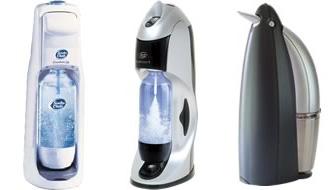
 Soda-Club makes three different soda makers: Fountain Jet, Edition 1, and Penguin. The Fountain Jet and Edition 1 uses 1 liter polycarbonate bottles and a large CO2 gas canister that can make 110 liters of carbonated water before it needs to be replaced. The Penguin model uses smaller 620 mL glass carafes and CO2 canisters that make 45 carafes (the Penguin looks cute and the carafes are really nice, but it costs about $250). Both the Fountain Jet and Edition 1 start at $80.
 The model that I tried out was the Edition 1. The basic kit comes with the soda maker (the big plastic contraption), a CO2 canister (Alco2Jet Carbonator), 2 carbonating bottles, and an assortment of soda mix samples.
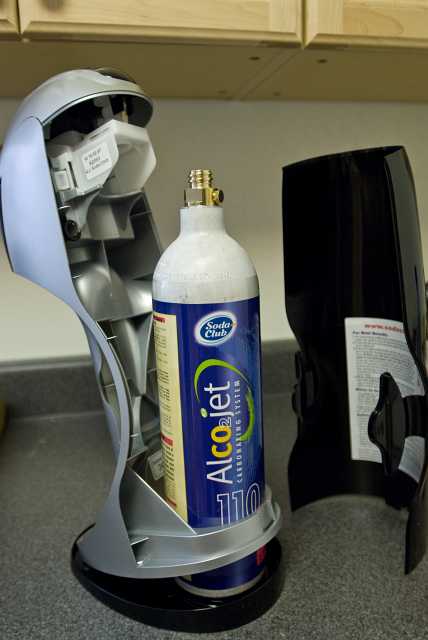 Putting together the soda maker was a breeze. The CO2 canister fits easily into the back of the soda maker. Just remove the back of the soda maker, tilt the front forward and place the canister into the base. The front of the maker then tilts back onto the canister.
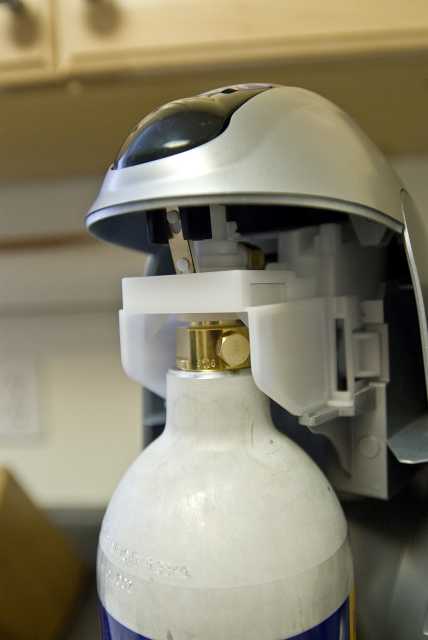 The canister then screws into the receptacle that lines up with the valve on top. The back panel then snaps in to cover the canister.
The 1 liter water bottles included in the kit should be pre-filled with drinking water and refrigerated before using the soda maker. (Cold water is able to hold more CO2 than warm water.)
 The next step is to attach the water bottle to the soda maker. This is facilitated by a lever that tilts the socket and nozzle so the bottle can be easily screwed in. (The tilt mechanism also makes it easy to remove the bottle after carbonation is complete.)
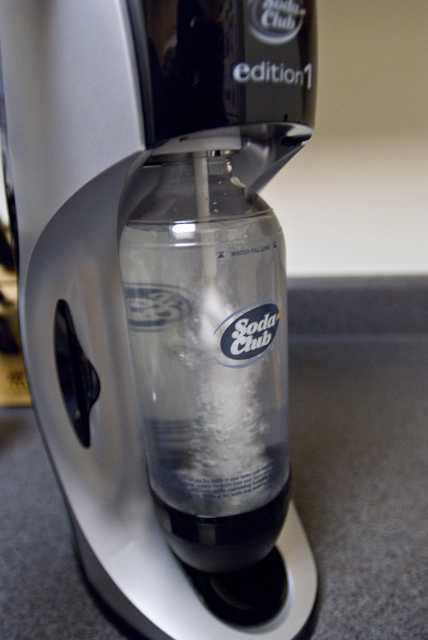 Pressing the large button on top of the maker causes the CO2 canister's valve to open and squirt the gas into the water. Short bursts are necessary so the water doesn't overflow out of the bottle. A few bursts are enough to cause a buzzing sound to come from the canister - a signal that the pressure is at the max. Soda-Club recommends about three buzzes, but I found that when mixing with juices or syrups, it helps to over carbonate a little, so I wait a minute and carbonate again.
Related Articles
Soda-Club instructs you to simply measure out the syrup in the cap and pour it into the bottle of carbonated water. (You don't want to add syrup to the water first or else you'll have an explosive mess on your hands when the CO2 is injected.) Rotate the bottle a couple times to mix, and viola! You have soda pop!
I didn't stop there - I proceeded to mix carbonated water with everything. Fruit juices were quite good, but I didn't want to dilute them too much so they came out a little less carbonated than I would have liked. Trader Joe's Strawberry Lemonade and carbonated water (half-half mix) was one of my favorite combinations. I also used a variety of Torani Italian Soda syrups (ranging from raspberry to praline) which worked wonderfully (as expected). Mixing carbonated water with milk was probably the only not-so-good idea.
In the end, since the device simply carbonates water, I realized that I could just buy carbonated water, but at $20 for a refill (they exchange canisters with you) that carbonates 110 liters of water, using the Soda Club is a lot cheaper than buying Crystal Geyser carbonated water at the grocery store (even at Trader Joe's who seems to have the low price at about $1 for a 1.25 L bottle).
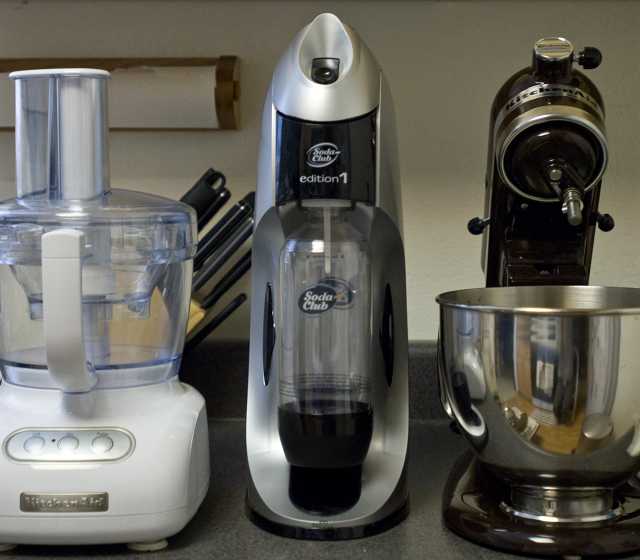 In case you're wondering, the soda maker isn't small - it's about the same size as other medium sized appliances (but a little slimmer than food processor or standing mixer) measuring in at 5.5-in. (14 cm) by 8.5-in. (21.6 cm) and 18.5-in. (47 cm) in height.
I find that I use my Soda-Club Edition 1 so often that I just keep it on my countertop. My other appliances have their own storage places, but the Soda club seems to have found a permanent home. If you like experimenting with beverages or just like to drink fizzy drinks, then I suggest you look into buying one for your home too.
Note: The Soda-Club product line is sold under different names in different countries. It's easiest just to go to Soda-Club's main website and select the country you're in to find out information on which models (and what their names are) are available in your location.
Related Articles

I am tired of paying $1.25 a liter so this is a great alternative.
Frank
This sounds like a great item, but I'm always wary of paying for something that I can DIY for a similar price & minimal effort.
Can you comment on how this system would compare with this DIY setup?
http://www.instructables.com/id/DIY-Soda-Water-%26-Home-Carbonation---Pays-For-Itsel/
Also, can you use any 1L bottles, or only those supplied by the manufacturer?
Thanks
Andrew
Nope, not much different at all. One nice thing is you can control the level of carbonation (lightly carbonated to "wow, I can't believe it's still bubbling like crazy!").
Well, it would carbonate it, but I'm not sure what happens when you inject carbon dioxide into a mixture of 40% alcohol and 60% water. You're not supposed to carbonate into anything but water becasue if the water contained large enough particles suspended in it (such as the soda mix syrup) then the bubbles don't dissolve into the water rapidly and instead latch onto the suspended particles causing the liquid to bubble over and spray out of the machine. A device like the one Andrew (ajanjigian) suggests might work better for that experiment.
http://www.instructables.com/id/DIY-Soda-Water-%26-Home-Carbonation---Pays-For-Itsel/
Also, can you use any 1L bottles, or only those supplied by the manufacturer?
The DIY setup you link to is quite interesting (as is the site <i>he</i> links to: http://www.truetex.com/carbonation.htm). Before I got a Soda-Club machine, I considered making my own but, oddly enough, what stopped me was wondering where to get my CO<sub>2</sub>. I could buy it from the local industrial suppliers in my area in 20 lb. quantities which would be extremely economical, but they were big and bulky, and I kept wondering if it would be "clean". I don't know anything about how they fill the tanks and what else they put in it that they don't tell you (or need to tell you since it's obviously not intended for consumption as a food). For all I know, industrial CO<sub>2</sub> contains other stuff that makes the flow through the valve more regular or something else that I'd be ingesting. Since I didn't have the time to research this further, and the Soda-Club was available (and wouldn't take up as much space as an awkward hose and valve combination) I went with that.
As to the bottles, yes, you have to use the manufacturer supplied bottles. They screw into the assembly to form a tight fit. When carbonated you can hear a slight hissing as pressure is slowly released, but the connection is tight enough that a decent amount of pressure is held in the bottle. The caps to the bottle are silicone lined to form an airtight seal. Even after a week, opening a half used bottle still releases that satisfying "Ssssst!"
I understand where you're going with this - I too prefer a non-proprietary system that is easy to maintain and works for almost forever, but I found to Soda-Club a decent alternative. (I have found that as I've become more and more busy - I've been prioritizing business, work, and fun differently than I would have in the past. Just a few years ago, I would have spent a Saturday and built myself a carbonation machine, but now, I'd rather research an article, work on the software backend, play board games with some friends I haven't seen because I've been working so much, and just finding time to sleep.)
I do make my own carbonated beverages. I realized that the equipment that I use to make beer is great for that purpose. I use stainless steel canisters that used to be used for soda before they switched to plastic bags of syrup. In beer land these are called Cornelius kegs. using those and a CO2 tank I am able to make 5 gallons at a time. Because there is no air inside the tank when it is pressurized the carbonated water lasts forever without spoiling.
I have seen portable contraptions for beer use that might work here as well such as using a "carbonator cap" for PET bottles with a "keg charger"
This arrangement would cost about $35 or so and would be much smaller. The drawback is the very small CO2 canister size.
thanks for the article
Adam
I agree with the whole "too busy to make one myself" thing - I don't even do my own oil changes any more, lol.
Did you do the math as well, and if so did it line up for you?
Would it be possible to heat the fruit juices slowly as to reduce them a bit and then add the water back with the carbonated water?
-OR-
What about the juices from concentrate? I don't know if making an entire pitcher at a time would be feasible or not, but you could probably play around with the non-frozen concentrates a bit and come out with a satisfactory result.
Just a thought
Chris
With the concentrated juice I would recommend using a more highly carbonated water because a considerable amount will be lost while stirring / shaking. However, I have found that using carbonated water + juice is a work around for not having a carbonator for your juice. Why not cut out he middle man and carbonate the juice directly?
A note on carbonation: Don't forget that the amount of CO2 you can disolve in a liquid varies with the temperature and that mechanical agitation (stirring, shaking, etc.) accelerates the co2 going into and coming out of solution depending on the partial pressure of co2 in the container vs. the liquid. Carbonation level is an equation dependent on the pressure of co2 and the temperature. I'm always impatient with my beer and force carbonate it in about 10 minutes by shaking 5 gallons of cold beer hooked up to a live, high pressure co2 line. When I'm done I really need some rest and a beer! ;-)
Also are the 3 models featured similar in price, I konw the penguiin is more because of it's design, but how about the other 2, would you find one superior for carbonation levels?
Thanks very much for your help.
The carbonating abilities of all three devices are the same. You can get more bubbles into the water by pressing the button a bit more - squirting in more carbon dioxide and then waiting about 20-30 seconds and doing it again. It uses more gas, but you get lots and lots of bubbles.
But - as a long time user I have to say that the plastic bottles get shabby and dont look nice after a while, also you can not put them into the dishwasher or use boiling water to clean them.
That´s why we bought the Penguin - the bottles are made of glass, look good on the table and are dishwashersafe.
Susanne
*They are selling a product -)
If you scroll down two or three articles, you'll see the one by me with a photo of my home carbonating system. In that photo, you'll also see my Soda Club. The advantages of building your own is significant, particularly if you drink a lot of bubbly watter.
Firstly, my system cost me only $75 bucks (vs the $100 bucks for the Soda Club) including the CO2 cannister, which I got on eBay. You'll want to buy the cheapest CO2 cannister that you can find, as when you get it reloaded, you'll be trading in yours for a filled one (so there's little point in buying a new one, only to lose it to someone else).
Secondly, the CO2 cannister in the Soda Club is a proprietary system that requires you to have them refill it. In addition to having intellectual problems with proprietary systems, the cost is quite high. By Soda Club's own admission, the cost of a liter of soda will range from between 0.23 - 0.27 cents (depending on the cost of the syrup that you buy). Mine, however costs less than 0.02 cents per liter (that's more than ten times cheaper for those of you bad in math).
In any event, I think any system beats buying liter after liter in the supermarket as the bottles themselves are bad for our environment, not to mention all the energy it takes to lug liter after liter from the supermarket to the car, to the house.
Misobrilliant
Thus far, I have made an average of 93 liters of carbonated water per carbonator – substantially fewer than the 110 liters that were advertised. If that trend continues for the remaining 2 carbonators my total number of liters for the 6 carbonators will be 558, and costs will be as follows.
149.99 - Edition 1 Starter Kit with 3 carbonators w/ license agreement.
74.97 – 2 carbonator refills and one spare w/ license agreement
14.99 – shipping fee for the refills.
55.80 – 558 liters of bottled water (our tap water tastes even worse when carbonated)
$295.75 – Total
$295.75 / 558 liters = $ .53 per liter
So far this is costing me a bit more than the $.50 per liter the generic seltzer water sells for locally at Hyper Mart.
It is understood that I now own the equipment, and will not need to pay an additional license fee for the use of the carbonators. Exchanging three carbonators at a time instead of two will result in lower shipping per carbonator. If the equipment continues to work indefinitely and the bottles do not wear out the future cost will become approximately $ .36 per liter provided by each additional carbonator.
Is it worth it?
The quality of carbonation with 3 buzzes is a bit less than desirable.
It is most convenient, and sure beats carrying all of those heavy bottles from Hyper Mart.
I never need to worry about running out.
Now that I have it, I will probably use the system as long as it continues working.
My usage: I mix it with fruit juice or a bit of whisky. Cranberry or orange juice is wonderful. Sparkling lemon (sweetened with Crème de Menthe) or limeade hits the spot on a hot summer day. My favorite: A tall glass of seltzer with about two fingers of tomato juice and a squirt of lemon.
Burp! :lol:
So they did the usual 3-5 buzzes and waited for a while did another buzz till it "burped" then went away for about ten minutes, I told him to take it outside to open it because I was worried about the mess it would make, but to my surprise there was no explosive result just a nice sparkling apple juice at less than 1/3 the cost of the local 500ML gourmet bottle! Trials were done with a chilled juice and also with berry and apple blends, next we will try grape, and suspect the result will be the same. Note that all these juices were clear, that is no pulp or sediment for the carbonate to cause possible explosive results, but we will try those as well in the future.
Email me at SodaClubRefill@yahoo.com for more details
POWPYP
Even their non-diet flavors contain Splenda which provides an odd flavor (when compared against pure sugar or high-fructose corn syrup). I recommend finding out where you can buy the syrup for the sodas that you like locally - there's some supplier providing the syrup to your fountain vendors. (The downside to this is that it's probably a really large bag of syrup that you'll have to buy.)
As other's mentioned, the $ savings aren't phenomenal, but the choice in how carbonated the water is, the savings for the environment and the savings for my bad back are all more than worth it for us.
Lemons
Sugar
Club soda
Black Salt (in India this is known as Nanak and it is a finely ground, greyish mauve color with a salty sulfur flavor). Black salt is easy to find in most Indian or South Asian grocery stores, but if it's not a *warm* shade of grey, it might not be good quality I have found.
You add fresh lemon juice to roughly equal parts sugar and allow it to dissolve the granules. Once the syrup is formed add club soda to taste and black salt to taste. Be careful when adding the black salt as it will create a lot of bubbles, so stir it in very slowly. Serve immediately with or without ice.
I find the key to this recipe is adding enough black salt and sugar in combination to balance the acid from the lemons.
The syrup created from the sugar and lemon juice by itself will keep for many days in the fridge (exactly how many (I'll leave to somebody else to say) and can be added to club soda with black salt in a pinch.
Then I saw the Fountain Jet version of the machine described here yesterday at Sams Club for $59.xx. I was totally surprised to see this, and of course bought one. It was cheaper than the Isi syphon bottle online.
I tried it today with Blackbox chardonnay It produced a nice dry "champagne". Hint: after carbonating in machine, wait until bubbles clear from wine, and foam on top subsides, and release pressure slowly to avoid mess. It may work better with dry than sweet wines - time to experiment!
(Important if you think avoiding BPA is a good thing)
Source: http://www.sodaclubusa.com/prodinfo.htm
When I sent an email stating that I felt I was mislead about the product, they immediately responded that they "did not like my tone" and I could "pursue whatever action I wanted" but they did not care.
WOW.
The product is great idea with lousy execution. I would stay clear. I am going to take advantage of their 100% 30-day satisfaction guarantee and send it all back.
The merchant agreed to issue a refund so that I would return the item, then, after I reported it had been mailed, sent an email saying that he now refuses to issue a refund based upon my negative (and truthful) review of my experience with his company. His exact words are:
"We will not be
refunding anything. Your attempts at badmouthing us serves as proof that you are an illiterate idiot who has buyer's remorse because you can't read a simple ad. You are an immature liar! Enjoy your valve!
Don't make the big mistake of continuing to libel us. It will be a costly
battle you cannot afford!
Punk!"
Yes, it seriously ended with Punk.
In spite of her unnecessary threats and toxic demands, we gave her the benefit of the doubt by offering her a refund. Instead of accepting this offer and writing the incident off as a simple consumer misunderstanding, she proceeded to libel our good name in this and many other forums for the sole malicious purpose of harming a good business. It is lamentable that Ms. Borrego's acts are one of the root causes for most consumer prices to skyrocket and make it impossible for small business people to conduct an honorable business.
Our satisfied customers on our website and user forum are indicative of the quality and care we take in producing a product.
It is unfortunate that Ms. Borrego's extortive techniques will only fail and serve no other purpose other than to illustrate her school age immaturity. Please stop by our website at sodaclubrefill.com and see for yourself that we have a great product that can save you alot of money on CO2 Refills.
Thank You Mr. Chu, I did not realize we were trying to meet YOUR standards of website quality. I suppose that in your world a website must meet certain "CHU" criteria for it to be considered "professional". Are your "professional" services available so we can meet your criteria? Or should we just assube that you had nothing nice to say and chose to say something instead?
Really, I would be interested in your definition of "professional" and how Ms. Borrego's vile attacks correlate with any justification for your comments and disclaimer. Incidentally, we have a disclaimer that clearly states our non affiliation with Soda-Club or SodaStream.
-blink-blink- Are we really doing this? Looking at your own site, do you feel like your website meets YOUR standards of quality? I don't mind that a lot of the web looks like it's slapped together. Not everyone can afford a graphic designer or has in-house talent that can put together a snazzy website. I'm pleased to find that you've attempted to fill your website with content (something sorely lacking in many websites - both "pretty/professional" and "sloppy/amateur"). However, I'm a little surprised that you don't know that your site looks like it was a bit thrown together. Not all websites need to look professional to me, but if a site (that is the sole form of representation for a business - since you don't provide phone ordering) looks amateur then that is a cause for comment.
I felt that Ms. Borrego's comment may be easily misconstrued to be referring to Soda-Club's service or website to the casual reader. So, I chose to clarify it. My comments on the appearance on the sodaclubrefill.com site are my own opinion and I don't see why it was inappropriate for me to state them. In no way did I support Ms. Borrego's complaints or arguments.
I suppose that in "Chu's World" a website put slapped together (as you put it) by disabled children selling pencils would be equally labled as unprofessional and merit the same crass assessment.
Sir, my opinion is that you are a very frustrated professional that has spent way too much time on the geekdom high-horse. Is there an axe you're grinding here or just feel the need to satisfy your ego by offering your jabs and criticism?
Our monetary resources are best spen on delivering a quality product FIRST. No amount of website candy can benefit a customer if the product is substandard. Frankly, customer's could care less about pretty sites, they want value for their hard earned Dollar. As a Californian, of all people YOU should be uniquely astute in that area.
Truly, we invite all constructive criticism. Yours is duly noted, at least the constructive parts which is still up for debate. As for the professionalism aspect, perhaps a better choice of words would have gone much further in making your points.
don't forget, all the search engines will be turning up your messages - you've done more damage to your own reputation than anyone else around here.
"Our monetary resources are best spen on delivering a quality product FIRST."
Yes, clearly you didn't bother to pay for a spell-checker either.
Either way, Michael made an off-hand comment that you foolishly decided to take issue with in a very public fashion. Now, per the prior commenter, your anger-laden posts are nicely indexed by Google and its peers for posterity.
The compelling reason for developing a nice looking website isn't solely to create "eye candy", it's so that you can establish trust and legitimacy in the eye of your audience (there are other reasons too, but I won't delve into them here). If I go to a site that is shabbily designed it might give me pause when I decide whether or not I want to transact with it. It doesn't take a Californian to recognize that.
Truly, we invite all constructive criticism. Yours is duly noted, at least the constructive parts which is still up for debate. As for the professionalism aspect, perhaps a better choice of words would have gone much further in making your points.
You clearly don't invite any constructive criticism, but it's fun watching you pay lip-service to it.
I suppose that in "Chu's World" a website put slapped together (as you put it) by disabled children selling pencils would be equally labled as unprofessional and merit the same crass assessment.
Sir, my opinion is that you are a very frustrated professional that has spent way too much time on the geekdom high-horse. Is there an axe you're grinding here or just feel the need to satisfy your ego by offering your jabs and criticism?
Our monetary resources are best spen on delivering a quality product FIRST. No amount of website candy can benefit a customer if the product is substandard. Frankly, customer's could care less about pretty sites, they want value for their hard earned Dollar. As a Californian, of all people YOU should be uniquely astute in that area.
Truly, we invite all constructive criticism. Yours is duly noted, at least the constructive parts which is still up for debate. As for the professionalism aspect, perhaps a better choice of words would have gone much further in making your points.
As an update, I ordered an adapter from sodaco2.com and for half the price sodaclubrefill.com tried to charge me, I was able to do exactly what I needed to do - adapt Soda Club bottles to be refilled at standard refilling stations.
I also looked into a home carbonation set-up and there are a number of very easy options out there for anyone who has not already invested in the Soda Stream set-up.
Where are these standard refilling stations? I don't know where I can go to refill CO2 tanks - that would be cool to know.
http://stores.kegconnection.com/Detail.bok?no=246
there is some very basically wrong with this story.
I serious doubt Sodastream has a private proprietary pick up and delivery service that covers all fifty states. they are using a commercial service, no?
no UPS, Fedex, or USPS delivery person is going to stand there and wait for your to package up and give them your empties.
Sodastream could provide "return" packaging and labeling in advance - did they offer that?
I rather suspect you need to contact somebody other than "customer non-service" with this issue.
http://stores.kegconnection.com/Detail.bok?no=246
Thank you Mr Chu for keeping this available as another interesting reference on the subject. :shock:
Also be aware that the cartridges and refills a.) are not always in stock at retail outlets listed on the SodaStream site b.) cost $24 per cartridge refill (as compared to $3 for a ’standard’ CO2 cartridge) c.) the size of the cartridge when available at a retail store “may not” match yours
The customer service on getting exchange CO2 cartridges is *horrible* - every order that I have placed has had some problem. Beware especially if you live in an area where they use an independent courier, rather than UPS. (seriously… call them up and check before ordering) In this case, they don’t send shipping confirmations or tracking by e-mail, and several times I have waited for bottles only to find that they have not yet shipped (in one case, for weeks).
I had value engineering in mind during the conception and design of my carbonation system.
I just recieved my soda maker (purchased from http://makeyoursoda.com as they offer a discount coupon of $10)
it is a marvelous machine- we are so happy with it
On a different note, I ordered a paint-ball adapter from Sodaco2.com several months ago. Up to this point, I still haven't been able to get it to work. Sodaco2.com is extreme slow to respond but when they respond, they try to take care of the problem. They even offered to make a modification to the valve on my carbonator to insure that the adapter will work. However, the only paintball place in my area can't seem to get it done. Has anyone else used the paintball adapter from Sodaco2.com and can give me advice on how to get it to work?
Everyone else seems to want to just jump in and state how they won't do business with them and how unprofessional they are. Americans have developed such an insatiable need to destroy each other in recent years. Jumping in and dropping f-bombs and name calling is only the begining.
What is interesting is that not unlike the street corner, all of the opinions here (except lucrece's which may or may not be the complete story) are based on some interpretation of allegations made only by an on-screen name and avatar. Everyone else is just repeating hearsay.
Folks, the internet is a very informative and public place, it also provides some degree of anonymity. I suspect that in the real three dimensional world, none of you know anything first hand about the website/business in question, or the owner(s), or any facts associated with them. I would also venture to say that in the real 3D world, none of you would out of courtesy or humanity, dare say these things for fear of being wrong or hurting an innocent person or business.
Search your souls for one brief instance and analyze these writings. Isn't it really that the safety of anonymity has encouraged the nay sayers to write their hateful comments? What happened to civility? Benefit of the doubt? How about just simple silence if you have nothing factual or constructive to add?
I don't know if this lucrece individual is telling the truth, do you? Have any of you been in business? I have, and I can tell you that I have bitten several inches off my tongue when dealing with customers that just cannot be satisfied. I work as a store manager for a major nationwide retailer.
Believe me when I tell you there are thousands of horror stories and things some customers pull on us every day. Some cannot be satisfied at any cost, some will defraud you, lie, and cheat you out of any profits. Some I would rather never enter our store because I know they will cost us money.
Guess what, in the end, it is all of us that pay.
All I am saying is that civility and decorum are at a great risk of being lost in this cyberspace medium unless we start being more human to each other. Hearsay should not be the guiding word.
My two cents. Flame me if you must, it only serves to prove my points.
On a different note, I ordered a paint-ball adapter from Sodaco2.com several months ago. Up to this point, I still haven't been able to get it to work. Sodaco2.com is extreme slow to respond but when they respond, they try to take care of the problem. They even offered to make a modification to the valve on my carbonator to insure that the adapter will work. However, the only paintball place in my area can't seem to get it done. Has anyone else used the paintball adapter from Sodaco2.com and can give me advice on how to get it to work?
Sounds like your review and comments should be about your actual experience with the sodaco2 people and not the other company. Again, here's an example of hearsay being proliferated without any facts. Have the sodaclub refill people sold you anything? Did they hurt you in any way? My ten bucks in my wallet say that if the only way you could say those negative things were face to face, in person, that you would not do so out of courtesy and manners.
From the response to the previous commenter, we can only assume that Anonymous is someone from SodaClubRefill.com again. The comments that Guest X wrote were not directed at any product sold by SodaClubRefill.com or direct experience with the company - both of which are very important aspects of business. What he was commenting on is a different aspect of doing business in the modern world - the good will of a brand and company as perceived by the general public. Given the readily accessible nature of reviews and comments on the web, Guest X points out that SodaClubRefill.com has chosen to retaliate, condescend, and/or attack their detractors instead of attempting to rectify, explain, or diffuse concerns over the conduct of the company (in the case of the first person who purchased goods) or the perceived professionalism (in the case of my comments on their website and Guest X's comments concerning SodaClubRefill's responses and name calling). Guest X's comments are valid even though he has not had direct experience with SodaClubRefill.com since how a company is seen to treat their previous customers is very important to new customers or those considering the use of a company's services.
From the response to the previous commenter, we can only assume that Anonymous is someone from SodaClubRefill.com again. The comments that Guest X wrote were not directed at any product sold by SodaClubRefill.com or direct experience with the company - both of which are very important aspects of business. What he was commenting on is a different aspect of doing business in the modern world - the good will of a brand and company as perceived by the general public. Given the readily accessible nature of reviews and comments on the web, Guest X points out that SodaClubRefill.com has chosen to retaliate, condescend, and/or attack their detractors instead of attempting to rectify, explain, or diffuse concerns over the conduct of the company (in the case of the first person who purchased goods) or the perceived professionalism (in the case of my comments on their website and Guest X's comments concerning SodaClubRefill's responses and name calling). Guest X's comments are valid even though he has not had direct experience with SodaClubRefill.com since how a company is seen to treat their previous customers is very important to new customers or those considering the use of a company's services.
Sorry to burst your bubble but I do not have any affiliation with that firm. Your assumption is wrong, condescending, presumptive, and downright insulting. Not unlike Guest X, you have assumed and christened as valid the hearsay comments of an obviously disgruntled customer that may or may not be either telling the truth or the complete story. Just as Guest X put his/her stamp of guilty by stating that said company had indeed treated the alleged customer badly, you sir are participating in the deception and promotion of the hearsay.
I have read your posts regarding this matter and can only arrive at one conclusion. That being, you are either a disgruntled customer yourself or you have a particular grudge or grievance with that company. The latter being a clue to any and all readers of your blogs and forums that you are not unbiased but rather a hate mongerer that seeks to destroy or humiliate others with your minuscule soap box.
As the prior posting stated, humanity is severely lacking. Civility is out the window. My wish is that some day, people as yourself who proliferate unsubstantiated commentary as fact, have to face either the gavel of a judge in a tort lawsuit, or the fist of a wronged human being.
Needless to say, the lack accountability granted by these blogs and forums only serve to protect the spineless and socially inept few that abuse the medium.
I challenge you to hold yourself to a higher standard and denounce non factual reviews, postings, or baseless demeaning commentary. That is not what this medium was intended to do.
Then again, asking the above is probably too much to ask because it detracts from the real objective here, write, harass, destroy, flame, and grin.
keep the flames coming!
Michael, further analysis of your response is revealing many flaws in your attempts at being the unbiased individual you seem to portray. While this is your sandbox, and we are your guests, you still need to adhere to some semblance of decorum and objectivity if we are to take you seriously.
While your defense of Guest X is understandable, given your bias in favor of negative reviews on sodaclubrefill dot com, you readily admit that no real experience has ever occurred with said firm. Further review of your personal blog reveals the following comment you wrote on June 15th 2008, and I quote: "People I talk to seem confused about his stance on taxes, how his plan for health care differs from Clinton’s plan, and seem to believe he wants to pull all the troops out of Iraq on Day One. Unfortunately, people believe what they want to believe and don’t bother investigating for themselves." The latter being a comment regarding presidential elections.
I would urge you to heed your own comments by embracing the part of "Investigating for themselves" and not just believing what you want to believe.
Further research reveals your own comments in this Forum, under the Reviews area where you commented about this website. In that area you stated, and I quote: "I do not "pull punches" - if I like a product, I say so. If I dislike it, I will make note of that as well. Often it is simply not worth my time to write a negative or middle-of-the-road review because I prefer to provide my readership with information that guides them to make correct purchases for themselves. For simplicity's sake, readers should assume that everything I review has been provided to me to test free of charge unless I say otherwise... I'm always up for reexamining my practices."
Again, you should heed your own comments, reexamine your practices. Have you reviewed the company's products? Do you have firsthand knowledge of the facts? Have the users posting the allegations done so in a fair and fully disclosed fashion?
While I realize there is a thin line that separates freedom of speech and outright slander / libel. Those as yourself who portray themselves as reviewers or consumer advocates should consider the information sources and how far that thin line is being crossed. No disclaimer in your policy section can serve as a shield from liability for content you post on a for profit site as yours. Especially if said content is found to be malicious, unfounded or outright false. Not to mention the fact that it cheapens the perception of professionalism you espouse to the public. Your CFE Inc. corporate immunity stops when you as an individual participate in said conduct, voluntarily, and with impunity.
It is probably fair to say that you do not enjoy the same protections granted under freedom of the press to news agencies and the like. While I do not advocate litigation as a means to resolve problems, sometimes it is necessary as a means to set precedent and prevent future injustice. I don't think you'll be sued over your comments, but a good question to ask yourself is "could I sustain or survive one?".
Lastly, this is really more about what is right versus what is tasty gossip. You appear to be an educated well rounded individual. If that is truly who you are, and not just another geek in the basement, then you should consider "reexamining" your approach to negative commentary based on hearsay. To continue doing so only violates your very own code of conduct.
I find it highly incredible that you, Guest X, can post with such certainty that the original thread poster (lucrece) was factual in his/her account of dealings with the company. Is it possible that you are also lucrece? You appear to be so certain as to the allegations that it makes me wonder. If not, then I do apologize for the assumption.
How do you know that the company or a representative of the company posted said statements or participated in name calling? Everyone here has the privilege of anonymity, are you sure?
Your comments are not amusing, especially if one considers the possibility that they may be either incorrect or just outright false, no one really knows except the company and the original poster. All you have done is proliferate hearsay as being fact.
The only fact you seem to inject here is only an opinion that their website looked "cheap". The latter being a very subjective judgment since websites are a product of creativity and art blended with useful information. You also state that you did not make a purchase due to the "cheap" look, yet no mention as to the technical merits or drawbacks of their product(s). I do find humorous as well as contradictory is your following comment:
Looks to me like you were taken on a ride greatly due to your own self imposed ignorance and arrogance. Having the benefit of my wife's profession as a Real Estate Trial Lawyer, I enlisted the help of one of her colleagues, a case researcher. I asked him to find out what he could about sodaco2 dot com and any public information on them or the owners. Here's what he just emailed me:
SodaCo2.com is owned by a Mr. Gair Lowery of San Antonio Texas. The business is operated out of his apartment [edited by moderator to remove personal address]
Mr. Lowery has several Public Filings of Judgments, Liens, and Law Suits as well as a Felony Criminal Drug Convictions in 2002, in San Antonio Texas. Research also indicates many complaints on eBay as well as PayPal for fraudulent business practices and non delivery of goods. His eBay seller name is sodaclubrefill (no "s" at the end, that is sodaclubrefill dot com's user name on eBay). It appears by the membership date that sodaco2 stole the name and idea from sodaclubrefill dot com. It is also fair to note that sodaclubrefill has a 90% reliability rating according to eBay due to negative feedback for deception and non delivery of goods. In contrast, sodaclubrefills has a 100% reliability and satisfaction rating.
Sounds like you've been had! It also sounds like you don't really research who you deal with but are more than willing to jump blindly on a bashing bandwagon..
Being curious, I visited the sodaco2 website and found it to be very uninformative on their products and their use as well as lacking in features desired by people interested in soda machine co2 alternatives. In contrast, the sodaclubrefill dot com website was overwhelmingly filled with just about everything there was to know about the subject matter, including detailed pricing, options, faq's and user support forum.
The above could possibly explain Guest X's poor "factual" experience with sodaco2 dot com as opposed to his inexperience and lack of factual knowledge with the sodaclubrefill dot com firm.
Guest X, your commentary is blatantly flawed and biased. Unless of course you are really lucrece in disguise and are here only for the purpose of stacking the deck. Again, if I am mistaken, I apologize for the misreading.
Since you have allegedly never made contact with the people at sodaclubrefill dot com, you may want to consider re visiting their so called "cheap" website and see if they will render any assistance with your dilemma and non functioning product. I know that when people walk into my store with questions, even if they are competitor related like Target or CostCo, I still help them with the hope of someday winning their business. Do you have the spine to do that or are you content with just bashing them with hearsay? Unless of course you are lucrece, which I again apologize if I am mistaken. ;)
Hmmm... Is it safe to assume that Guest X is really "lucrece" in disguise?
Isn't there any backbone any more? Is this medium so conveniently anonymous that people can throw stones at each other and then duck behind an avatar? I know that my posts are also perceived as equally anonymous, but I have yet to bash anyone or fail to provide factual accounts of my findings.
Michael, I now realize what has driven your offensive posture towads my comments and in favor of those bashing the people at sodaclubrefill dot com, your driving force is MONEY! Pure and simple, they are advertisers here! Heck, they probably even sent you the machine you evaluated back on page 1 of this thread! You have been unmasked my friend! That actually adds contempt and questions of character in my humble opinion.
Your little soapbox here is just a revenue stream with modifiable ethics that will result in free merchandise and a stroke to your evidently immense ego and self assessment. I'm no psychology major but a quick glance at your postings in the blogs and forums you control offers a very clear picture of a narcissistic self absorbed individual. Then again, most engineers I know suffer from the same God complex.
It's all clear to me now. This is probably my last post since people with God complexes usually fix things with a delete key or other means of distorting the facts.
Flame on!
that's because you have not posted any facts.
if you're a "Guest, with the facts." what are the facts you are "with" and where did they come from?
>>they probably even sent you the machine you evaluated back on page 1 of this thread!
demonstrated fact of total ignorance in how product reviews work.
>>Pure and simple, they are advertisers here!
actual fact: show me the ad
>>Then again, most engineers I know suffer from the same God complex.
methinks you've got yourself severely confused - it appears to be you who insists you are omnipotent - but it still leaves the fact that you have not posted any "facts" - just rants, raves and baseless accusations.
little response other than your own - that's because the people who hang around here actually operate within the bounds of logic.
>>since people with God complexes usually fix things with a delete key
do take notice, none of your posts - with all kinds of outrageous claims of "fact" - have been deleted, edited or modified.
that's a fact - now explain your rant.
Suffice it to say that I have posted only the facts, the research and verification is left up to those who are interested or are genuinely unbiased. Dilbert is obviously not in that category.
I am very well aware of the review process as posted by the illustrious Mr. Chu. As for ads from Soda-Club or Sodastream, open your eyes and you will see them in the footers and headers of this site along with ads from hundreds of others who contribute to Mr. Chu's income. Not unlike the people at JD Power and Associates, Mr. Chu reviews according to his revenue stream and quashes dissenting views with crass remarks and proliferation of hearsay. As long as the revenue stream is protected, who cares about the truth. Right?
Flame on Dilbert! This is like watching a train wreck of sugar overdosed geeks.
Are you capable of reading anything other than C++ code? Read the postings and you will be enlightened. Of yourse, that is assuming there's objectivity on your behalf.
Moi? Omnipotent? Are you suffering from the disorder also known as Penis Envy? All I have done is point out the obvious. Your little elite bashers have been called out on the carpet and you don't like it. Baseless accusations? That's the basis of this entire thread, accusations by either a real or fictional customer of a business, further promoted by the sycophants of Mr. Chu and his advertisers. As for bounds of logic, sir, I know Mr. Spock... you sir are NO Mr. Spock. Read your own drivel ato yourself in front of a mirror and see if it is logical.
>>do take notice, none of your posts - with all kinds of outrageous claims of "fact" - have been deleted, edited or modified. that's a fact - now explain your rant.
Re read the thread Mr. Dilbert, it may serve to educate you.
so perhaps we can get back to the facts?
repeat:
if you're a "Guest, with the facts." what are the facts you are "with" and where did they come from?
if you are not sodaclubrefill.com or lucrece, then by your own definitions you have no factual information relating to that situation.
you do need to look at the name calling, insults and obnoxious behavior you've demonstrated on this Forum.
you are blatantly engaging in the precisely the anonymous cowardly circular insulting rhetoric of what you purport to be so dysfunctional in this country.
so perhaps we can get back to the facts?
repeat:
if you're a "Guest, with the facts." what are the facts you are "with" and where did they come from?
if you are not sodaclubrefill.com or lucrece, then by your own definitions you have no factual information relating to that situation.
you do need to look at the name calling, insults and obnoxious behavior you've demonstrated on this Forum.
you are blatantly engaging in the precisely the anonymous cowardly circular insulting rhetoric of what you purport to be so dysfunctional in this country.
Oh Dilbert... stop that, I can't laugh any harder! The facts I have posted are in the form of observations of the basher's agendas.
- You asked about the facts relating to ads being in this forum and I showed you where they are, ALL OVER THIS FORUM. Put your glasses back on!
- You asked about the facts relating to my other posts, and I already stated their source as being PUBLIC RECORDS RESEARCHED BY A LAW FIRM. I only posted that as a rebuttal to Guest X's suspiciously awkward praise of the sodaco2 firm. Guest X, bashes one company, praises sodaco2, gets screwed by sodaco2, then asks for help. Where's your critique on this one? Cat got your tongue?
Beyond that, all my statements have been about the lack of facts and/or substance to the accusations flying to and from Chu, Guest X, and lucrece, the last two being suspiciously one in the same.
What do you need, an information enema? Want someone to read the posts to you s l o w l y? All you appear to be doing is parsing every letter in every sentence so it suits your purpose and then use it as a distraction to redirect the debate. Gibbs does that quite well for Obama at the White House. Are you Chu's version of Gibbs the Spin Meister?
So let's summarize, if I am not lucrece or sodaclubrefill, according to you I don't have the facts? Yes, that is correct, that is what I have already stated ad nauseum! NONE OF YOU have those relevant facts either, including Chu, Guest X, and YOU. The ONLY facts presented here so far are that this forum is laughable and should not be taken seriously as an unbiased source of information. Anyone can jump in here and anonymously write whatever they want about anyone, and do so anonymously or under the monikers of lucrece, Guest X, sodaclubrefill, Dilbert, etc, and do so without the need for accountability. Mr. Chu, the Gatekeeper, can play favorites at will, as long as his revenue stream from advertisers like Google, Illy, GM, and SodaClub keeps flowing.
It's probably safe to say that in the real world, when faced with the possibility of real consequences for your actions, moderation and civility would prevail. No one likes to get their teeth knocked down their throat when they insult another person face to face, especially when malice is the only motivator. In this medium, you enjoy the safety an DSL connection can bring (some of the time).
Flame on Dilbert! You never disappoint! Since this is Chu's Cooking Forum, you should try some recipes for Fricassee of Crow.
>>The facts I have posted are in the form of observations of the basher's agendas.
there but one single sodaclubrefill.com 'basher' - if you choose to call lucrece that
you are the one bashing sodaco2 - and everyone else who has defended lucrece's right to voice their experience or opinion.
no one else has 'bashed' sodaclubrefill.com - they merely observed theywould not care to do business with an individual exhibiting the posted behavior.
it is you who has bashed Michael Chu with your completely unfounded assumptions of fact as to how this web site operates. you do not have that information - so you choose to bash others for exactly what you have done / are doing.
"Civility is out the window."
you are doing a very good job at proving that.
"Needless to say, the lack accountability granted by these blogs and forums only serve to protect the spineless and socially inept few that abuse the medium. "
note: Mr. Chu is not anonymous, nor am I, but you are.
"Is this medium so conveniently anonymous that people can throw stones at each other and then duck behind an avatar?"
note: exactly what you have done / are doing.
"This is like watching a train wreck of sugar overdosed geeks"
note: oh, definitely a train wreck - my opinion is you are driving your own wrecked train
"Are you suffering from the disorder also known as Penis Envy?"
"Read your own drivel ato (sic) yourself in front of a mirror and see if it is logical."
note: now, what was that about civility?
"Guest X, bashes one company, praises sodaco2, gets screwed by sodaco2, then asks for help. Where's your critique on this one? Cat got your tongue? "
note: nope. I guess that's why you choose to "expose" sodaco2 past. smells like competitor bashing to me.
"What do you need, an information enema? Want someone to read the posts to you s l o w l y?"
note: yes, I need you to slowly explain how you have any facts to dispute anyone's opinion about what happened between sodaclubrefill.com and lucrece.
you now say you have no facts regarding what happened between sodaclubrefill.com and lucrece.
I submit you also have no facts about this web site.
I submit you also have no facts or knowledge about how web site advertising works.
so what we're left with is:
(1) one person posted their first person experience, which was not good, with an online company.
(2) the other party to that dispute chose to respond in a very unprofessional manner - see the multiple comments, my opinion is not singular on that topic.
(3) being entirely fact driven yourself, you insist that item (1) should be disallowed as their is no proof that the item (1) poster ever had business dealings with the item (2) poster and furthermore there is not proof that the item (2) poster is actually the 'other party' to the dispute.
(4) note that you have not objected to item (2) postings - frankly, considering the respect and civility you have displayed in this thread, I'm not surprised.
(5) note that 'other party' - despite the public opportunity to pour oil on the water, be civil and resolve the issue(s), choose another approach.
(6) a subsequent poster expressed their reluctance to deal with the item (2) poster
(7) being entirely fact driven yourself, you insist that the item (6) poster should be disallowed because they have no experience with the item (2) poster. Apparently you have never asked someone for a recommendation?
you claim to have no interest in any of this. your stated motive is simply to insist that civility should rule. you have failed your own motive with the continued insults and innuendo.
in the end analysis, according to your own windmill tilting, no one should be permitted to express their experiences on-line, as there is no proof they actually had an experience.
quite frankly, it is entirely possible that you are Guest X, posting here to simply to generate a discussion where you, representing sodaclubrefill.com, could generate an opportunity to bash your competition with their past history.
your adamant flaming and insulting of essentially everyone in the Forum and in the thread certainly does not support the theory that you are an un-involved individual.
“this forum is laughable and should not be taken seriously”
Your posts firmly establish which party is laughable.
You're not anonymous? Why don't you post your email address, home phone, cell phone, real name, and address here? Oh, I know why... your slow but not stupid. You'd rather flame and hide. The latter being what everyone does here, myself included to the extent that I have voiced my opinion as a non registered guest. Registering here would by hypocritical considering how I feel about the lack of objectivity and bias in this forum.
Personally, I stay anonymous for fear of having to put a 50 cal in a an obsessed stalker's forehead. So, in the spirit of avoiding breaking the law, I just blend into this cesspool you people call a discussion forum.
No one here is my competitor, I have no horse in this race other than being fed up with hit and run artists like lucrece, guest x, Chu, and you. I'm not in business, financially do not need one, nor do I care to be in one. Especially if it means dealing with vile peopl, yourself included. Surely you as well as everyone is entitled to an opinion, that's what makes this country great.
So Dilbert, please press on with that code you're working on for your employer. Pay your taxes on time and keep the flames rolling. I just love it when you rant! How do I know you're a geek? Only a geek watches out for missed keystrokes or minor typos. It's part of their anal retentive DNA which also accounts for their crass behavior and separation anxieties.
Is Chu paying you a commission on a per word basis or is this just a freebie hatchet job? Ah, don't bother responding, I recognize lackeys when I see their rants, your opinions while being disturbing, do amuse me and has provided hours of laughter for my wife and colleagues. I know that it is a lot of fun because everyone at her law office has tuned in to observe your neck swelling and fist pounding responses. BTW, so far the applause is deafening, everyone is thoroughly enjoying your performance. You should consider America's Got Talent.
Oops... I changed my mind, please respond! I want to hear the sound of your suspenders popping as you crack open another vial of angina medication. I know this is getting to you. You are so predictable!
XXXXOOOOO
I don't eat Twinkies. in fact very few sugar treats.
>>You're not anonymous?
no, I am not. I am a registered user with my email, identity, etc., on file to the administration of this site. I am in fact accountable for my posts. you, remaining anonymous, remain unaccountable.
I'm not flaming - that's your warped interpretation of a civil response.
I'm not hiding - I will refute your logic until they pry the keyboard out of my cold dead fingers.
>>fed up with hit and run artists like lucrece, guest x, Chu, and you.
Guest X related no bad experiences with your sodaclubrefill.com association.
nor did Michael Chu,
nor did I.
your imagination runneth over.
>>Surely you as well as everyone is entitled to an opinion, that's what makes this country great.
so everyone except lucrece and Guest X is entitled to an opinion?
what's so special about them?
have you examined your own logic?
>> everyone at her law office has tuned in to observe your neck swelling and fist pounding responses.
(a) I don't for a nanosecond believe any of that. I suspect "they" - if in fact "they" even exist - are professionals and have better things to do that follow your rantings and ravings.
and
(b) "neck swelling and fist pounding" - it is you who are tossing out all the insults and innuendo - and neck swelling your importance as a "Guest with the facts" - which turns out by your own admission - you are a "Guest with no facts"
I'm just calmly and unemotionally refuting your BS.
>> I want to hear the sound of your suspenders popping as you crack open another vial of angina medication. I know this is getting to you. You are so predictable!
I don't wear suspenders, I don't have a heart condition. that is fact - an obvious point you've overlooked in your assumptions and innuendo.
I'm so glad you're amused - you'd better get used to me because I've been doing online sysop'ing / moderating and dealing with shills, trolls and spammers like you since the mid-1980's. I will follow and continue to calmly and politely refute your nonsense & BS for a very, very long time.
oh, I would like to add, my online identify is Dilbert of Dillbert - essentially everywhere - just so you don't confuse me with somebody else - because I will definitely jump in the face of your BS anywhere on the web.
I have the personal ethic to stand up to my opinions and identity - a quality sorely lacking in your case.
You must love me a lot since you've offered to "follow me around". Where can I mail you a picture of me so you can recognize me as you follow? Really Dilbert as in "Dillbert", how's that C++ code coming? Employer happy or is the project late due to having to focus on me?
Since you're such an eminence on the web, how did you manage to swallow this entire thread, hook, line, sinker, and pole? You are more fun than a Sea World roller coaster.
Let's play a game. We keep typing back and forth, I keep pointing out your penis envy; abandonment issues; sugar highs; pharmaceutical intake; swollen neck; etc. and you can respond by calling me a troll; shill; coward; and whatever else your room temperature IQ can muster. Then, you can examine my messages for typos and publicly note them as your most intelligent feat for the day. Forget the content, in Dilbert's world the content is unimportant.
I look forward to this exchange as I type away, only interrupted by the occasional need to check on my day trading account. No big deal, I'll even dedicate a task window and name it Dilbert. Maybe even attach an avatar to it so it reminds me of the less evolved.
Heck, even my grand daughter is enjoying this. She watches the feed on the big screen in the living room. You're going viral dude! It's now a toss-up between her watching you or Sponge Bob. I keep telling her that Sponge Bob is smarter and funnier but she still wants Uncle Dilbert.
xxxxxxxxxxOOOOOOOOOOOOOOxxxxxxxxxxxxx
can't beat that. I've matured and given up comic books. But indeed I did enjoy them in my pre-teens.
>>You must love me a lot since you've offered to "follow me around".
not even close. if our paths cross, you'll know about it - because I'll still be Dillbert.
>>Since you're such an eminence on the web
you're the one insisting I put on my glasses - so exactly where did you come up with that?
>>Forget the content
amen.
there is no content - rants, raves, insults, allegations, innuendo - yes.
content - no.
thought – no.
>>so it reminds me of the less evolved
Ah, infinitely civil, indeed.
>>Heck, even my grand daughter is enjoying this.
Poor kid. we have two girls and one boy, as one parent to another, please convey my condolences to her mother.
Are you on your third or fourth Twinkie tonight? They must be affecting your creativity sweetie, just quoting one-liners won't cut it. Then again, the omnipotent moderator sysop wizard of C++ code should know that. You ust be an impostor! I've paid good money for this entertainment, the least you can do is live up to our agreement, I type, you correct spelling errors, screw the content. OK Dilly?
Do you beat your wife? If you do, then I really pity her now, you must really be in a lunatic rage over being late on that C++ project due to dealing with me.
Let's pause this for a couple of hours shall we? I need to go watch the master spinmeister, Obama, your idol!
No insults Dilly, just pointing out the blatantly obvious. You're just a Chu lackey and public suck-up. You have no backbone; you suffer from typical geek abandonment issues; and you've spent too much time in the basement.
Try getting out some time. Socialize in person as opposed to hiding behind your comfy keyboard. I know you probably spend a lot of time cranking out code for your employer, but eventually you'll be free from those shackles if you invest wisely. Another benefit of socializing in public is that you will develop more useful skills other than pinting out tyypos (here's some for you), or fighting battles for Chu as his paid minion.
Not unlike you, Obama did not disappoint me last night. He stuck to his guns and recycled the same diarrhea of the mouth as you have. Py no attention to the facts, drink the kool-aid and all will be better. One big difference though, at least Obama has enough money that he does not need to tpe at his keyboard all day to earn a paycheck. He also does not feel the need to be a suck-up in order to be loved. While his policies are wrong for our country, he at least has my respect for having a spine.
So Dilly, go back to that keyboard and show us what you've got. Rip out some more good one-liners. Maybe Chu will get fed up and delete this entire irrelevant thread and let us have our own side show. Besides, he's probably getting concerned that this is not relevant to Tempering Chocolate and may not be in tune with his revenue stream.
Flame on little buddy! I just can't wait til you start attacking my mommy. You're so predictable!
xxxxxxxxxxooooooooooooooooxxxxxxxxxxxxx
no insults? really? interesting observation.
>>You have no backbone
sez' he who cowardly hides behind anonymous postings.
>>fighting battles for Chu as his paid minion.
fact : I'm not paid for any of this here, nor anything else anywhere else on any web.
>>Maybe Chu will get fed up and delete this entire irrelevant thread
I doubt it.
Having said that, I would invite anyone to try out a Fizz Giz (just google "fizzgiz") and take a look at a very inexpensive & effective home carbonation system. You can use it to carbonate anything in a common soda bottle and the COMPLETE system is under $30 at many places. CO2 cartridges it uses are sold everywhere & have been for 60+years. Nothing proprietary need be bought for use with it. That probably addresses most of the complaints I read in here.
The aussie is right. Make yourself an ice cold soda & chill.
Don't hold your breath. That jerk took me for over $130 and never received the product, then had to file a complaint with paypal and had to wait 3 weeks to get my money refunded. Sodaco2.com is a scam. Supposedly the guy builds his stuff in his apartment in san antonio texas.
I went to sodaclubrefill.com and got their fillstationpro-II and it works flawlessly. Although I had to buy the replacement carbonator valve due to the anti refill mechanism in the factory ones, my refills now cost alot less. Here in Canada CO2 from sodastream is almost non existant due to post regulations. Regardless of what you do, get your money back, sodaco2 is a scam and you'll never see a delivery.
I was just generally searching for reviews on either company when I read this and thought it interesting. It really speaks to what can said in an anonymous setting and how much we can really believe on what we read online is true or not.
Anyway, decided to go with a bar gun soda system and to build a ice block cooler out of a min fridge. Though its odd that I cannot see any plans for something like that.
This company have some service issues.
1. I ordered a pro fill unit via Paypal and due to software timeout, it defaulted to my old address. I did not catch that until I reviewed the Paypal shipment data.
I immediately sent a change of address query to the sodaco2 email with the order number, my phone, and email.
(The web site says: If you have any questions, comments, or concerns, please email our 24 hours a day, 7 days a week support. Responses are usually given within 6-12 hours. )
Well, no replies or phone calls for 2 weeks, then I got a shipment confirmation from UPS going to my old address.
I called one of my friends to intercept and hold the package for me.
2. Once I travelled a few months back to the old address and get the unit... Looked just like what they showed on the web. A whole bunch of O-rings that do not fit any where that I can tell.
The unit does not screw flush by hand as shown in their video, leaks like a sieve if tightened by hand.
Put some electrical tape and using a mini pipewrench , it can now screw down far enough to stop the leak.
(Backing it out shows the lower threads on their pro fill unit rubbed off all the anodized materials as well as some metal. So much for CNC machining)
3. Does not defeat the anti-fill feature. Have to crack the valve just a small portion or you can hear the anti-fill valve slamming shut. Furthermore, the main fill ball valve started to leak on the stem.
So much for the video demo/instruction to fill. Does not match any thing that I experienced with this product.
Full refund in 7 days? Sure if it ships out 14 days later.
Fast response? None or never.
Work as promised? Nope
They were very careful about hiding ALL traces that can lead back to the state/city origin of the company. That would have helped decide from the BBB list. Guess that should have been a big RED flag.
Oh well, buyers beware.
:(